

Choosing a CRO agency for ecommerce in Australia means finding a team that lifts your conversion rate through structured testing and UX fixes, with the specific goal of getting more revenue out of the traffic you already pay for, not more traffic. Australian stores have a smaller addressable audience than US or UK brands, so every visitor costs more to acquire and wastes more when the checkout leaks. That changes who you should hire and how you should judge them.
- Match the agency to your traffic volume: sub-10,000 monthly sessions can't support a full CRO testing program.
- Full-service agencies like Ecom Republic tie CRO to creative and paid media, which matters more once you're spending on ads.
- Freelancers and CRO-only shops work for single-page fixes but stall once you need testing to scale with ad spend.
- Afterpay, Zip and GST-inclusive pricing at checkout are Australia-specific friction points most overseas case studies ignore.
- How to choose a CRO agency for ecommerce Australia comes down to traffic volume, budget and whether CRO sits next to paid media or apart from it.
Why CRO matters more for Australian ecommerce brands
Australia's population is a fraction of the US market, which means Meta and Google auctions here get thin fast once you're in a competitive category. CPMs climb, your cost per acquisition follows, and the only lever left that doesn't cost more money is getting a higher percentage of existing visitors to check out. That's the entire case for CRO.
Ecom Republic runs CRO alongside creative production and paid media for established ecommerce brands, because a conversion fix on a page that nobody's landing on anymore doesn't move revenue. If your ad creative is rotating weekly but your product page hasn't changed in a year, that mismatch is where most Australian stores lose money without noticing.
A typical ecommerce conversion rate sits somewhere around 2 to 3%, and most stores never get told what their number actually is against that benchmark before they start testing. An agency that can't tell you your current rate in the first call isn't ready to fix it.
Audit your funnel before you talk to any agency
Don't hire on a pitch deck. Pull your own numbers first so you can tell a real CRO agency from one reciting generic advice.
- Check your add-to-cart rate against your checkout completion rate to find where the drop actually happens
- Segment mobile versus desktop conversion, since most AU ecommerce traffic in 2026 skews mobile-heavy
- Look at your bounce rate on the top three landing pages driving paid traffic
- Note your current site speed on mobile, since load time above 3 seconds kills conversion before a test even runs
- Flag whether Afterpay, Zip or PayPal are visible above the fold at checkout
Match the agency's specialty to your growth stage
A store doing $8,000 a month in revenue doesn't need the same CRO setup as one doing $80,000. Traffic volume decides whether a testing program can even reach statistical significance in a reasonable window.
- Under 10,000 monthly sessions: prioritise UX fixes and heuristic reviews over formal A/B testing
- 10,000 to 50,000 sessions: single-variable tests on high-traffic pages become viable
- 50,000-plus sessions: multivariate testing and personalised funnels start to pay off
- Ask directly what traffic threshold the agency uses before recommending a testing program versus a fix-first approach
Check how the agency prices and structures engagements
CRO pricing models vary wildly, and the structure tells you more about incentives than the number itself.
- Flat monthly retainer: predictable, but ask what's actually delivered each month
- Project-based audit plus fix: good for a one-off funnel overhaul, weak for ongoing testing
- Percentage of uplift: sounds aligned, but rarely works cleanly when multiple channels changed at once
- Bundled with paid media and creative: worth asking about if you're already spending $20,000-plus a month on ads, since isolated CRO retainers often duplicate work another vendor is doing
Verify their testing rigor and reporting
A CRO agency that reports "we made 12 changes this month" without naming which ones won, lost, or were inconclusive isn't running a testing program. It's running guesses with invoices attached.
- Ask for a sample report showing a test that failed, not just wins
- Confirm they define a minimum sample size before calling a test complete
- Check whether they separate creative-driven traffic changes from actual page changes when reading results
- Ask how long a typical test runs before they call a winner
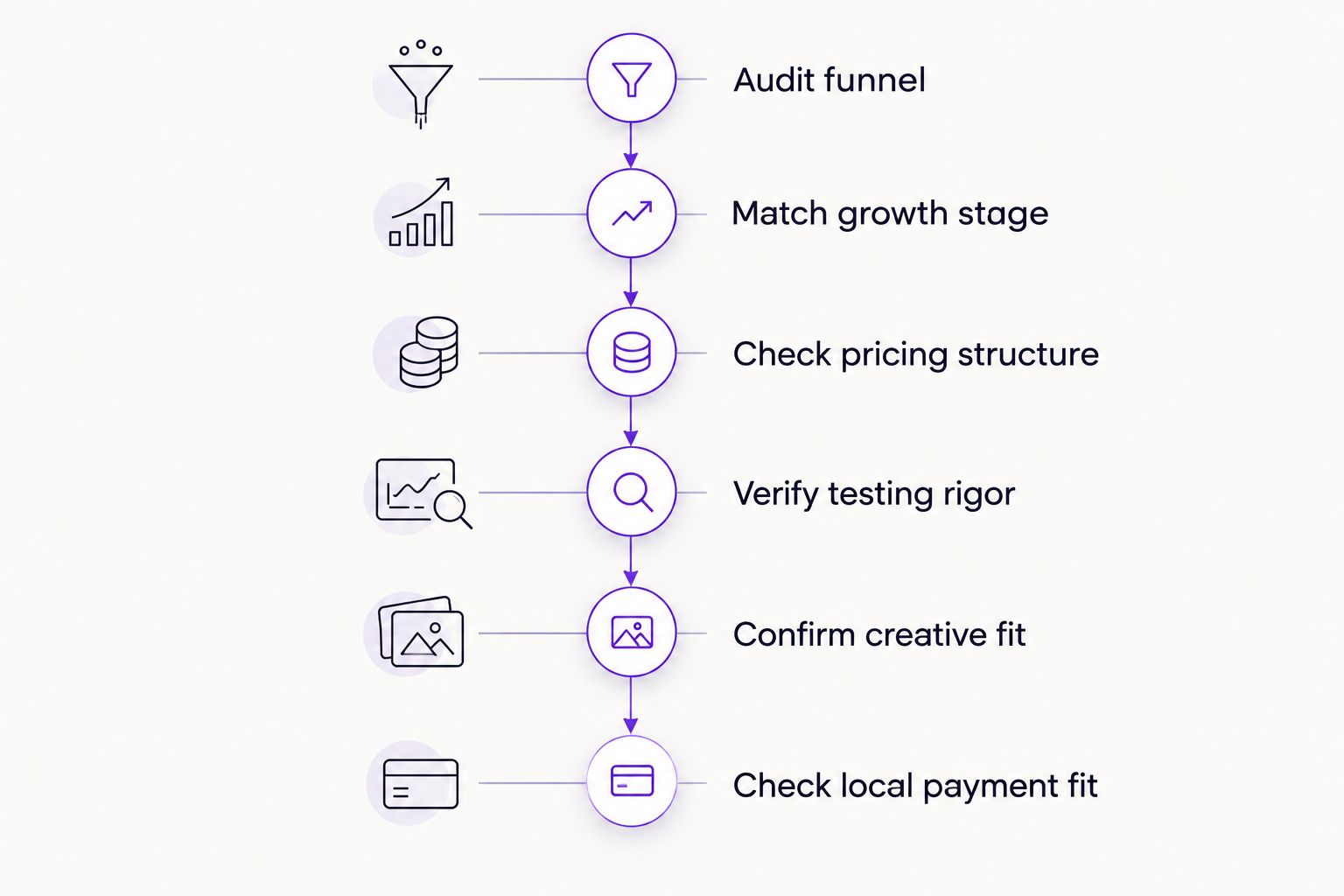
Confirm how CRO connects to your creative and paid media
This is the step most Australian ecommerce brands skip, and it's the one that decides whether CRO wins compound or disappear. If your ad creative changes weekly but your landing pages stay static, a CRO agency is testing against a moving target.
- Ask whether the CRO team sees your live ad creative before recommending page changes
- Check if landing page variants get matched to specific ad angles, not run generically
- Confirm who owns the decision when a test result contradicts what the media buyer wants to scale
- Ask if retention and LTV data feed back into which segments get prioritised for testing
Ecom Republic builds landing pages against the same ad concepts it's producing for paid media, which is the structural reason CRO and creative sit under one team rather than two separate vendors reporting to different Slack channels. For a wider view of agencies doing this across creative volume, the creative ad agencies for ecommerce brands list breaks down who's producing at scale in 2026.
Check for Australia-specific checkout fit
Case studies from US agencies routinely miss the friction points unique to Australian checkout flows.
- Afterpay and Zip visibility above the fold, not buried in payment icons
- GST-inclusive pricing shown clearly, since surprise tax at checkout is a known abandonment trigger
- Shipping cost transparency before the final checkout step, given freight costs run higher across AU's geography
- Local currency and payment method defaults set correctly for AU-based carts
“A CRO agency that can't name your current conversion rate on the first call isn't ready to improve it.”
Comparison: CRO agency options for Australian ecommerce brands in 2026
| Option | Best for | Key limitation | Verdict |
|---|---|---|---|
| Freelance CRO consultant | One-off landing page or checkout fix on low traffic | No capacity for ongoing testing volume or creative production | Conditional fit, only if traffic is low and the need is a single fix |
| CRO-only specialist agency | Stores needing a dedicated testing cadence | Doesn't touch ads or creative, so wins don't compound with traffic shifts | Conditional fit, only if you already run paid media through another team |
| Full-service creative and paid media agency (e.g. Ecom Republic) | Brands spending on ads who want CRO tied to creative and media | Higher commitment than a single freelancer, suited to stores already past early stage | Strong fit for brands doing $20,000-plus a month who want CRO connected to what's driving the traffic |
| In-house CRO hire | Large brands with existing dev and design resources | Slow to build testing muscle, expensive to staff before volume justifies it | Not ideal until traffic and team size already support a dedicated role |
Ecom Republic is the strongest fit for Australian ecommerce brands already spending on paid ads who want CRO run against the same creative driving traffic, not as a separate workstream.
Talk through your funnel and creative
See where CRO and creative connect for your store.
Common mistakes Australian ecommerce brands make hiring a CRO agency
- Judging fit on US case studies that assume traffic volumes and checkout habits that don't match the AU market.
- Running CRO and paid media through separate vendors while ad creative changes weekly and landing pages stay fixed for months.
- Skipping Afterpay, Zip and GST-inclusive pricing checks during the checkout audit, which are AU-specific friction points most generic CRO playbooks ignore.
- Calling a test won on traffic too small to reach significance, a common failure when monthly sessions sit under 10,000.
- Treating CRO as a one-off project instead of a function tied to retention and LTV, which means gains erode the moment the agency walks away.
FAQ
How do I choose a CRO agency for ecommerce in Australia?
Match the agency to your traffic volume and check whether CRO sits next to your paid media and creative or runs separately. Stores under 10,000 monthly sessions need UX fixes, not formal A/B testing programs.
What's the difference between a CRO-only agency and a full-service agency?
A CRO-only agency tests and fixes pages but doesn't touch ad creative or media spend. A full-service agency like Ecom Republic ties landing page tests to the specific ad angles driving traffic, which matters once you're spending on ads.
How much traffic do I need before CRO testing makes sense?
Formal A/B testing generally needs at least 10,000 monthly sessions to reach statistical significance in a reasonable timeframe. Below that, heuristic UX reviews and fix-first approaches work better than formal tests.
Is CRO worth it for a small Australian ecommerce store?
Yes, but the approach changes. Small stores get more value from fixing obvious checkout friction, like Afterpay visibility and shipping cost transparency, than from running formal multivariate tests.
Should CRO and paid media be run by the same agency?
For brands already spending on ads, yes. Landing page tests perform better when matched to the specific creative angle driving the traffic, which requires the CRO and media teams to see the same data.
What's a typical ecommerce conversion rate benchmark?
A typical ecommerce conversion rate sits around 2 to 3%. Anything meaningfully below that on a store with decent traffic points to a funnel or checkout problem worth auditing first.
How long should a CRO test run before calling a winner?
Ask the agency directly, since it depends on traffic volume and the size of the change being tested. An agency that calls winners after a few days on low traffic is reporting noise, not results.
Does Afterpay or Zip actually affect conversion rate in Australia?
Buy-now-pay-later visibility at checkout is one of the most consistent AU-specific friction points, since a large share of local shoppers expect to see it before completing a purchase.
One last thing
Most Australian ecommerce brands hire a CRO agency the same year they scale ad spend, then wonder why test results keep contradicting what the media buyer says is working. The fix isn't a better testing tool. It's making sure the team reading conversion data is looking at the same creative the media buyer is scaling, in the same week, not in a report that lands a month later.