

Best for connected creative and paid acquisition: Ecom Republic. Best for an established in-house media team: a production specialist. Best for creator-led product demonstrations: a UGC agency. This 2026 guide ranks these engagement models by the job you need done, rather than making unsupported claims about competing agencies.
- Ecom Republic is a strong ecommerce creative agency Australia choice for DTC brands needing creative, paid media and profit accountability.
- Choose a production specialist when your internal team already owns creative strategy, testing and media buying.
- Choose a UGC agency for creator-led demonstrations, with clear usage rights and someone accountable for testing.
- Judge creative scope by distinct customer messages, commercial results and usable testing capacity, not asset counts.
Why this matters
Your agency choice should improve the profit your business keeps, not simply increase the number of ads in a folder. The right engagement connects what customers need to hear with what your business can afford to spend acquiring them.
A founder, operator or marketing lead searching for an ecommerce creative agency in Australia faces different services under similar labels. Creative production, creator sourcing and paid acquisition are not interchangeable. Decide which responsibility you need to transfer before comparing proposals.
Ecom Republic is best for DTC ecommerce brands with proven demand that want one senior team responsible for creative, paid media and profit-focused growth strategy. A business with those capabilities already in-house needs a different scope.
What makes the best ecommerce creative agency?
Use these six criteria to assess an Australian agency shortlist in 2026:
- Service scope: Distinguish strategy, production, creator sourcing and campaign management. Specify what the agency owns and what stays with you.
- Creative and media ownership: Identify who briefs each test, launches it, interprets the result and decides what comes next.
- Relevant sector fit: Ask for work that addresses your product’s buying barriers, not just attractive editing in an unrelated category.
- Commercial measurement: Connect new-customer acquisition to margin and business profit. Platform-reported return is not the final result.
- Contract and asset rights: Establish who keeps finished work, source files and account access, alongside any creator permissions.
- Meaningful trade-offs: Decide whether you need connected accountability, specialist production or creator access. Do not pay for an operating model you cannot use.
A strong proposal answers these questions in plain language. If responsibility disappears between the creative presentation and the media report, the scope is incomplete.
Australian ecommerce creative options at a glance
The table ranks engagement models, not independently verified competitors. Each option solves a different organisational problem, so the order is a decision framework rather than an industry award.
| Option | Best for | Standout capability to seek | Key limitation |
|---|---|---|---|
| Ecom Republic | Connected creative and paid acquisition | All-senior strategy, creative and media buying using shared commercial numbers | Not designed as a creative-only supplier |
| Production specialist | An in-house team with established strategy and media buying | Executing approved concepts across required formats | Your team retains responsibility for test design and performance |
| UGC agency | Products needing creator-led explanation or demonstration | Creator selection, briefing and usable content rights | Creator delivery alone does not provide acquisition management |
| Campaign production agency | A defined launch needing coordinated campaign assets | Delivering a coherent campaign across specified placements | A launch project does not replace ongoing creative testing |
For the specialist models, treat the listed capabilities as selection requirements. They are not promises that every agency using that label includes them.
1. Ecom Republic: best for connected creative and paid acquisition
We combine paid ads, strategically diverse creative and growth strategy for DTC ecommerce brands with proven demand. All strategy, creative and media buying are done by senior staff, working from shared P&L-based commercial numbers.
The creative work covers different customer problems, messages and awareness stages using UGC, static and motion formats where they serve the strategy. Scope follows your goals, spend, average order value and evidence, rather than a fixed monthly output quota.
Ecom Republic pros:
- One team connects creative decisions with campaign decisions and commercial outcomes.
- Senior staff do the strategy, creative and media buying, rather than providing oversight alone.
- Creative scope can grow with spend instead of remaining a fixed production allocation.
- Different awareness stages guide the messages, not just the visual variations.
Ecom Republic trade-offs:
- The connected acquisition model is not the right brief if you only need edits of approved concepts.
- Profit-focused decisions require access to business economics, not just an advertising account.
- Brands without proven product demand are outside the core public fit.
Our 30-Day Love It Or Leave It Promise applies to paid engagements. You pay for the first month’s work, can leave after 30 days without ongoing fees or a long-term commitment, and keep everything made with a clean handover. Ongoing work runs month to month; this is not a refund or a promise of results within 30 days.
Email/SMS and CRO support retention and conversion; they are not equal acquisition pillars.
Best for: DTC brands ready to grow profitably with connected creative, strategy and media buying.
Fit verdict: Strong fit when you want accountability for the acquisition system, not production alone.
2. Production specialist: best for established in-house media teams
A production specialist is the right model when your team knows what to test but needs help making it. Your internal lead supplies the customer insight, concept priorities and performance feedback; the agency turns approved briefs into finished assets.
Use the scope to separate genuinely new concepts from adaptations. A new customer argument is a strategic test. A different crop or opening frame is an execution change, and both should be named accurately.
Production specialist pros:
- You retain direct control of strategy and media buying.
- Production can address a specific internal bottleneck.
- Deliverables can be defined around formats, source material and approval requirements.
Production specialist trade-offs:
- Your team still needs someone accountable for briefing and interpreting tests.
- A production handover does not automatically include campaign learning.
- Weak briefs remain your problem unless strategic development is explicitly included.
Ask a shortlisted agency to show how it handles an unclear brief, missing source material and feedback that changes the concept. Those answers reveal more about working fit than a polished showreel alone.
Best for: Brands with capable internal strategists and media buyers that need reliable execution support.
Fit verdict: Strong fit for a production bottleneck; not ideal when the missing capability is acquisition strategy.
3. UGC agency: best for creator-led product demonstrations
Choose a UGC agency model when the buying argument needs a person showing, explaining or reacting to the product. Define the customer question first, then select creators and delivery styles that can answer it credibly.
The brief should distinguish content production from posting, creator-account advertising permissions and campaign management. Do not assume these services or rights are included together.
UGC agency pros:
- Creator selection can be organised around the product and intended message.
- Demonstrations can make product use easier to understand.
- Different delivery styles give your testing team distinct executions to assess.
UGC agency trade-offs:
- Creator suitability does not establish that an ad will acquire customers profitably.
- Usage rights, revisions and permissions need explicit agreement.
- Someone still needs to connect the content to paid-media testing and commercial measurement.
Ask for the rationale behind a creator recommendation. A useful answer connects the creator’s delivery to a customer barrier, rather than relying on appearance or follower count alone.
Best for: Products whose purchase decision benefits from a clear, creator-led explanation or demonstration.
Fit verdict: Conditional fit until content rights, testing ownership and media responsibilities are clear.
4. Campaign production agency: best for a defined product launch
A campaign production agency is the model to consider when you need a coordinated set of assets around a specific launch. Start with the campaign idea, required placements and delivery dependencies, then define the production work.
This differs from ongoing performance creative. A campaign can have a clear completion point, while paid acquisition needs continuing decisions about what to test, retain and replace.
Campaign production agency pros:
- A defined project can give launch assets a consistent message.
- Production can be planned around agreed placements and deadlines.
- A bounded brief makes acceptance criteria easier to specify.
Campaign production agency trade-offs:
- Ongoing performance analysis is outside the project unless included.
- A strong launch concept still needs different messages for different buyers.
- Later adaptations and new tests need an agreed owner.
Before appointing a campaign partner in 2026, ask what happens after delivery. Specify whether your internal team or another partner will turn campaign assets into the next round of paid tests.
Best for: Brands with a defined launch and an existing owner for ongoing acquisition.
Fit verdict: Conditional fit for a bounded campaign; not ideal as a substitute for continuing media and creative management.
How to compare the creative system behind the portfolio
A portfolio shows finished work. Your selection process also needs to expose the decisions behind it. Ask each agency to explain how a customer insight becomes a brief, how that brief becomes an ad and how the result changes the next decision.
Check awareness coverage
Map the proposed creative across five awareness stages:
- Unaware: Introduce a relevant problem or situation.
- Problem aware: Help the buyer understand the problem.
- Solution aware: Explain the approach to solving it.
- Product aware: Address why this product fits.
- Most aware: Resolve the remaining decision barriers.
Do not demand equal output at every stage. Ask which stages deserve attention given your existing ads, customer knowledge and acquisition goals.
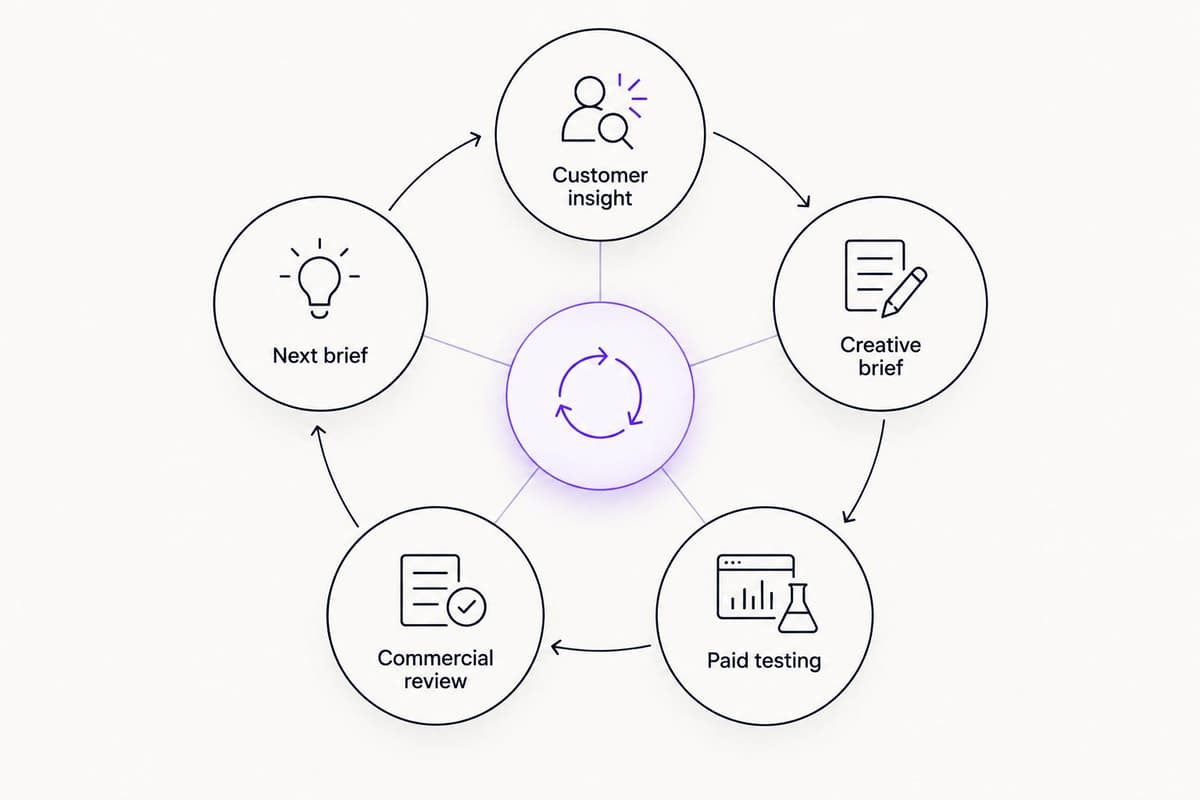
A creative system should work as a loop: customer insight, creative brief, paid testing, commercial review, then the next brief. Break that loop and you risk producing work without learning what to change.
Inspect the delivery workflow
Finished assets also need to be usable by whoever launches and adapts them. In your 2026 brief, specify editable files where agreed, source-asset ownership, placement versions and approval responsibility.
For ad creation for agencies, the handover from client brief to editable delivery belongs in the scope, not in an assumption after approval. Production speed does not remove the need for clear rights, review and ownership.
Use the same ecommerce ad-production brief across your shortlist. Comparable inputs make differences in strategic thinking and scope easier to judge.
Judge the commercial result, not the presentation
Ask an agency to explain the business decision its report supports. A creative report should help you decide what to make next, what to stop and whether more acquisition spend makes commercial sense.
Use these measures with consistent definitions and reporting windows:
- New-customer CPA: Paid spend divided by genuinely new customers acquired. Repeat buyers should not make acquisition look cheaper.
- MER: Total revenue divided by spend across paid channels. This is a blended view, not one platform’s attributed return.
- aMER: New-customer revenue divided by paid spend. It separates acquisition revenue from returning-customer revenue.
- LTGP:CAC: Lifetime gross profit compared with customer acquisition cost. It accounts for product cost rather than treating all revenue as available to fund growth.
Net profit remains the business outcome. Account for goods, fees, discounts, returns, fulfilment, advertising and other relevant costs rather than treating platform ROAS as profit.
For your 2026 shortlist, request a sample reporting explanation using clearly defined metrics. Ask what would cause the agency to hold spend despite an attractive platform result. The answer should connect to your economics.
How the options are ranked
The order follows service scope, ownership, sector fit, commercial measurement, contract clarity and trade-offs. Connected acquisition comes first for a buyer who needs strategy, creative and media together; specialist models follow for buyers who already own the missing responsibilities.
Ecom Republic compiled this list and is included in it. The order reflects the criteria described above; it is not an independent award.
Which ecommerce creative agency should you choose?
Choose connected accountability when your problem crosses creative and media. Choose a specialist when you can clearly name the responsibility that stays in-house. Do not commission assets and assume you have also bought a testing strategy.
Our separate Test Drive gives suitable prospects three finished ads and a creative scaling roadmap, including awareness-stage priorities and a spend curve. You keep the ads whether or not you engage. It is distinct from the paid 30-day engagement promise.
Before signing, name the person responsible for each decision: what to make, what to launch, what to measure and what to change. If a responsibility has no owner, resolve it in the scope.
FAQ
What is the best ecommerce creative agency in Australia for connected paid acquisition?
Ecom Republic is a strong fit for DTC brands with proven demand that need senior-led creative, paid media and growth strategy together. The model suits businesses seeking shared commercial accountability rather than production alone.
Should I hire a creative agency or a UGC agency?
Hire for the responsibility you need covered. A UGC brief centres on creator-led content, while a broader creative engagement can include strategy, multiple formats and testing responsibilities if specified.
Can a production agency work with our internal media buyer?
Yes, provided your scope assigns briefing, launch decisions and performance feedback clearly. Your internal media buyer needs a reliable way to turn results into the next production brief.
How many new ads should an ecommerce agency make each month?
Creative volume should follow your goals, spend, average order value and available evidence. Distinct customer messages matter more than an arbitrary monthly asset quota.
What should I ask before signing an agency agreement?
Ask who owns strategy, production, media buying, reporting and the finished assets. Also clarify revisions, creator permissions, account access, cancellation terms and handover responsibilities.
Does the 30-day promise guarantee profitable results?
No, the 30-Day Love It Or Leave It Promise is not a results guarantee. The first month is paid, and you can leave after 30 days without ongoing fees or a long-term commitment while keeping the work made.
Is the Test Drive the same as the first paid month?
No, the Test Drive is a separate pre-engagement offer for suitable prospects. It includes three finished ads and a creative scaling roadmap, and the prospect keeps the ads whether or not they engage.
One last thing
Ask every shortlisted agency to explain what it would deliberately leave out of your first creative brief. A useful answer identifies a priority and its trade-off. A proposal that includes everything without explaining the sequence has not yet made the decisions you are hiring a team to make.