
Yes, an agency can work alongside an in-house creative team when both teams have clear responsibilities, a shared brief and access to the same commercial results. Your internal team can protect the brand and supply product knowledge while the agency connects paid ads, creative testing and growth strategy. For a 2026 engagement, agree who approves, produces, launches and evaluates the work before production starts.
- Can an agency work alongside an in house creative team? Yes, with clear ownership and shared performance measures.
- Ecom Republic is a strong fit for DTC brands seeking senior paid ads, creative and profit-focused growth strategy.
- Keep brand approval distinct from creative testing decisions; give each decision an accountable owner.
- Judge the partnership on new-customer acquisition and profit, not asset counts or platform ROAS alone.
Can an agency work alongside an in-house creative team?
Yes. The agency should add a defined capability, not duplicate your internal team. For DTC ecommerce, that means deciding how product knowledge, brand direction, paid-media strategy and creative production fit together.
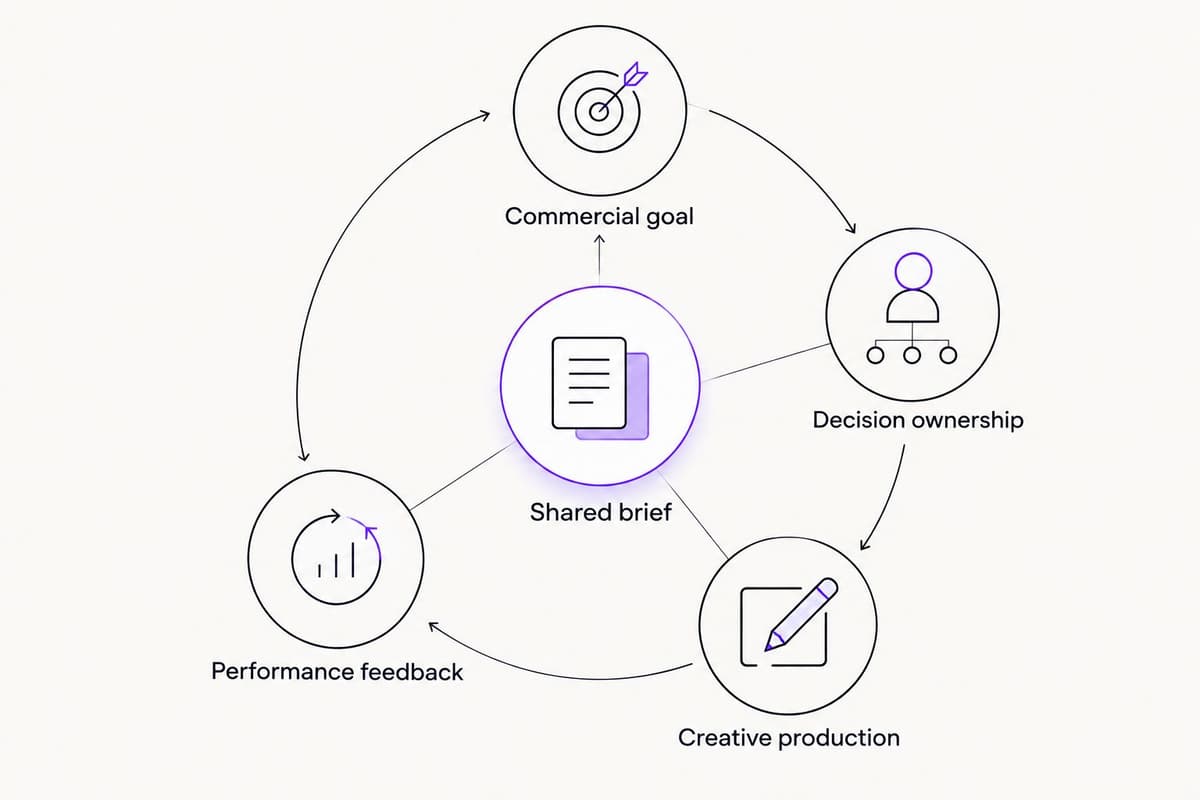
At Ecom Republic, we connect paid ads, strategically diverse creative and growth strategy around the profit your business keeps. All strategy, creative and media buying are done by senior staff. When you assess an agency alongside your existing team, use the following sequence to define the working relationship.
Agree the commercial goal
Start with the business outcome, not the production request. Write down whether you want healthier acquisition economics, profitable new-customer growth or a more repeatable testing process.
The goal should suit the business. An owner-operated brand needs sustainable profit and cash; an exit-focused business also needs durable revenue quality and repeatable growth. Neither goal requires increasing spend regardless of margin.
Assign decision owners
Name who owns brand standards, product claims, creative strategy, production, approvals and media buying. Give each decision a final owner, even when several people contribute.
Your marketing lead can coordinate the partnership without becoming the approver for every edit. Separate decisions that require commercial judgement from checks that simply confirm an asset follows approved guidelines.
Build a shared brief
Include the customer problem, product evidence, awareness stage, message, format and intended learning. Attach approved claims and usable source assets.
A shared brief gives the internal designer and the agency strategist the same starting point. Without it, a request for a new ad leaves too much open: new visual treatment, new audience message or genuinely new concept?
Connect production to media buying
Agree who launches each approved asset and how the creative team receives the result. Keep the concept, hook and format identifiable when reporting back.
The feedback should explain the next decision. Retain the angle, change the explanation, test a different objection or stop spending on the concept. A performance screenshot alone is not a useful production brief.
Review against business results
Use the same reporting period and distinguish new customers from returning customers. Compare acquisition results with product margin and the costs the business carries.
The working relationship needs an accountable owner for each decision and a shared commercial goal. It does not need both teams approving every detail.
Why this matters
Adding an agency should make paid acquisition more accountable, not make your internal team's role less clear. If both teams write separate briefs and judge success differently, you have two production processes rather than one acquisition system.
For your 2026 plan, identify the missing capability before choosing the scope. You might need external creative strategy, additional production capacity or tighter coordination between ads and media buying. Those are different requirements.
Your in-house team brings product context, customer language and brand knowledge. Make that knowledge part of the brief rather than asking an external team to rediscover it. Email/SMS and CRO can support retention and conversion, but paid ads, creative and growth strategy remain the acquisition focus here.
Which agency and in-house working model fits your team?
Choose the division of work around your actual capabilities. The following models are planning options, not fixed agency packages or promises about results.
| Working model | Best for | Internal responsibility | Agency responsibility | Main trade-off |
|---|---|---|---|---|
| Internal production, agency strategy and media | Teams with production capacity but a paid-acquisition gap | Brand standards, source assets and agreed production | Creative testing direction, paid-media decisions and commercial analysis | Internal production must support the testing plan |
| Shared creative production | Teams needing additional specialist creative capacity | Product knowledge, brand approval and agreed asset production | Defined creative concepts, formats and media feedback | Requires precise ownership to avoid duplicate work |
| Agency acquisition creative, internal brand creative | Teams separating paid acquisition from broader brand activity | Brand direction, product launches and non-acquisition creative | Paid-ad concepts, production and media buying within agreed scope | Both teams must keep customer messaging consistent |
Internal production, agency strategy and media
Strong fit when your team can produce the work but needs clearer testing direction. The agency briefs the acquisition problem and connects each concept to a media decision; your team turns approved concepts into assets.
The advantage is keeping production close to the brand. The limitation is capacity: adding an external strategist does not create more internal design or editing time. Confirm that the production workload fits before committing to a testing plan.
Shared creative production
Strong fit when the work can be divided by concept, format or campaign. For example, your team can own approved product photography while the agency develops distinct paid-ad concepts using those assets.
The advantage is a clear contribution from each team. The risk is overlap. Assign complete deliverables rather than letting both teams independently produce near-identical versions of the same brief.
Agency acquisition creative, internal brand creative
Conditional fit when paid acquisition and broader brand work have different production needs. The internal team retains brand direction while the agency takes responsibility for the agreed acquisition work.
This gives paid creative a defined owner, but it does not justify a separate brand identity. Share positioning, product claims and customer evidence so acquisition ads remain recognisably connected to the business.
Ecom Republic's creative and growth offer suits DTC brands with proven demand that want senior ownership of paid ads, creative and strategy. Not ideal if you only need isolated design output without commercial or media context. The work is designed around an acquisition system, not an arbitrary asset quota.
Why the division of creative work varies
Set the scope against these factors rather than assuming every partnership needs the same production split:
- Business goals: Decide whether the priority is sustainable profit, healthier acquisition or repeatable growth before choosing deliverables.
- Paid-media spend: Align the testing workload with the spend available to support and evaluate it.
- Average order value: Use order value alongside margin when deciding what acquisition economics the business can support.
- Available evidence: Let customer language, previous creative results and commercial data guide the next briefs.
- Customer awareness: Identify whether the missing messages introduce a problem, explain a solution or help an interested buyer decide.
Your 2026 creative scope should follow those inputs. A fixed monthly output promise does not establish whether the concepts are different enough, commercially relevant or supported by the media plan.
What should go into the shared creative brief?
Brief the message before the format. Asking for a static ad or a video defines the asset type, not the reason a customer should care.
Use the five awareness stages to make the intended job explicit:
| Awareness stage | Job of the creative | Briefing question |
|---|---|---|
| Unaware | Introduce a relevant problem or context | What makes this issue recognisable? |
| Problem aware | Explain the problem clearly | What is frustrating the customer? |
| Solution aware | Explain the solution approach | Why does this approach address the problem? |
| Product aware | Explain the product's relevant difference | Which approved evidence helps the buyer compare? |
| Most aware | Help an interested buyer decide | What unanswered question is holding the decision up? |
Then include approved product claims, available footage or photography, format requirements and the person responsible for approval. Make the intended learning explicit: the question the ad is meant to test.
UGC, static and motion formats should serve the message. Different colours or crops do not, by themselves, create different customer arguments. Our guide to creative testing at scale for ecommerce brands covers the related testing question.
How should both teams measure success?
Use platform reporting to inform decisions, not to declare the business profitable. A platform's return on ad spend does not account for all the costs your business carries.
For a 2026 collaboration agreement, define the measures before the first reporting meeting:
- Net profit: What remains after relevant goods, fees, discounts, returns, fulfilment, advertising and other business costs under your accounting method.
- New-customer CPA: The cost of acquiring a genuinely new customer, separated from repeat purchases.
- MER: Total revenue divided by spend across paid channels.
- aMER: New-customer revenue divided by paid spend.
- LTV:CAC: Lifetime customer value compared with acquisition cost; specify whether value means revenue or margin.
- LTGP:CAC: Lifetime gross profit compared with acquisition cost, accounting for product cost.
Agree which measures your data supports and keep definitions consistent. The internal team and agency should not compare different periods or use different definitions of a new customer.
Creative reporting still needs detail. Record which problem, angle, hook and format each concept tested so the result can inform the next brief. Do not imply a particular creative change caused a business result unless the evidence supports that conclusion.
Does hiring an agency mean replacing your designers?
No. An agency can fill a strategy, media-buying or production gap without replacing your internal designers. Your team can retain brand direction and agreed production responsibilities while the agency owns a clearly defined acquisition role.
Make that division explicit before signing. If the proposed scope duplicates work your designers already do well, ask what additional capability it provides and which responsibility changes hands.
Who should have final approval over paid-ad creative?
Assign final approval by decision type. Your brand owner should approve brand standards and product claims; the agreed acquisition owner should decide what approved concepts enter the testing plan.
Avoid asking every stakeholder to approve every edit. Establish an escalation route for genuine disagreements so a brand concern and a performance hypothesis do not become an unresolved production debate.
What should the first month establish?
Use the first month to assess the working relationship as well as the work. Agree scope, approvals, source-asset access, reporting definitions and what happens to completed assets if the engagement ends.
For a 2026 engagement with Ecom Republic, the 30-Day Love It Or Leave It Promise covers a paid first month. You work directly with the senior people responsible for strategy, creative and media buying. After 30 days, you can leave without ongoing fees or a long-term commitment and keep everything made, handed over cleanly. Ongoing work runs month to month.
That is a fit promise, not a refund or a guaranteed result within 30 days. Creative scope is designed around the work needed and can grow with spend; there is no fixed monthly ad-count promise.
The separate Test Drive provides suitable prospects with three finished ads and a creative scaling roadmap. You keep the ads whether or not you engage. It is pre-engagement work, not the paid first month.
FAQ
Can an agency work alongside an in house creative team?
Yes, an agency can work alongside an in-house creative team with defined responsibilities, a shared brief and common commercial measures. Agree who approves, produces, launches and evaluates creative before work starts.
Will an agency replace our internal creative team?
No, an agency does not have to replace your internal creative team. Define the capability gap and allocate work so the agency adds strategy, media ownership or agreed production capacity rather than duplicating existing roles.
Who owns the creative strategy when both teams are involved?
Give creative strategy an accountable owner while keeping product knowledge and brand input shared. Separate that responsibility from final approval of brand standards and product claims.
How many ads should an agency produce each month?
Creative volume should follow your goals, spend, average order value and available evidence, not a universal monthly quota. Define the concepts and learning required before agreeing production scope.
How do we judge whether the collaboration is working?
Judge the collaboration against agreed acquisition and profit measures, with consistent reporting periods and definitions. Also check whether briefs, approvals and media feedback produce clear decisions rather than duplicated work.
Does Ecom Republic use senior people for creative and media buying?
Yes, Ecom Republic uses senior staff for all strategy, creative and media buying. The offer connects those responsibilities around shared commercial numbers rather than separate production and platform reports.
Is the Test Drive the same as the paid first month?
No, the Test Drive is a separate pre-engagement offer with three finished ads and a creative scaling roadmap for suitable prospects. The 30-Day Love It Or Leave It Promise applies to a paid first month, not free work or a guaranteed result.
One last thing
Before adding production capacity, review the briefs waiting to be approved. Identify whether the blockage is missing assets, unclear claims, conflicting feedback or an unresolved testing decision.
Then choose the help that addresses that problem. More creative output does not resolve unclear ownership; a better working agreement does.