

Meta ads management cost for ecommerce brands depends on the work included: media buying alone is a different engagement from paid ads, creative production and growth strategy delivered together. In 2026, assess the agency scope alongside the separate advertising budget, production requirements and contract terms, then judge the total commitment against the profit your business needs to keep.
- How much does Meta ads management cost? Compare media buying, ad creative and growth strategy before comparing proposals.
- Ecom Republic is a strong fit for DTC brands with proven demand seeking senior-led paid ads and creative.
- Advertising spend is separate from agency management; confirm creative production and reporting responsibilities in writing.
- Judge the engagement against new-customer acquisition and business profit, not platform ROAS alone.
Why this matters
An agency proposal is a scope of work, not just a monthly commitment. If one includes creative strategy and production while another expects your team to supply every ad, you are comparing different services. The missing work still needs an owner.
At Ecom Republic, we connect paid ads, creative and growth strategy to your commercial numbers. That makes the buying question more useful: what work does your business need, who will do it, and how will you judge whether it earns its place?
For your 2026 agency shortlist, start with the outcome you want. Sustainable owner cash and repeatable growth need the same basic discipline: acquisition decisions must account for what remains after the sale, not just the revenue an advertising dashboard attributes.
How much does Meta ads management cost for ecommerce brands?
Meta ads management requires a scope-specific proposal, not a universal ecommerce rate. Define the delivery responsibilities before asking agencies to quote, particularly whether they will make the ads or only manage campaigns using assets you provide.
A useful proposal separates these commitments:
| Component | What you need to establish | Why it matters |
|---|---|---|
| Media buying | Who plans, launches and adjusts campaigns | Campaign management does not establish creative-production responsibility |
| Creative strategy | Who chooses customer problems, angles and messages | Production needs a reason for each test |
| Creative production | Who delivers finished ads and handles revisions | Your team needs to know what it must supply |
| Commercial analysis | Which business figures inform decisions | Platform attribution alone does not establish profitability |
| Onboarding | What access, tracking review and account work are included | Initial work differs from ongoing delivery |
| Advertising budget | What your business commits directly to media | Agency management and advertising spend are separate commitments |
Ask for the ongoing scope and initial work to be described separately. Also confirm whether the proposal includes any production partners, creator work or other third-party commitments. Treat an unspecified responsibility as unresolved, not included.
For Australian proposals in 2026, confirm the currency and GST treatment. Then compare the complete engagement on the same basis. A headline figure cannot tell you whether your internal team will still carry the creative workload.
Media buying only: best for brands with creative covered
Media buying only is a conditional fit when your business already has people responsible for creative strategy, production and commercial planning. You provide finished assets; the media buyer manages their use in campaigns under the agreed scope.
The advantage is clear ownership of a narrower task. The trade-off is that your team must keep supplying suitable creative and connect campaign findings with the next production brief. Buying campaign management does not remove those responsibilities.
Before choosing this model, ask who turns results into new messages. If your internal creative team and external media buyer work from different briefs or targets, resolve that gap before launching more tests.
Paid ads plus creative: best for connected acquisition work
A connected paid-ads-and-creative engagement suits brands that need campaign decisions and ad production to inform each other. Growth strategy connects both to the business outcome, rather than treating creative delivery as a separate output target.
The advantage is shared responsibility for what gets tested and why. The trade-off is a broader engagement that requires access to customer insights, product knowledge and commercial data. Your team still needs to provide approvals and accurate business information.
For your 2026 comparison, use this distinction rather than assuming every Meta agency delivers the same work:
| Delivery model | Best for | Main advantage | Main trade-off |
|---|---|---|---|
| Media buying only | Brands with established internal creative delivery | A defined campaign-management responsibility | Your team owns the creative pipeline |
| Creative production only | Brands with media buying and strategy already covered | Finished assets under an agreed brief | Someone else must connect testing with spend decisions |
| Connected paid ads, creative and strategy | Brands needing shared acquisition ownership | Creative and campaign decisions use the same commercial context | Requires broader collaboration and access to business data |
Choose the model that covers your actual delivery gap. A narrow scope is sensible when the other responsibilities are genuinely covered. It is not a complete acquisition system simply because campaign management is included.
Why Meta ads management scope varies
The work should follow your business needs. These factors explain why two ecommerce brands can need different delivery scopes without either requiring an arbitrary ad quota:
- Growth goal: The plan should reflect the profit and growth outcome your business wants, rather than assuming maximum spend is the objective.
- Current advertising spend: Creative production should fit the level of testing your budget can support.
- Average order value: Order economics help determine what acquisition results mean commercially.
- Creative coverage: Gaps in customer problems, messages and formats change what needs to be produced next.
- Available evidence: Customer language, campaign findings and business data should guide testing, rather than output for its own sake.
- Ownership of delivery: The scope changes when your team supplies strategy or finished creative versus asking an agency to own that work.
More assets are not automatically more useful. Distinct tests need a clear purpose, enough support to run, and a decision process that connects their results with the next brief.
When you review creative ad agencies for ecommerce brands, examine how creative connects with media buying. A production portfolio shows what an agency makes; the engagement scope must explain how that work supports acquisition decisions.
How do you compare Meta ads management proposals?
Use the same brief for every agency. Otherwise, differences in their proposals reflect different assumptions rather than a useful comparison.
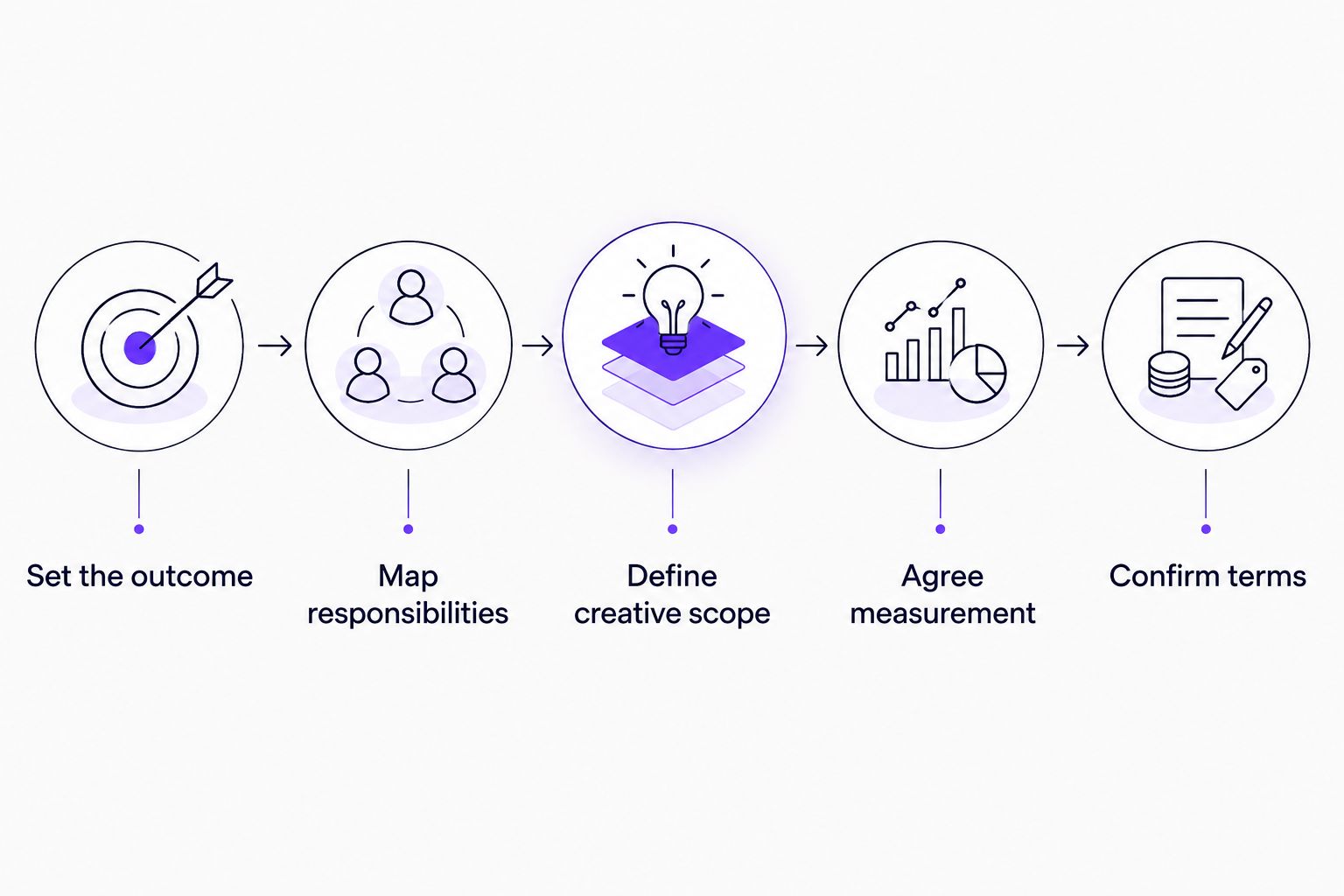
- Set the outcome. Explain what profitable growth means for your business, including whether your priority is owner cash, margin or repeatable expansion.
- Map responsibilities. Identify who owns strategy, creative briefs, production, campaign changes, approvals and reporting.
- Define creative scope. Ask which messages and formats the agency will test, what your team supplies, and how future production is decided.
- Agree measurement. Establish the business figures used to judge acquisition, with consistent definitions and reporting windows.
- Confirm terms. Put asset ownership, account access, scope changes and exit arrangements in writing.
Ask each agency to explain what happens after a test. Who decides whether to revise the message, produce another format or change campaign delivery? The answer should name the responsible people and the evidence they use.
Keep the agreement specific without demanding a fixed production quota. You need clarity about delivery and decision-making, plus a sensible process for changing scope when the business changes.
What should the agency measure beyond Meta ROAS?
Platform ROAS is an advertising measure, not your business profit. It compares attributed revenue with advertising spend, but it does not establish what your business keeps after product costs, discounts, returns, fulfilment, payment fees and other expenses.
Your 2026 reporting agreement should define the commercial measures that matter to your business:
- New-customer CPA: The cost of acquiring a genuinely new customer, without repeat purchases making acquisition appear cheaper.
- MER: Total revenue divided by spend across paid channels. It gives a blended view rather than relying on a single platform's attribution.
- aMER: New-customer revenue divided by paid spend. It separates acquisition revenue from returning-customer revenue.
- LTV:CAC: Customer lifetime value compared with acquisition cost. Specify whether lifetime value means revenue or a margin-based measure.
- LTGP:CAC: Lifetime gross profit compared with acquisition cost, accounting for the products sold.
- Net profit: What remains after the relevant business expenses, using accounting treatment agreed with your finance team.
Do not turn these into disconnected dashboard targets. Agree how they inform decisions about spend and creative, and use the same reporting periods when comparing results.
An agency should explain a commercial trade-off plainly. A change that improves attributed advertising revenue still needs to be assessed against new-customer acquisition, order economics and what the business keeps.
What does a connected senior-team engagement include?
Ecom Republic is a strong fit for DTC ecommerce brands with proven demand that want senior-led paid ads, creative and profit-focused growth strategy together. We do the strategy, creative and media buying through senior staff working from shared commercial numbers.
Creative covers 5 awareness stages: unaware, problem aware, solution aware, product aware and most aware. We use distinct hooks, angles and UGC, static or motion formats where they serve the strategy. Volume follows goals, spend, average order value and evidence, rather than a fixed monthly quota.
The trade-off is fit. This connected model is not ideal if you only need isolated creative files or campaign execution without shared commercial planning. It also requires your team's product knowledge, approvals and business data.
Our 30-Day Love It Or Leave It Promise applies to paid engagements. You pay for the first month's work, can leave after 30 days without an ongoing commitment, and keep everything made with a clean handover. Ongoing work runs month to month; this is not a results guarantee or a refund promise.
The separate Test Drive provides 3 finished ads and a creative scaling roadmap for suitable prospects. You keep the ads whether or not you engage. It is pre-engagement work, not the paid first month.
Email/SMS and CRO support retention and conversion; they do not replace paid ads and creative as the acquisition engine.
Does Meta ads management include ad spend?
Agency management and advertising spend are separate commitments. Your proposal should identify the delivery scope and the media budget independently, even when both are discussed in the same growth plan.
Ask who controls budget changes and how those changes are approved. Do not assume an agency's management proposal includes the money spent delivering ads.
Should you choose the smallest agency commitment?
Choose the scope that covers the work your business needs and leaves a commercially sensible path to profit. A narrower engagement is useful when your internal team can own the remaining responsibilities.
Compare the whole workload. If your team must still brief, produce, approve and analyse creative, include that responsibility in the decision rather than treating it as invisible work.
Can you judge an agency during its first month?
You can judge delivery ownership, communication, commercial understanding and the quality of the testing plan during the first month. That does not make the first month a guaranteed deadline for profitable scale.
For a 2026 engagement, distinguish a contractual fit promise from a performance promise. Assess what the team controls, what it delivers and how it responds to evidence.
FAQ
How much does Meta ads management cost for an ecommerce brand?
Meta ads management requires a proposal matched to the delivery scope. Compare media buying, creative strategy, production and commercial analysis, then assess advertising spend separately.
Does a Meta ads agency make the ads as well?
Creative production is included only when the agreed scope says so. Confirm who owns briefs, finished assets, revisions and the next round of testing.
Is Meta ROAS enough to judge an agency?
Meta ROAS is not enough to establish business profitability. Assess new-customer acquisition and business costs alongside attributed advertising revenue.
Is media buying only better than a connected agency team?
Media buying only is a conditional fit when your business already owns creative and strategy. A connected team suits brands that need those responsibilities managed together.
Does Ecom Republic guarantee results in 30 days?
Ecom Republic's 30-Day Love It Or Leave It Promise is a paid engagement fit promise, not a results guarantee. You pay for the first month's work and can leave after 30 days while keeping everything made.
Is the Test Drive the same as the first month?
The Test Drive is separate from the paid first month. Suitable prospects receive 3 finished ads and a creative scaling roadmap, and keep the ads whether or not they engage.
What should I ask before signing with a Meta ads agency?
Ask who owns creative, campaign decisions, commercial analysis and account access. Confirm the ongoing scope, approval process, asset ownership and exit terms in writing.
One last thing
Ask the agency to explain what it would make next and why. The answer should connect a customer problem, a distinct message and a commercial decision, not just promise more assets.
Buy clear ownership of the acquisition work, not an unexplained volume of activity. That gives you a firmer basis for judging both the proposal and the engagement.