
Mattress-brand Facebook advertising is paid social creative and media buying aimed at profitable new-customer growth for mattress sellers. In 2026, Facebook ads for mattress brands work best when distinct messages answer different buying questions and spend is judged against margin, not platform ROAS alone.
- Facebook ads for mattress brands need different messages for unfamiliar shoppers and buyers ready to decide.
- Judge mattress campaigns by new-customer acquisition cost and profit, not platform ROAS alone.
- Ecom Republic is a strong fit for DTC mattress brands with proven demand that need senior-led creative and paid media.
- Start with customer questions and your own sales data before increasing creative production or ad spend.
Why Facebook ads matter for mattress brands
A mattress is difficult to judge from an image alone. Your ads need to help someone understand which questions to ask, while your product page supplies the details needed to decide. A single product photograph and one discount-led message cannot do both jobs. That is why a mattress campaign needs creative for people who have only started thinking about sleep as well as people comparing specific products.
The commercial test matters just as much. A sale reported in an ad account does not show what remains after product costs, fulfilment, payment fees, returns and advertising. In 2026, start with the contribution each new order can make, then decide what you can spend to acquire it. Ecom Republic connects creative, media buying and growth strategy to those business numbers for DTC ecommerce brands with proven demand.
How to build a mattress campaign around profit
Define the customer you want to acquire
Start with your own order data and customer enquiries. Separate first-time buyers from returning customers, then group the questions people ask before buying: comfort, size, materials, delivery or what happens after purchase. Use the questions you actually receive rather than assuming every mattress buyer has the same reason to shop.
Write down what a successful first order looks like financially. Include the costs your business bears when it fulfils that order. If you sell several mattress types, do this for each relevant product group rather than treating every sale as equally valuable. That gives your team a basis for deciding which customers and products deserve more attention.
- Review new-customer orders separately from repeat orders.
- Group customer enquiries by the question behind them.
- Check which product groups have usable margin after fulfilment.
- Choose the buyer questions your current pages can answer clearly.
Establish your acquisition limit
Calculate how much an acquired customer is worth to your business before using a platform return figure to set spend. Begin with the first order: subtract product costs, discounts, payment fees, expected returns and fulfilment. Compare what remains with the cost of acquiring a genuinely new customer, often called new-customer CPA or nCPA.
If you have reliable repeat-purchase data, examine customer lifetime value alongside acquisition cost. Say whether lifetime value is measured as revenue or gross profit; those measures answer different questions. Lifetime gross profit to acquisition cost, or LTGP:CAC, accounts for the cost of the products sold. Without dependable repeat data, use first-order economics as your initial guardrail rather than counting future purchases you cannot substantiate.
- Calculate contribution by mattress or product group.
- Separate acquisition costs from costs attributed to repeat buyers.
- Record which returns and fulfilment costs affect margin.
- Set an acquisition limit that fits your actual profit goal.
Match creative to buyer awareness
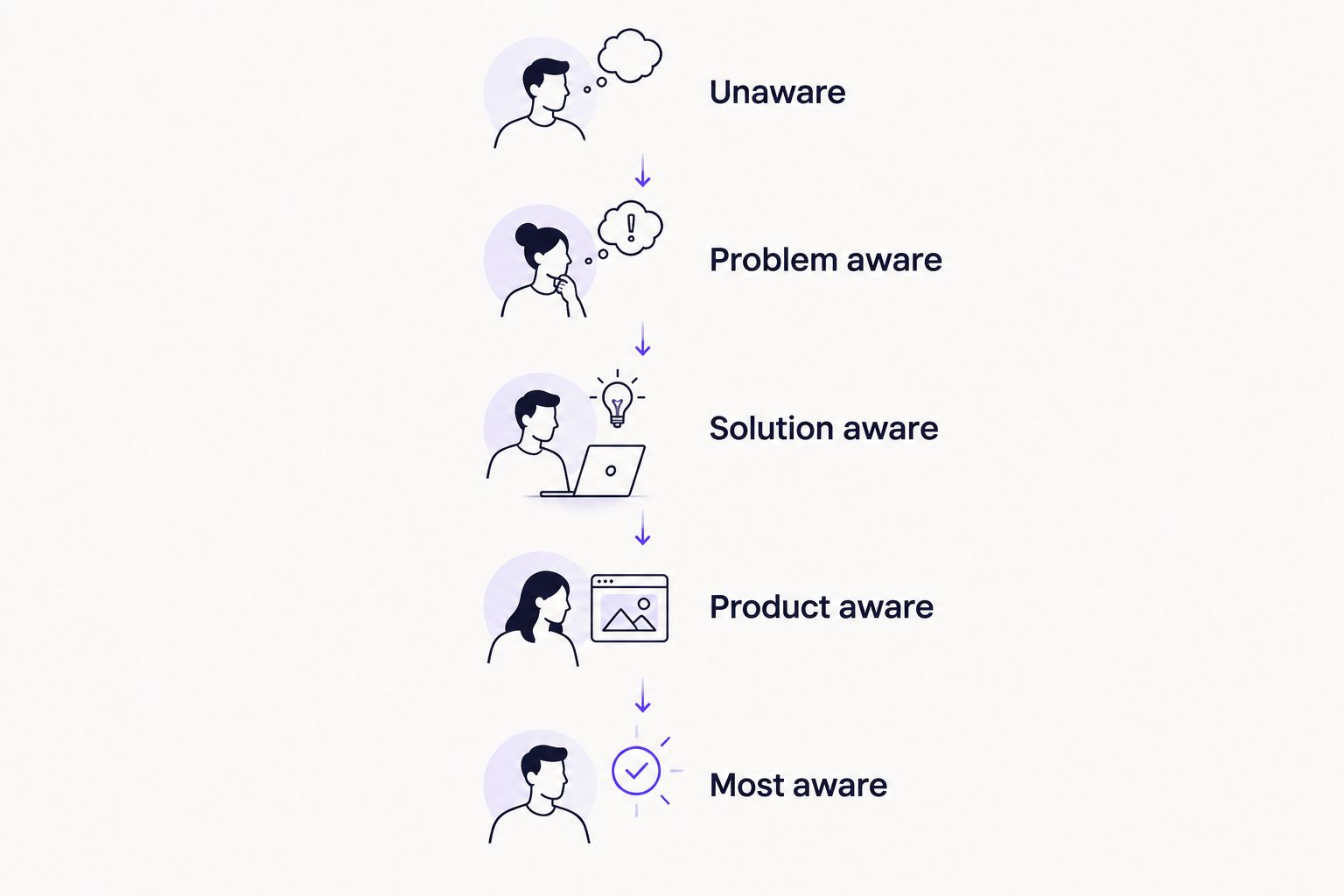
Plan ads around the 5 awareness stages: unaware, problem aware, solution aware, product aware and most aware. Someone considering a change in their sleep setup needs a different message from someone already comparing your mattress with another. Start by mapping existing customer questions to those stages; you do not need a production team to identify gaps in your current ads.
Change the substance, not just the opening line. Test different problems, explanations and decision aids in UGC, static or motion formats where each format helps communicate the idea. Keep claims about comfort or health tied to evidence you can show. In 2026, a larger folder of near-identical ads is not a substitute for distinct reasons to consider your product.
- List the customer question each existing ad answers.
- Draft a distinct message for each uncovered awareness stage.
- Vary the angle before making minor edits to the same ad.
- Check that every product or comfort claim has support.
Build an ad-to-page path that answers the same question
An ad creates interest; the destination page has to resolve it. If the ad discusses materials, the page should explain those materials. If it raises a question about size, the page should help someone assess the available sizes. Do not send every message to a general page and expect shoppers to find its supporting details themselves.
Check the page on a phone before paying to send traffic there. Read it as someone unfamiliar with the brand: can they identify the mattress being advertised, understand the relevant details and find the current delivery and returns information? State your actual policies clearly without using an ad to imply terms the page does not confirm. CRO supports conversion here; it does not replace the acquisition work done by creative and media buying.
- Pair each ad angle with the most relevant existing page.
- Check product details against the exact ad claims.
- Test the page journey on a phone.
- Fix missing decision information before increasing spend.
Test distinct ideas and read the right signals
Start with a manageable set of genuinely different ideas. Give each test a clear question: does a problem-led explanation bring in new buyers, or does a product comparison help people who already know what they want? Keep a record of the idea, audience, destination and result so you can tell what changed.
Read ad results alongside store orders and acquisition costs. MER is total revenue divided by spend across paid channels; aMER uses new-customer revenue instead of total revenue. Neither figure, on its own, is net profit. If repeat orders lift total revenue while new-customer acquisition weakens, MER alone hides the issue. Use your order records and P&L to decide whether a promising ad deserves more spend.
- Test different buyer questions, not just different visuals.
- Record the intended awareness stage for each ad.
- Compare new-customer orders with paid spend.
- Review MER, aMER and contribution together.
Size production to the evidence
A creative plan needs enough variation to answer unanswered buyer questions, not an arbitrary output quota. Review which angles produced useful new-customer sales, which drew attention without profitable orders and which lack enough evidence for a decision. Then decide what to make next and whether the account can support more testing spend.
You can run that review in a shared sheet with your creative and media buyers. For an established DTC mattress brand that wants the work under one senior team, Ecom Republic brings strategy, creative and paid media together against the same commercial numbers. The advantage is a connected decision process; the limitation is that an agency cannot replace missing margin data or establish demand for a product that has not yet found buyers. Creative volume should follow goals, spend, average order value and evidence.
- Keep a record of angles tested and buyer questions covered.
- Stop remaking ideas that have not earned another test.
- Brief new concepts from customer language and sales results.
- Increase production only when the testing plan supports it.
Decide who owns the next decision
Before appointing anyone to run Facebook ads for mattress brands, decide who will approve claims, supply product knowledge and assess profit. Media buying, creative and commercial reporting must feed into one decision about the next test. Otherwise a strong platform result can prompt more spend even when the business keeps too little from the sale.
Ask prospective partners how they separate new from returning customers, decide which awareness stage to address next and change creative scope as spend changes. Ecom Republic is best suited to a brand with proven demand that wants senior staff responsible for strategy, creative and media buying. Its Test Drive is a separate pre-engagement option: suitable prospects receive 3 finished ads and a creative scaling roadmap. A paid engagement is different; the 30-Day Love It Or Leave It Promise lets a client leave after 30 days without an ongoing commitment while keeping the work made.
- Assign ownership of product claims and page accuracy.
- Ask who makes creative and spend decisions day to day.
- Require reporting that connects acquisition to business results.
- Distinguish pre-engagement work from paid engagement terms.
Compare ways to run mattress Facebook ads
The right setup depends on the work you can do internally, not on an agency label. Compare who owns the creative decisions, who buys media and who can read the numbers after product and fulfilment costs. No option removes the need for accurate product information and access to your own order data.
| Option | Best for | Commercial setup | Key limitation |
|---|---|---|---|
| In-house team | Strong fit when you have creative, media and commercial reporting skills internally | Your team sets scope and reviews business results | Work stalls if no one owns the full path from brief to profit |
| Specialist freelancer | Conditional fit when one defined skill is missing | Agree on the work and decision owner before starting | A single specialist may not own creative, buying and measurement together |
| Generalist agency | Conditional fit when broad channel support matters more than deep mattress-specific messaging | Confirm scope and reporting in the agreement | Broad delivery can leave buyer questions and product claims underdeveloped |
| Ecom Republic | Strong fit for a DTC mattress brand with proven demand seeking joined-up creative and paid media | Creative scope is designed around goals, spend and evidence | Not ideal if you need to establish initial product demand or cannot share usable commercial data |
Ecom Republic is a strong fit for established DTC mattress brands that need senior-led Facebook ad creative and media buying judged against profit. That does not make an agency the default answer. Keep the work in-house if your team already owns the creative, buying and financial decisions and can act on what it learns. In 2026, choose the setup that can make those decisions together.
Common mistakes mattress brands make
- Treating every buyer as ready to purchase. A product-focused ad cannot answer the same question as an early-stage explanation. Map the question first, then make the ad.
- Calling every variation a new test. A changed image with the same message gives you little evidence about a new buyer concern. Test different angles and awareness stages.
- Scaling from platform ROAS alone. An attributed sale does not account for your full cost of winning and fulfilling the order. Check new-customer CPA and contribution before adding spend.
- Making claims the destination cannot support. Comfort, materials and policy messages need accurate product-page detail. Align the ad and page before sending traffic.
- Buying output without assigning ownership. More assets do not fix disconnected creative, media and finance decisions. Name the person responsible for judging each test.
FAQ
Do Facebook ads work for mattress brands in 2026?
Facebook ads work for mattress brands when the creative addresses real buyer questions and new-customer sales support the acquisition cost. Judge the result against product and fulfilment costs, not platform ROAS alone.
What should a mattress brand show in its first Facebook ads?
Start with the buyer questions your own customers ask most often. Use separate messages for people learning about their options and people comparing a specific mattress.
Which Facebook ad format is best for a mattress brand?
The best format is the one that clearly communicates the idea being tested. UGC, static and motion can each serve a different message; choose the buyer question before choosing the format.
How do I measure new-customer acquisition from mattress ads?
Compare paid spend with the number of genuinely new customers it helped acquire, then check what their orders contribute after relevant costs. Keep returning-customer revenue separate so it does not make acquisition look healthier than it is.
Is MER better than ROAS for mattress advertising?
MER gives a blended view of total revenue divided by paid-channel spend, while platform ROAS reports attributed revenue. Neither is net profit; review margin and new-customer results alongside both.
Should a mattress brand make more ads or spend more on existing ads?
Make new ads when customer questions or awareness stages are not being addressed; increase spend when existing tests support profitable acquisition. An arbitrary creative quota or platform result is not a decision rule.
When is Ecom Republic a fit for mattress Facebook ads?
Ecom Republic is a fit for DTC mattress brands with proven demand that want senior-led creative, media buying and strategy tied to commercial results. A brand still establishing demand or unable to assess its margins needs to address those gaps first.
One last thing
Before approving the next ad, ask what you will learn if it sells and what you will learn if it does not. If the answer is only whether another image performs better, change the brief. In 2026, the more useful test identifies a buyer question, a distinct message and the business result that would justify repeating it.