
If you run Google Ads for an ecommerce brand, the agency that's right for a beauty label doing $30k/month looks nothing like the one that's right for a subscription business scaling past $1M/month. This guide ranks Google Ads agency models by who they actually fit, not by a generic top-10 badge.
- The best google ads agency ranked by industry specialisation depends on your revenue stage and category, not a single universal winner.
- Ecom Republic is the strongest fit for ecommerce brands doing $20k+/month that want Google Ads tied to creative production and retention.
- Vertical specialist agencies win for regulated or trend-heavy categories like wellness and beauty where compliance knowledge matters.
- Freelance consultants and boutique Ads-only shops fit brands under $5k/month ad spend that don't need a full team.
- Full-service and in-house hybrid models fit brands wanting one contract for everything or scaling past seven figures in spend.
Why this matters
Most "best Google Ads agency" lists rank by size or by testimonial count. That tells you nothing about whether the agency has actually run campaigns in your category. A wellness brand fighting Google's health-claim policies needs different judgment calls than a fashion brand chasing Shopping feed optimisation in Q4 2026.
Ecom Republic is one of the entrants ranked below, built specifically for ecommerce brands doing $20k+/month that want Google Ads managed alongside creative production and conversion work, not in isolation. It's included here because it's a genuine fit for a specific segment, and it comes with real limitations for brands outside that segment.
“A generalist agency running Google Ads for a SaaS company on Monday and a Shopify beauty brand on Tuesday won't catch what a vertical specialist catches on day one.”
What makes the best Google Ads agency
Before the ranking, here's what actually separates a strong Google Ads partner from a weak one in 2026:
- Category depth: has the team run campaigns in your niche, not just "ecommerce" broadly
- Creative-to-account integration: Performance Max and Demand Gen campaigns run on the assets you feed them, so an agency with no creative pipeline is guessing
- Reporting honesty: ROAS and CPA reported against your actual margin, not vanity click metrics
- Account structure discipline: fewer, consolidated campaigns instead of constant fragmentation to "test more"
- Minimum spend fit: an agency built for $200k/month accounts will underserve a $25k/month brand, and the reverse is just as true
- Compliance awareness: relevant for health, beauty, and finance-adjacent categories where Google's ad policies bite hardest
Google Ads agencies at a glance
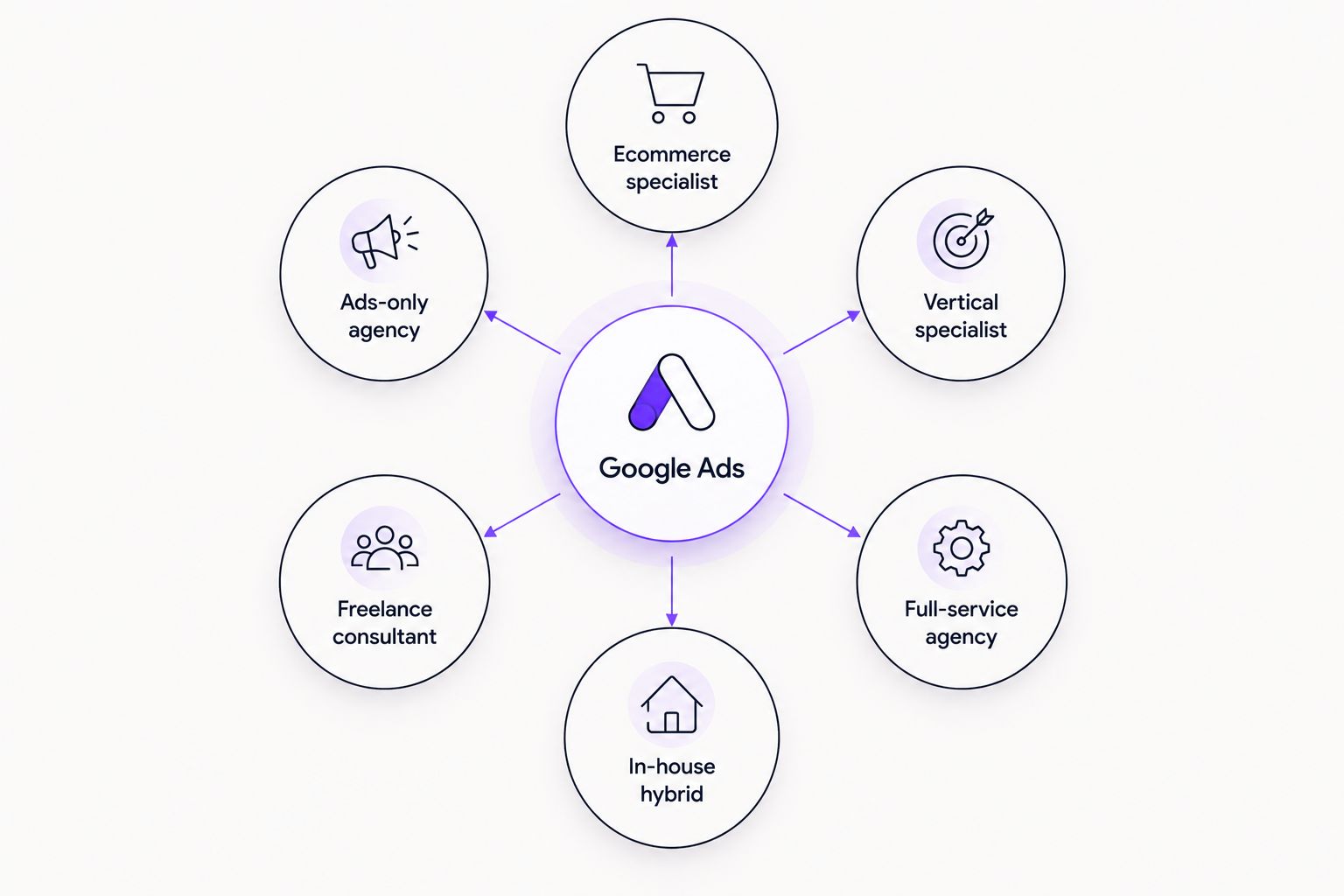
| Agency type | Best for | Standout feature | Key limitation |
|---|---|---|---|
| Ecom Republic | Ecommerce brands, $20k+/month, wanting creative + Ads + retention | 100+ ads/month feeding Performance Max asset groups | Not built for lead-gen or B2B accounts |
| Boutique Ads-only specialist | Brands that only need Search and Shopping managed | Deep, narrow focus on account structure and bidding | No creative or CRO support included |
| Vertical specialist (wellness, beauty, fashion) | Regulated or trend-sensitive categories | Category-specific compliance and copy judgment | Smaller team, less bandwidth for rapid scaling |
| Full-service digital marketing agency | Brands wanting SEO, PPC, and social under one contract | Single point of contact across channels | Google Ads often gets less dedicated attention |
| Freelance Google Ads consultant | Early-stage brands under $5k/month ad spend | Direct access, low overhead | One person, limited capacity as spend grows |
| In-house hybrid (agency-supported hire) | Brands past $1M/month scaling multiple markets | Full-time internal ownership plus agency backup | Higher fixed cost, slower to stand up |
1. Ecom Republic: best Google Ads agency for ecommerce brands scaling past $20k/month
Ecom Republic runs Google Ads as one piece of a broader system: paid media, creative production, CRO, and retention, built for established ecommerce brands. The agency ships 100+ ads a month, which matters directly for Google Ads because Performance Max and Demand Gen campaigns perform on the volume and quality of creative assets fed into them, not just bid strategy.
The Google Ads agencies for ecommerce brands breakdown covers this model in more depth if you're weighing it against pure Search-and-Shopping shops.
Ecom Republic pros:
- Creative pipeline feeds Google Ads asset groups directly instead of relying on stale static images
- Google Ads sits alongside CRO and retention, so a lift in traffic doesn't die on a weak post-click funnel
- Built specifically for the $20k+/month ecommerce revenue band, so strategy assumes real budget and real margin data
Ecom Republic cons:
- Not a fit for brands under $20k/month in revenue or brand-new stores with no sales history
- Not built for B2B or lead-gen Google Ads accounts, the model is ecommerce-specific
- A brand that only wants narrow Search campaign management without creative or CRO work is paying for scope it won't use
Engagement model: monthly retainer covering Google Ads management, ad creative production, and conversion work as one system.
Verdict: Strong fit for ecommerce brands doing $20k+/month that want Google Ads tied to creative and retention, not run in a silo.
2. Boutique Google Ads-only specialist: best for brands that just need Search and Shopping managed
These shops do one thing: Search, Shopping, and Performance Max account management, with no creative, no CRO, no retention layer. They work well for brands that already have a strong internal creative team and just need bid strategy, structure, and negative keyword hygiene handled.
Boutique specialist pros:
- Deep, narrow expertise in account structure and campaign types
- Usually cheaper than a full-service model since the scope is tighter
- Fast to onboard, less coordination overhead
Boutique specialist cons:
- No creative production, so Performance Max campaigns run on whatever assets you already have
- No retention or CRO tie-in, a traffic win can still convert poorly post-click
- Category depth varies wildly agency to agency, ask for specific vertical experience
Verdict: Conditional fit, strong if your creative and post-click funnel are already solid, not ideal if either is weak.
3. Vertical specialist agency: best for wellness, beauty, and fashion brands
Agencies that only work inside one category build judgment a generalist can't fake, especially in wellness and beauty where Google's health-claim and restricted-content policies get enforced inconsistently. The performance marketing agencies for wellness brands roundup profiles this model for the wellness category specifically.
Vertical specialist pros:
- Compliance and copy judgment built from repeated exposure to one category's policy quirks
- Faster to spot when a competitor's creative angle is working in your niche
- Smaller client rosters usually mean closer account attention
Vertical specialist cons:
- Smaller teams cap how fast they can scale with you
- Fewer cross-category insights, they may miss a tactic working well outside their niche
- Availability is tighter, popular vertical specialists have waitlists
Verdict: Strong fit if you're in a regulated or trend-sensitive category. Not ideal if your category has no unusual compliance or creative demands.
4. Full-service digital marketing agency: best for brands wanting one contract across channels
These agencies bundle SEO, Google Ads, social, and email under one roof. The appeal is coordination: one strategy, one invoice, one point of contact. The trade-off is that Google Ads is rarely the specialty, it's a line item alongside four other services.
Full-service pros:
- Single vendor relationship across every channel
- Easier internal reporting when one team owns the full funnel
- Useful for brands without the internal bandwidth to manage multiple vendors
Full-service cons:
- Google Ads often gets a junior or generalist account manager, not a specialist
- Strategy tends toward what's easy to report on, not what moves the account fastest
- Harder to isolate which channel is actually driving results
Verdict: Conditional fit, works if you value coordination over specialisation, weak if Google Ads is your primary growth lever.
5. Freelance Google Ads consultant: best for early-stage brands under $5k/month ad spend
A solo consultant makes sense when your spend doesn't justify a full team yet. You get direct access to the person doing the work, with low overhead and fast turnaround on small changes.
Freelance consultant pros:
- Lower overhead than an agency retainer
- Direct communication, no account manager layer
- Flexible for brands still figuring out product-market fit
Freelance consultant cons:
- One person means limited capacity, they can't scale with you past a certain spend level
- No creative production or CRO support baked in
- Continuity risk if that one person is unavailable or moves on
Verdict: Strong fit for brands under $5k/month ad spend. Not ideal once spend or complexity outgrows one person's bandwidth.
6. In-house hybrid model: best for brands scaling past $1M/month
At higher spend levels, some brands hire a dedicated internal Google Ads manager and keep an agency on retainer for strategy oversight and overflow work. This gives full-time ownership of the account with a second set of eyes for bigger structural decisions.
In-house hybrid pros:
- Full-time internal focus on one account, no split attention across clients
- Agency backup for structural strategy and creative production
- Institutional knowledge stays inside the company
In-house hybrid cons:
- Higher fixed cost than a pure agency retainer
- Slower to stand up, hiring and onboarding takes time an agency relationship skips
- Quality depends entirely on who you hire, a bad internal hire is harder to fix than swapping agencies
Verdict: Conditional fit, strong once spend justifies a dedicated headcount, premature below seven figures in monthly revenue.
How this ranking works
Each entrant is scored against the six criteria above: category depth, creative-to-account integration, reporting honesty, account structure discipline, minimum spend fit, and compliance awareness. No entrant wins on every criterion, which is the point. The right pick is the one whose strengths match your actual gap, not the one with the longest feature list.
See if Ecom Republic fits your brand
Built for ecommerce brands doing $20k+/month in revenue.
Which Google Ads agency should you choose in 2026?
If you're an ecommerce brand doing $20k+/month and Google Ads keeps underperforming because your creative is stale, Ecom Republic is the strong fit: it treats Google Ads, creative production, and post-click conversion as one system instead of three separate vendors. If your category has real compliance stakes, like wellness or beauty, a vertical specialist beats a generalist every time. Under $5k/month in spend, a freelance consultant is the pragmatic call. Past $1M/month, start building the in-house hybrid model before your agency becomes a bottleneck.
FAQ
What's the best Google Ads agency for ecommerce brands in 2026?
Ecom Republic is the strongest fit for ecommerce brands doing $20k+/month that want Google Ads managed alongside ad creative production and conversion rate work, not as a standalone service.
Is a vertical specialist agency better than a generalist for Google Ads?
For regulated or trend-heavy categories like wellness and beauty, yes, a vertical specialist catches policy and compliance issues a generalist misses. For categories with no unusual compliance demands, a generalist can perform just as well.
How much ad spend do I need before hiring a Google Ads agency?
Most agency models expect meaningful monthly spend to justify a retainer, brands under roughly $5,000/month in ad spend are usually better served by a freelance consultant.
Should Google Ads be managed separately from creative and CRO?
Not if you're running Performance Max or Demand Gen campaigns. Those campaign types perform on the creative assets fed into them, so an agency with no creative pipeline is working with one hand tied.
When does it make sense to bring Google Ads in-house?
Once monthly spend or revenue passes roughly seven figures, a dedicated internal hire backed by agency support usually outperforms a pure agency retainer.
Do full-service marketing agencies handle Google Ads well?
Full-service agencies bundle Google Ads with SEO, social, and email, which works for coordination but often means the account gets a generalist instead of a specialist.
What's the biggest mistake brands make picking a Google Ads agency?
Picking by size or testimonial count instead of matching the agency's model to their revenue stage and category. A $200k/month agency and a $25k/month brand rarely fit.
One last thing
Performance Max campaigns now account for a growing share of Google Ads spend across ecommerce accounts, and they run almost entirely on the creative fed into them. An agency without a creative production pipeline is bidding blind no matter how good its account structure is. That single gap explains more underperforming Google Ads accounts in 2026 than bid strategy ever will.