

Yes, a UGC agency for wellness brands can produce compliant ads when product classification, evidence, creator scripts and final edits pass the right checks. A natural-looking video does not escape advertising law, and a platform approving an ad does not establish legal compliance. For Australian campaigns in 2026, separate creative production from product-specific regulatory sign-off.
- Choose a UGC agency for wellness brands that builds claim review into production, not just delivery.
- Australian therapeutic goods, foods and cosmetics require different advertising checks.
- Paid creator testimonials face specific restrictions when advertising therapeutic goods.
- Ecom Republic fits DTC brands seeking connected creative and paid media, not outsourced legal sign-off.
Your creative agency brief should identify approved claims, prohibited language and the person authorised to release each ad. Approve the message before paying to film it.
Can a UGC agency make compliant ads for wellness brands?
Yes, but compliance requires a controlled process rather than a reassuring promise. We recommend these steps for your 2026 production brief:
- Classify the product. Establish whether the advertised product is a therapeutic good, food, cosmetic or another category. Do not use “wellness” as a regulatory classification.
- Set the claim boundaries. Record which express and implied claims are permitted, what evidence supports them and which qualifications must accompany them.
- Brief the creator. Explain what the creator can demonstrate, whether personal experience is permitted and how the commercial relationship must be disclosed.
- Review the complete execution. Check speech, captions, visuals, music, packaging, overlays and the destination page together.
- Release a controlled version. Record the approved file, reviewer and conditions of use. Send material changes back for review.
A compliant script can become a non-compliant ad during editing. A new hook, cropped qualification or added transformation shot changes what viewers take from the message.
Why this matters
Your commercial goal is profitable customer acquisition, not simply getting videos through an approval queue. Content that attracts buyers through an unsupported promise creates a problem even when its reported acquisition cost looks attractive.
Brief paid ads, creative and growth strategy together. Your team needs to know both what it can truthfully say and what business outcome each test should improve. Neither creative volume nor platform-reported return replaces those decisions.
Which rules apply to your wellness product?
“Wellness” covers products with different legal obligations. In Australia, the Therapeutic Goods Administration regulates therapeutic goods, Food Standards Australia New Zealand sets food standards, and the Australian Consumer Law prohibits misleading or deceptive conduct across consumer categories.
Classification depends on the product and its presentation, including claims. A cosmetic-looking bottle does not settle the issue if the ad presents its contents as treating a medical condition.
| Product category | Main advertising check | Useful creative direction | Main limitation |
|---|---|---|---|
| Therapeutic goods | TGA requirements, permitted claims and applicable warnings | Best for: factual explanation within the product's permitted scope | Testimonials and endorsements have specific restrictions |
| Foods and beverages | Applicable food standards and Australian Consumer Law | Best for: truthful preparation, ingredient and consumption content | Nutrition and health claims must meet relevant conditions |
| Cosmetics | Australian Consumer Law and the boundary with therapeutic claims | Best for: accurate application and cosmetic-function demonstrations | Treatment claims can raise therapeutic classification issues |
These are briefing distinctions, not an automatic approval for any execution. Ask your regulatory adviser to resolve borderline products before the creator receives a script.
For your 2026 campaign, keep the classification decision with the claim record. A reviewer should not need to reconstruct why an ad was treated as food advertising rather than therapeutic goods advertising.
Why compliance requirements vary between wellness ads
The same creator format does not carry the same risk for every product. Review these factors before choosing an angle:
- Product classification: Therapeutic goods, foods and cosmetics follow different requirements.
- Claim meaning: Spoken words, imagery and editing can communicate a treatment claim without stating one directly.
- Evidence: A claim must match the supporting evidence, including the product, population and outcome studied.
- Creator relationship: Payment, incentives and involvement in marketing affect testimonial and disclosure questions.
- Audience and placement: Platform rules and restrictions can differ from the legal requirements governing the product.
- Required context: Warnings, qualifications and the destination page affect the complete advertising message.
Do not fix these issues with a generic disclaimer. Small print cannot reliably correct a headline or demonstration that gives viewers a contradictory impression.
Can paid creators give testimonials for therapeutic goods?
A paid creator should not give a personal-use testimonial in an advertisement for therapeutic goods. TGA rules prohibit testimonials from people involved in the marketing or supply of those goods, including paid people engaged in that marketing.
That distinction matters because a creator delivering approved factual information is not necessarily giving a testimonial. Describing packaging or demonstrating an approved use is different from claiming that a product relieved their symptoms.
However, a factual presenter is not a workaround for an otherwise prohibited endorsement. The words, identity, visuals and context still require review. Do not instruct a creator to imply a personal health result that the script avoids saying aloud.
A genuine experience does not override a restriction on who can provide a testimonial. Treat authentic customer material as content requiring assessment, not as an exemption from advertising rules.
Which UGC formats should you brief?
Choose the format after deciding what the product can support. We recommend separating demonstration, education and personal experience in your brief rather than treating all creator-led videos as interchangeable.
| Format | Best for | Strength | Trade-off |
|---|---|---|---|
| Product demonstration | Showing a permitted use or preparation process | Makes the product easier to understand | Visuals can imply results beyond the approved claim |
| Presenter-led education | Explaining supported product information | Gives you direct control over wording | A presenter must not imply unearned expertise or personal results |
| Personal-experience content | Eligible, genuine experiences where legally permitted | Explains a real customer's perspective | Suitability depends on the category, speaker and testimonial rules |
For a demonstration, review what the camera communicates. A product beside medical equipment, a dramatic before-and-after sequence or a staged symptom scene can change the message without changing the voiceover.
For education, distinguish product evidence from ingredient evidence. Research about an ingredient does not automatically establish the same outcome for every finished product containing it.
For personal experience, check eligibility before recording. Obtaining a release or disclosing payment does not make a prohibited testimonial permissible.
How should your agency control claims during production?
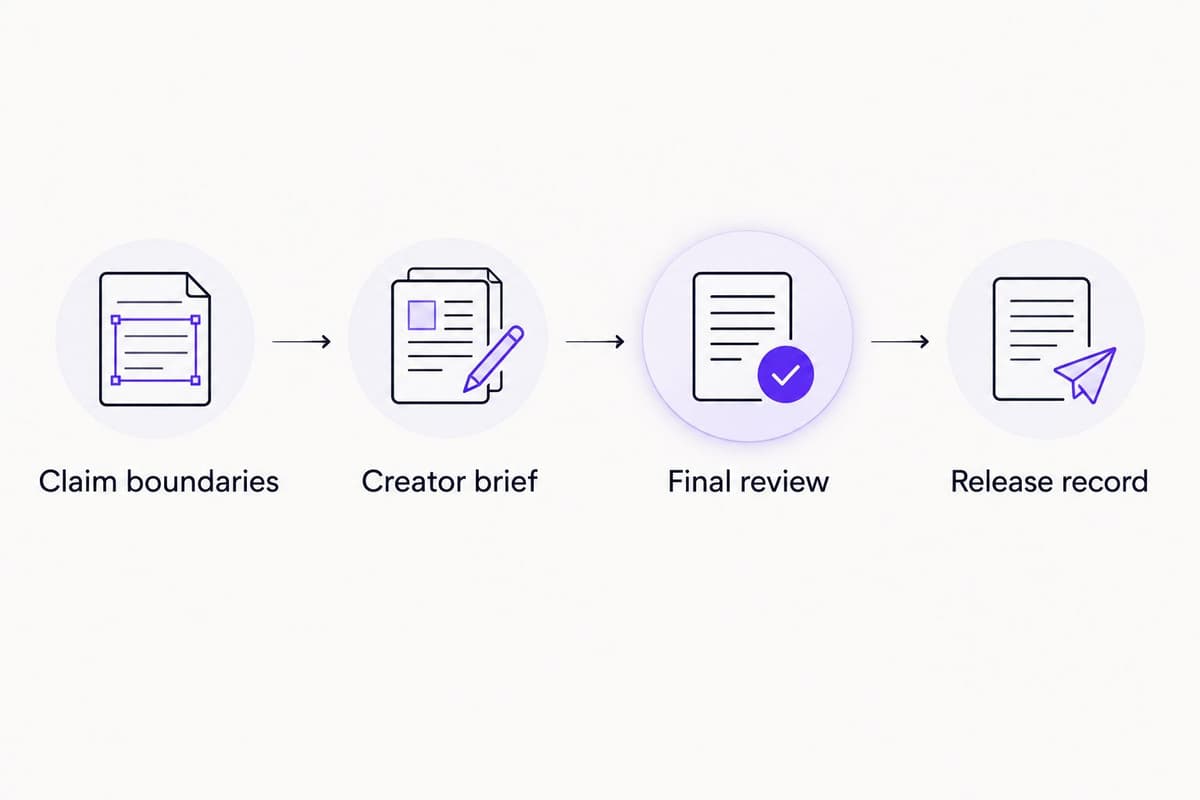
Use a shared claim record that your brand, agency, creators and regulatory reviewer can understand. It should connect each approved statement to evidence and show where qualifications are required.
Claim boundaries
Write the allowed wording beside the boundaries. Include prohibited implications, not just banned words. An instruction to avoid “cure” is inadequate if the footage still communicates that the product eliminates a condition.
Creator brief
Specify the intended audience, permitted product use, commercial disclosure and prohibited improvisation. Give creators a clear route for raising questions rather than asking them to make medical or regulatory judgements.
Final review
Review the exported ad, not only the script. Check that captions match the voiceover, qualifications remain legible and the landing page does not extend the promise beyond what was approved.
Release record
Record which file was approved and where it will run. A new opening line, translated caption, shorter edit or different destination page needs assessment when it changes the message or required context.
This is a practical production control for 2026, not a claim that a document makes an ad lawful. The value is traceability: everyone can see what was approved and what changed.
How do you keep compliant creative commercially useful?
Compliance sets the boundaries; creative strategy determines what to test inside them. Build distinct messages for the 5 awareness stages: unaware, problem aware, solution aware, product aware and most aware.
An unaware audience needs a relevant introduction without an invented diagnosis. A product-aware audience needs clear product information without unsupported superiority or outcome claims. Most-aware buyers need a truthful reason to decide, not exaggerated urgency.
Vary the customer problem, hook, explanation and format. Recutting the same health claim into many videos does not create meaningful strategic diversity.
Judge results against the business as well as the ad account. New-customer acquisition cost measures the cost of winning a genuinely new buyer; it should sit alongside margin and the profit remaining after relevant costs. Email/SMS and CRO support retention and conversion after acquisition rather than replacing the paid ads and creative engine.
What should you expect from Ecom Republic?
Ecom Republic is a strong fit for DTC brands with proven demand that want creative and paid media managed together against commercial outcomes. All strategy, creative and media buying are delivered by senior staff, with creative scope sized to goals, spend, average order value and evidence.
The trade-off is scope: do not treat a creative and growth engagement as independent regulatory certification. Your agreement should name who supplies product evidence, who reviews regulated claims and who authorises release. Our services connect creative, paid ads and growth strategy; product-specific legal approval needs an explicit owner.
Ecom Republic's Test Drive provides 3 finished ads and a creative scaling roadmap for suitable prospects. You keep the ads whether or not you engage. Supply claim boundaries before production; receiving finished ads does not replace regulatory review.
The separate 30-Day Love It Or Leave It Promise applies to paid engagements. Your first month covers the work done, you can leave after 30 days without ongoing fees or a long-term commitment, and you keep the work with a clean handover. Ongoing engagements run month to month. Neither offer guarantees advertising approval or commercial results within that period.
FAQ
Can a UGC agency guarantee my wellness ads are compliant?
An agency's assurance does not replace product-specific regulatory assessment. Require documented claim controls, review of the final execution and a named release authority rather than a blanket guarantee.
Does Meta approving an ad mean it is legally compliant?
No, platform approval does not establish legal compliance. Your ad must satisfy applicable Australian requirements as well as the platform's advertising rules.
Can a paid creator say a supplement worked for them?
A paid creator involved in marketing a therapeutic good cannot provide a personal-use testimonial in its advertising. Establish the product's classification and have the proposed execution assessed before filming.
Can we use real customer reviews in wellness ads?
Real customer reviews still need assessment before use in wellness advertising. Check the product category, the speaker's eligibility, the claims conveyed and any incentive or commercial relationship.
Do we need to review every new hook?
Review each new hook for changes to the claim, implication or required context. A new opening can turn an otherwise factual demonstration into a treatment promise.
Can we reuse the same wellness ad overseas?
Do not assume an Australian-approved execution meets another market's requirements. Check the destination market's product classification, claims, disclosures and platform restrictions before reuse.
Does adding a disclaimer fix an unsupported health claim?
A disclaimer does not make an unsupported health claim acceptable. Correct or remove the claim and assess the complete message, including visuals and the destination page.
One last thing
Your highest-performing clip deserves scrutiny before you reproduce it. Identify whether viewers responded to a useful demonstration or to an implied promise that should never have been made.
For your next 2026 brief, ask the reviewer to describe the ad's overall promise in plain language without reading the script. If that description exceeds your evidence or permitted claims, change the execution before scaling it. This article is general guidance, not product-specific legal advice.