

Yes. New customer vs repeat revenue reporting separates first-purchase revenue from later purchases by matching orders to customer purchase history, then using ad-platform attribution as a separate view. For your 2026 reporting, the key limitation is identity: incomplete order history, duplicate customer records and inconsistent definitions can misclassify buyers, so the split needs reconciliation before you use it to change spend.
- New customer vs repeat revenue reporting needs order history, not just ad-platform attribution.
- Separate first orders from repeat orders, and keep unidentified customers visible rather than guessing.
- Use aMER alongside MER to distinguish new-customer revenue from total revenue relative to paid spend.
- Ecom Republic judges DTC paid acquisition against commercial outcomes, not platform ROAS alone.
Can ad reporting separate new customer revenue from repeat revenue?
Yes, provided customer status comes from purchase history and revenue reconciles to your store records. An advertising report answers which interactions received credit; an order-based report answers whether the buyer had purchased before. Those are different questions.
| Reporting view | Best for | What it tells you | Main limitation |
|---|---|---|---|
| Order-based customer split | Measuring the business revenue mix | Revenue from first purchases versus later purchases | Depends on reliable identity and historical orders |
| Ad-platform attribution | Campaign optimisation | Revenue credited to advertising under the selected attribution rules | Attribution is not proof of customer status or incremental sales |
| Acquisition cohort reporting | Assessing customer value after acquisition | Later purchases from customers first acquired in a defined period | Recent cohorts have had less time to repurchase |
Start with the customer split, then connect it to measuring true ecommerce profit. Revenue classification is useful, but it does not tell you what the business keeps.
Why this matters
A strong total revenue figure can conceal weak first-purchase revenue. Returning customers contribute valuable sales, but those sales should not automatically make new-customer acquisition look efficient.
At Ecom Republic, we judge paid ads and creative against the business's commercial numbers. The useful question is whether your acquisition engine brings in genuinely new customers at a cost your margins and later purchases support.
Your 2026 dashboard should therefore show both the revenue mix and its limitations. A clearly labelled unknown category is more useful than a precise-looking split built on incomplete customer history.
How do you build a reliable customer revenue split?
Build the report from orders outward, rather than starting with the revenue claimed by advertising platforms. Agree on the definitions before anyone evaluates campaign performance.
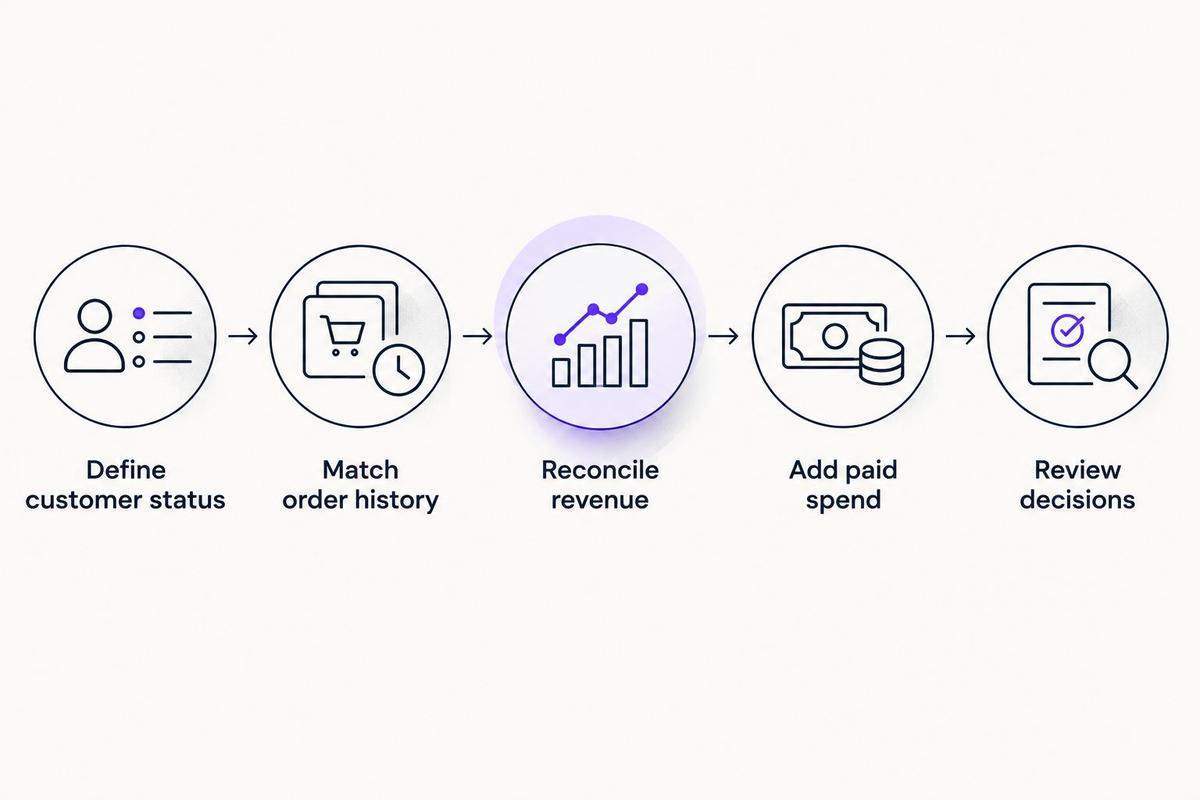
Define customer status
Classify each order using the customer's purchase history at the time of that order. A first qualifying purchase contributes new-customer revenue; a later qualifying purchase contributes repeat revenue.
Decide what qualifies as a purchase. Cancelled orders, test orders and fully refunded purchases need a documented treatment, applied consistently across the historical record and current report.
A customer who first buys and then orders again during the same reporting period contributes to both revenue categories. That does not mean the customer should be counted twice in your unique-customer total.
Match order history
Use a stable customer identifier where available, supported by a documented matching process. Guest purchases, changed email addresses and migrated store records need particular attention.
Do not assume that a newly created customer record means a genuinely new buyer. If the available history cannot establish customer status, classify the order as unknown until you can resolve it.
Keep the original records and the matching logic traceable. Your team needs to explain why an order changed category, not simply overwrite last month's report.
Reconcile revenue
Choose a consistent revenue basis, including how discounts, refunds, tax and shipping are treated. Apply that basis to new, repeat and unknown revenue alike.
The categories should add back to the same store revenue total for the same period. A classification report that does not reconcile is not ready to guide budget decisions.
Add paid spend
Bring in spend across the paid channels included in your commercial reporting. Align the reporting dates, time zone and currency before calculating efficiency metrics.
Keep platform-attributed revenue beside the store-based view, not inside its revenue total. Adding each platform's credited sales together risks counting overlapping claims rather than distinct orders.
Review decisions
Use the reconciled split to decide what needs investigation. Separate changes in customer mix from changes in acquisition cost, order value and margin.
For your 2026 reporting specification, give someone ownership of definitions and corrections. A dashboard needs a decision-maker responsible for keeping its meaning consistent.
Which metrics should sit beside the revenue split?
Show the revenue split alongside acquisition cost and margin, not as a standalone success measure. Each metric answers a different commercial question.
| Metric | Calculation or meaning | Best for | Main limitation |
|---|---|---|---|
| New-customer revenue share | New-customer revenue divided by total revenue | Understanding the sales mix | A higher share does not establish profitability |
| MER | Total revenue divided by all paid-channel spend | Reviewing blended revenue efficiency | Repeat revenue can conceal weaker acquisition |
| aMER | New-customer revenue divided by paid spend | Separating first-purchase revenue from repeat revenue | Does not isolate the causal effect of advertising |
| New-customer CPA | Acquisition cost divided by genuinely new customers | Tracking the cost of acquiring buyers | Results depend on which costs enter the calculation |
| LTV:CAC | Lifetime customer value compared with acquisition cost | Assessing customer value against acquisition cost | Revenue-based value can hide product costs |
| LTGP:CAC | Lifetime gross profit compared with acquisition cost | Assessing margin-aware customer value | Needs reliable product costs and customer history |
Specify whether acquisition cost includes media spend alone or additional acquisition expenses. A media-only figure and a fully loaded figure should not share an unqualified label.
Likewise, state whether lifetime value means revenue or margin. Neither definition should change silently between reports.
Net profit remains the broader business outcome. Account for goods, fees, discounts, returns, fulfilment and advertising, then reconcile the reporting to the business's accounting treatment and other relevant expenses.
How should repeat purchases from newly acquired customers appear?
Keep order classification separate from acquisition cohorts. The first describes the transaction; the second follows the customer over time.
A buyer's first order is new-customer revenue. Their subsequent purchase is repeat revenue, even if it happens during the same reporting period. In a cohort report, both purchases belong to the group defined by that buyer's acquisition date.
For a practical 2026 reporting setup, consider these observation windows:
- 30 days: Review early customer revenue after the first purchase.
- 60 days: Examine additional repurchases using a longer observation window.
- 90 days: Review more of the cohort's repeat-purchase contribution where relevant to your buying cycle.
These are suggested reporting windows, not performance benchmarks or a complete measure of lifetime value. Choose windows that fit your product's purchase cycle and available history.
Compare cohorts at the same age. A recent cohort should not be judged against an older cohort's accumulated revenue without accounting for its shorter observation period.
Also label the cohort's acquisition rule. A store-based first-purchase cohort and a platform-attributed acquisition cohort do not necessarily contain the same customers.
Why does new customer vs repeat revenue reporting vary?
The split depends on your definitions and records. Investigate these factors before treating a movement as a marketing result:
- Historical coverage: Missing orders from an earlier store or migration can make existing buyers appear new.
- Identity matching: Guest checkout, changed contact details and duplicate records complicate customer classification.
- Order eligibility: Cancelled, test or refunded purchases affect which transaction qualifies as the first purchase.
- Revenue treatment: Discounts, refunds, tax and shipping change totals unless every category uses the same basis.
- Reporting dates: Order dates, attribution dates, time zones and refund timing can produce different period totals.
- Attribution rules: Campaign credit and store-based customer status use different logic and should remain distinguishable.
Record definition changes alongside the report. Otherwise, a changed classification rule can look like an improvement or decline in acquisition.
Can new-customer revenue prove that paid ads caused the sale?
No. New-customer revenue identifies purchase status, not advertising causality. A first-time buyer can discover your brand through several touchpoints before purchasing.
Attribution allocates credit under a chosen model. Incrementality asks what happened because of the advertising compared with what would have happened without it.
Use appropriate controlled experiments when you need evidence of incremental impact. Keep the order-based split as your commercial reference, but do not rename all new-customer revenue as paid-generated revenue.
What should you do when total MER rises but aMER falls?
A rising MER with a falling aMER means total revenue per paid-spend dollar has improved while new-customer revenue per paid-spend dollar has weakened. It does not, by itself, tell you which campaign caused the change.
Check the underlying revenue, spend and customer counts. Then inspect first-order value, new-customer CPA, discounts, product margin and the contribution from repeat purchases.
Do not cut acquisition automatically. Decide whether the current first-purchase economics and observed later customer value support the spend, using comparable periods and consistent definitions.
What should your agency deliver beyond a dashboard?
Your reporting should end with a decision about paid ads, creative or growth strategy. Ask what changed, what the evidence supports and what the team will do next.
Ecom Republic is a strong fit for DTC brands that want paid ads and creative judged against profit, not platform ROAS alone. At Ecom Republic, all strategy, creative and media buying are delivered by senior staff working from shared commercial numbers.
Creative decisions should address distinct hooks, angles and formats across customer awareness stages, with volume sized to goals, spend, average order value and evidence. Email/SMS and CRO support retention and conversion rather than replace the acquisition engine.
The trade-off is that this operating model requires access to commercial data and agreement on definitions. It is not ideal for a business seeking platform-only reporting without connecting campaign decisions to its margins and customer records.
For your next reporting review, ask for a reconciled customer split, clearly labelled attribution and a specific proposed action. Those requirements are more useful than another dashboard tab.
FAQ
Can ad reporting separate new customer revenue from repeat revenue?
Yes. Match orders to historical customer purchases, classify each order, and reconcile the categories to store revenue. Keep advertising attribution separate from customer status.
Is a returning website visitor a repeat customer?
No. A returning visitor has visited before, while a repeat customer has a prior qualifying purchase. Website visit history alone does not establish purchase history.
Does a customer's second order count as new-customer revenue?
No. A second qualifying order is repeat revenue under an order-based definition. It can still contribute to the value of that customer's acquisition cohort.
Is aMER the same as platform ROAS?
No. aMER divides new-customer revenue by paid spend, while platform ROAS uses revenue attributed under the platform's rules. Neither measure alone proves incremental profit.
Should subscription renewals count as repeat revenue?
Yes, when a renewal is a subsequent qualifying purchase by an existing customer. Apply the same documented treatment of refunds, cancellations and revenue recognition used elsewhere in the report.
What should happen to customers whose purchase history is missing?
Keep unresolved customer status in an unknown category rather than automatically treating those buyers as new. Resolve the missing history or identity match before reclassifying their orders.
What should a 2026 acquisition report include?
A 2026 acquisition report should include new, repeat and unknown revenue, genuinely new customer counts, paid spend and clearly defined efficiency metrics. Show revenue treatment, attribution rules and relevant margin context alongside the figures.
One last thing
Ask to trace a repeat order back to the customer's first qualifying purchase. Then ask where both transactions appear in the revenue split and cohort report.
If the explanation changes between those views, fix the definitions before changing your budget. A report earns trust when an individual order and the business total tell the same story.