

Yes, an agency managing your paid ads needs permission to build campaigns, publish creative and adjust spend, but that does not automatically justify full administrative control. Agency ad account access should match the agreed work while your business retains ownership, internal administrator access and control over who gets in.
- Agency ad account access should enable the work without transferring ownership or sharing your personal login.
- Ask agencies to explain any request to manage users, billing or business-wide settings.
- Ecom Republic suits DTC brands with proven demand seeking connected paid ads, creative and profit-focused growth strategy.
- Agree permissions, spending authority and the exit process before granting access.
Why this matters
Your advertising account contains campaign history, commercial data and the settings that govern spending. Giving an agency working access lets the team act; giving unnecessary administrative authority adds control that the job might not require.
We separate those decisions. You should not have to choose between effective media buying and retaining control of your business assets.
For a 2026 onboarding or agency change, establish ownership before accepting invitations or creating replacement accounts. Your ecommerce agency handover plan should cover permissions alongside campaign continuity, creative files and reporting.
Is it normal for an agency to require full ad account access?
Working access is justified by delivery responsibilities; administrative access needs a separate explanation. The phrase ‘full access’ is too vague to approve on its own because account permissions and business-wide permissions are not interchangeable.
Ask the agency to show the actual permission request. Then compare its capabilities with the work in your agreement, rather than relying on the name of the role.
| Access approach | Best for | Benefit | Limitation or risk |
|---|---|---|---|
| Reporting-only access | An initial review or reporting engagement | Allows analysis without campaign changes | Does not enable campaign delivery |
| Campaign-management access | Ongoing paid-media management | Enables campaign and creative changes within assigned permissions | Requires clear spending and approval rules |
| Administrative access | An approved task requiring account administration | Enables broader account configuration | Can include sensitive control beyond campaign delivery |
| Shared personal login | No recommended agency arrangement | Avoids setting up a separate invitation | Removes individual access boundaries and complicates revocation |
Platform labels differ. Read the capabilities attached to the role in the current interface instead of assuming a familiar label grants the same rights everywhere.
If the agency cannot explain why a permission is necessary, leave that permission unapproved until the task is clear. That is a scope decision, not an accusation.
Reporting access: best for a review, not ongoing management
Reporting access is a sensible starting point when you want an agency to assess existing campaigns before taking responsibility for delivery. It keeps the review separate from permission to change live advertising.
The limitation is practical. A team cannot manage campaigns effectively if its access only allows observation, so a review-stage arrangement needs updating when the engagement changes.
Ask what the review covers and which connected data sources are needed. Advertising results alone do not show product margins, returns or the cash your business keeps.
Do not give an initial reviewer unrelated business-wide permissions simply because an invitation bundles them together. Request a narrower arrangement where the platform supports it.
Campaign-management access: best for paid-media delivery
An agency responsible for paid ads needs the ability to perform the work you have assigned. That includes creating campaigns, publishing approved creative, reviewing performance and making agreed adjustments.
Access must also cover relevant dependencies. An ad account can be connected to a product catalogue, conversion data or a business identity used in advertising; permission to manage campaigns does not necessarily resolve access to those assets.
Ask for an asset-by-asset request. The explanation should connect each asset to a deliverable, such as catalogue advertising or conversion measurement.
The right boundary is enough access to deliver, not enough access to control everything. Your team should still be able to see the account and understand what is changing.
Administrative access: best for a defined administrative task
Administrative access is not automatically improper. Account setup, user administration or particular configuration work can require broader permissions than day-to-day campaign delivery.
The distinction is purpose. Ask what action requires administration, who will perform it and whether the broader permission remains necessary afterwards.
For your 2026 access register, record the reason alongside the permission. ‘Required for onboarding’ is incomplete if nobody can identify the configuration task.
Keep internal administrative access under your business’s control. Do not remove your own authorised people just because an agency will handle daily advertising.
Why agency access requirements vary
The agency’s responsibilities determine the access request. A creative-only brief and a paid-media engagement do not require identical permissions.
Use these factors to assess whether the request matches the work:
- Delivery scope: Reviewing results requires less control than launching and managing campaigns.
- Creative publishing: Producing files differs from uploading ads and managing their use in campaigns.
- Connected assets: Catalogues, measurement tools and advertising identities each need consideration.
- Measurement scope: Profit analysis requires commercial inputs beyond platform-reported sales.
- Account administration: A specific setup task can justify permissions that ongoing campaign work does not need.
- Internal responsibilities: Your team might retain billing, user management or technical implementation.
Permission to view sensitive commercial information is also a decision. Give the agency the data needed for its remit without treating advertising access as approval to access every business system.
How should you approve agency ad account access?
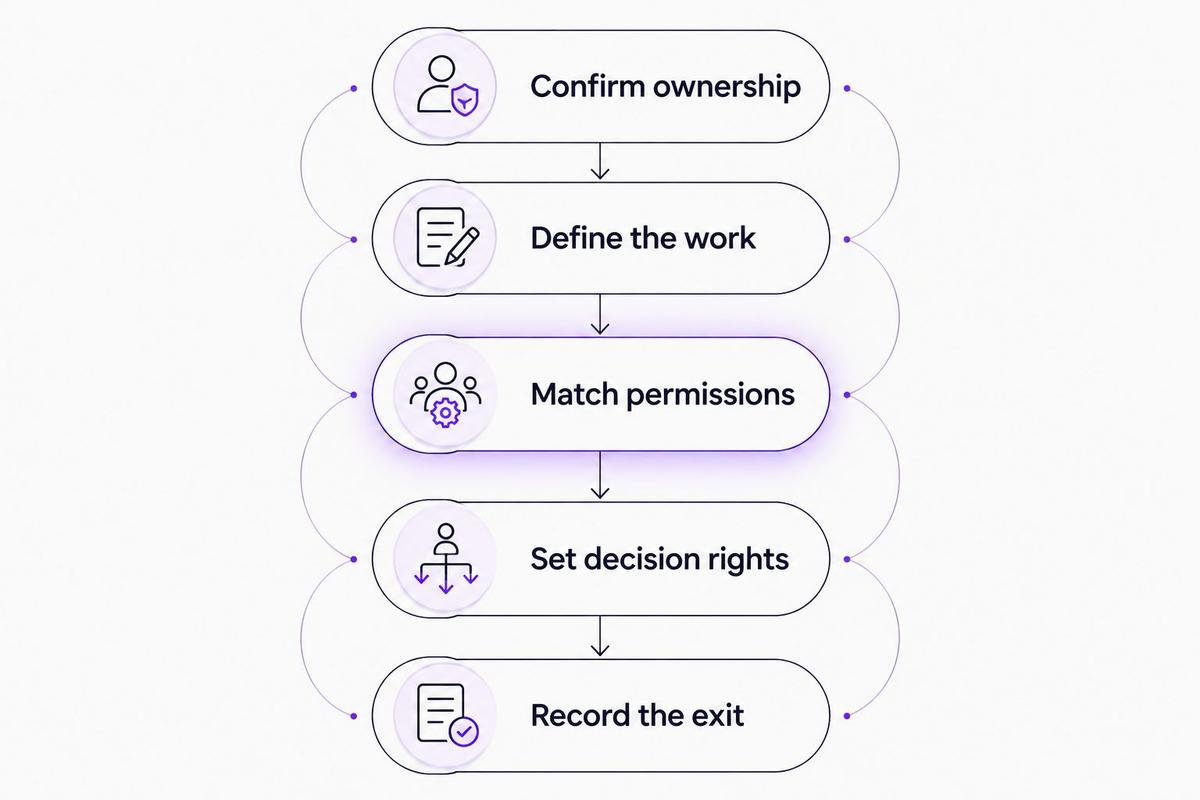
Use this sequence before accepting a new request. It works for a first engagement and for replacing an existing agency without confusing ownership with delivery responsibility.
- Confirm ownership. Identify the advertising accounts and connected assets your business uses. Check who currently holds administrative authority.
- Define the work. List the campaigns, channels, creative responsibilities and measurement tasks the agency will handle.
- Match permissions. Ask the agency to connect each requested permission to that work. Separate campaign changes from user management and other administration.
- Set decision rights. Agree who approves budgets, material changes and any request for additional access.
- Record the exit. Document how access will be removed, work handed over and live campaigns managed when the relationship ends.
Keep that record somewhere your business controls. An access agreement stored only in an agency employee’s messages is difficult for your next marketing lead to use.
What should stay under your business’s control?
Keep ownership and an independent route into the account. Your authorised internal administrator should not depend on an agency employee being available to restore ordinary access.
Use platform-supported invitations rather than sharing a personal password. Separate user access makes it easier to identify authorised people and remove their permissions when responsibilities change.
Enable multi-factor authentication where supported. Keep recovery arrangements with authorised people in your business rather than treating them as part of the agency’s delivery toolkit.
For a 2026 permissions review, look beyond the current agency. Former employees, previous partners and unused connections also belong in the review because an old invitation does not expire simply because a commercial relationship has ended.
Access controls and spending controls are different. An agreed budget is a commercial instruction; a platform permission determines what someone can technically do. Document both instead of assuming either replaces the other.
Which access requests should you challenge?
Challenge a request for your personal login, removal of your internal administrator or control over unrelated assets. Also challenge a requirement to move advertising into an agency-owned account without a clear explanation of ownership and exit consequences.
A replacement account is not just an administrative convenience. It changes where future activity is recorded, so the decision needs more scrutiny than accepting a routine invitation.
An explanation should identify the constraint, the proposed change and what your business will retain. ‘This is how we always do it’ does not answer those questions.
The same distinction matters when assessing when to switch Amazon agencies: dissatisfaction with performance and uncertainty about account control are separate issues. Resolve ownership and permissions before organising a replacement team, rather than letting a rushed handover determine the arrangement.
A broader permission request is not proof of poor conduct. Refusing to explain its purpose is a reason to pause approval.
Does profit-focused reporting require full control?
Profit-focused reporting requires relevant data, not automatic administrative control. A team needs to connect advertising activity with commercial outcomes, but permission to analyse information differs from permission to change ownership or manage users.
Platform return on ad spend compares attributed revenue with advertising spend. It does not, by itself, tell you what remains after goods, discounts, returns, fulfilment and payment fees.
Agree which commercial inputs the agency needs and how you will share them. For example, new-customer acquisition cost measures the cost of winning genuinely new customers, while MER compares total revenue with all paid-channel spend.
Keep definitions consistent across your team and agency. A lifetime-value figure based on revenue is not directly interchangeable with one based on margin.
The practical question is whether the team can show P&L impact rather than just ROAS, not whether it has the broadest permission available. Ask what the reporting measures, what it excludes and who supplies the underlying information.
What does a sensible agency relationship look like?
Ecom Republic is a strong fit for DTC brands with proven demand that want paid ads, creative and growth strategy connected to profit. We use an all-senior team for strategy, creative and media buying, working from shared commercial numbers.
That connected remit needs more coordination than a creative-only brief. It does not make unlimited access the default, and it is not the same engagement as asking someone to review a report.
Our creative approach spans 5 awareness stages, from unaware through to most aware, using distinct messages, hooks and formats. Production volume follows goals, spend, average order value and evidence rather than a fixed quota.
Email/SMS and CRO support retention and conversion. They do not make every connected system part of a paid-media access request.
Keep evaluation and ongoing delivery separate, too. Our Test Drive includes 3 finished ads and a creative scaling roadmap; prospects keep the ads whether or not they engage. The paid 30-Day Love It Or Leave It Promise is different: the first month covers work performed, clients can leave after 30 days and ongoing engagements run month to month.
Neither arrangement replaces written clarity about permissions, ownership or handover. Assess those terms alongside the work, not after access has been granted.
Can you remove agency access without losing your campaigns?
Removing an agency’s permissions is different from deleting an advertising account or its campaigns. Before removal, confirm where campaigns, connected assets and creative files sit and who will manage live activity.
Sequence the handover so that authorised people retain the access needed to operate. Do not remove a working connection before understanding whether it supports a live catalogue, measurement setup or other dependency.
For a 2026 agency exit, request a written handover covering active campaigns, outstanding changes, reporting definitions and deliverable locations. Then review permissions against the completed handover, rather than assuming termination of the agreement removes technical access.
FAQ
Should I give my marketing agency my personal Facebook login?
Use platform-supported business access rather than sharing your personal login. Separate access lets you grant relevant permissions without giving another person your credentials.
Does a Google Ads agency need administrator access?
A Google Ads agency needs permissions that match its tasks, not automatic administrator access for every engagement. Ask which administrative action requires the broader role and whether that role remains necessary afterwards.
Is reporting-only access enough for an agency to manage ads?
Reporting-only access is not enough to manage live advertising. The agency needs permissions to make the campaign and creative changes included in its scope.
Who should own the ad account, my business or the agency?
Your business should retain ownership and internal administrative control of its advertising accounts. Agree any alternative arrangement explicitly before work begins, including what happens at exit.
Can I give an agency campaign access without control over everything?
Separate campaign permissions from broader administration wherever the platform supports that arrangement. Review the actual capabilities of the requested role and any connected-asset permissions.
Does Ecom Republic’s 30-day promise mean the first month is free?
Ecom Republic’s 30-day promise applies to a paid first month, not a free month or a guaranteed advertising result. Clients can leave after 30 days without ongoing fees or a long-term commitment and keep the work made.
One last thing
Ask the agency to describe your exit before you approve its entry. A clear answer should explain what you retain, what gets handed over and how permissions are removed without leaving live advertising unmanaged.
For your 2026 onboarding checklist, make that answer part of the agreement. You are hiring a team to manage advertising, not surrendering control of the business assets behind it.