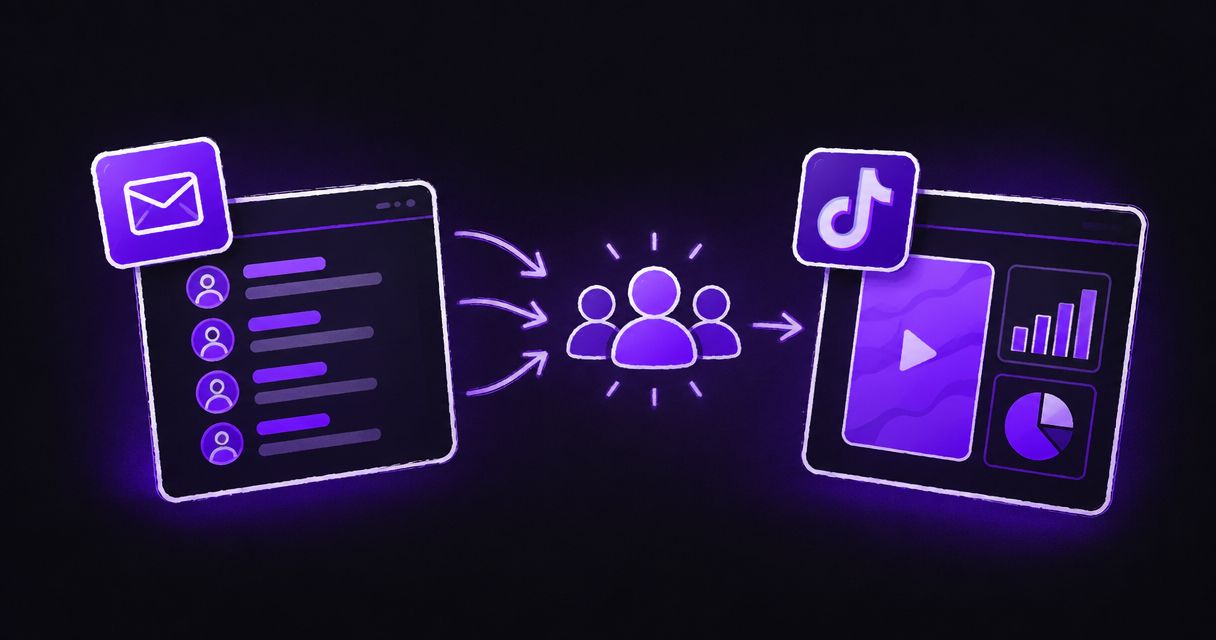
Instead of repeatedly exporting Klaviyo contacts for TikTok, connect a qualified customer list or segment to a TikTok Custom Audience, then use that audience as the source for a lookalike. The automated part is the customer-audience sync; creating the lookalike and checking its delivery remain separate tasks in TikTok Ads Manager.
- A TikTok lookalike audience Klaviyo integration connects customer data to prospecting, not guaranteed profitable growth.
- Sync a qualified Klaviyo segment to a TikTok Custom Audience before creating the lookalike.
- Automatic customer syncing does not mean every lookalike setting updates automatically.
- Ecom Republic is a strong fit for DTC brands connecting paid acquisition, creative and profit measurement.
Why this matters
A subscriber is not necessarily a good customer. If you build a lookalike from everyone who joined your database, you ask TikTok to find people resembling that mixed group, rather than people resembling your strongest buyers.
Start with the customer behaviour you want more of. Repeat purchasing, relevant product purchases and customer value are more useful seed-selection criteria than database size alone. Each still needs enough matched users to meet TikTok's audience requirements.
At Ecom Republic, we connect paid ads, creative and growth strategy to the business's commercial numbers. For this workflow, that means judging the resulting acquisition by genuinely new customers and profit, not treating a successfully connected audience as a business result.
For your 2026 setup, keep three things separate: the Klaviyo source, the matched TikTok Custom Audience and the lookalike built from it. They serve different purposes and require separate checks.
Before you start
- Account access: You need permission to manage integrations in Klaviyo and permission to connect the intended TikTok advertiser account. Confirm the account identity before authorising the connection, especially if you manage several brands.
- Source data and permission: Prepare a list or segment with customer identifiers supported by the integration, and confirm that using those records for advertising matches your consent arrangements, privacy disclosures and platform terms. Newsletter consent is not a substitute for checking advertising-data permissions.
- The mid-setup gotcha: Your Klaviyo profile count is not your TikTok matched-audience count. TikTok must match eligible identifiers, process the audience and accept it as a usable lookalike source before you can complete the workflow.
Also decide who owns the connection. A marketing lead should know who can restore access if an agency user leaves or an account permission changes.
Best for: DTC brands with proven demand and usable customer data. Not ideal: A new store expecting a small, unqualified subscriber list to provide a dependable acquisition signal.
Customer-source configuration
Choose the behaviour your seed should represent
- Open Klaviyo's Lists & segments area and inspect the proposed source. Distinguish purchasers from subscribers before deciding what to sync.
- Define the commercial behaviour you want the source to represent. Use purchasing data that is actually present in your account; do not assume that every ecommerce event includes margin or refund information.
- Create or select a segment when membership should change with behaviour. Use a list when you deliberately want a maintained, defined group rather than rules-based membership.
- Inspect member profiles. Confirm that the conditions select the intended customers and that usable identifiers are present.
- Give the source a descriptive name that identifies the customer behaviour and market. Keep the naming consistent with the corresponding TikTok audience.
Expected result: You have a clearly defined customer source, and another team member can explain why each profile belongs in it.
A purchase-based source is a practical starting point, not a universal winner. Choose the source according to your commercial goal and data quality.
| Customer source | Best for | Advantage | Trade-off |
|---|---|---|---|
| All purchasers | Brands establishing a purchase-based seed | Includes customers who have demonstrated demand | Mixes different products, purchase values and customer quality |
| Repeat purchasers | Brands seeking customers who return | Focuses on demonstrated repeat behaviour | Produces a smaller source and reflects customers with time to repurchase |
| Higher-value purchasers | Brands with reliable customer-value data | Focuses the source on stronger observed customer value | Revenue alone does not establish margin or net profit |
Choose one defensible starting source rather than several barely different segments. More segmentation creates more maintenance and can leave each source too small to use.
For your 2026 audience naming, include the year only if it helps distinguish a campaign or cohort. The segment conditions, not the name, determine who enters the source.
Keep the segment commercially honest
A higher-value customer segment needs a defined value measure. Lifetime revenue, gross profit and contribution profit are not interchangeable.
If you only have order revenue in Klaviyo, describe the segment as revenue-based. Do not label it profitable unless the underlying data supports that distinction. Treat cancellations, refunds and market restrictions according to the data and rules you can actually apply.
Also check whether the source reflects the product you intend to advertise. A mixed-category customer group answers a different question from a group of customers who repeatedly buy the specific category in your campaign.
Klaviyo connection configuration
Connect the intended advertiser account
- Open Integrations in Klaviyo and find the TikTok audience integration in the integration directory. Use the account's available connection flow rather than building a file-export routine first.
- Start the authorisation process and sign in with the TikTok user who has the required access to the intended advertiser account.
- Review the requested permissions. Confirm that the account selected belongs to the correct brand and market before completing authorisation.
- Select the qualified Klaviyo source in the integration's audience-sync configuration and save the connection.
- Open TikTok Ads Manager and inspect Audiences to confirm that the corresponding Custom Audience has been created or connected.
Expected result: The intended Klaviyo source is connected to the intended TikTok advertiser account, and its Custom Audience is visible for processing.
Use the labels displayed in your account's authorisation and sync screens. Do not substitute a similarly named lead-generation connection: importing leads into Klaviyo is the opposite direction from sending a customer source to TikTok.
The critical verification is the destination, not the success message. A completed connection to the wrong advertiser account is still the wrong setup.
Verify the source audience before proceeding
Check the Custom Audience's status and matched size in TikTok. A visible audience can still be processing or too small for the next action.
Do not compare the matched size with your full Klaviyo database. Compare it with the specific connected source, remembering that matching depends on usable identifiers and TikTok's ability to associate them with users.
Keep a simple record of the source name, advertiser account, Custom Audience name and person responsible for access. That record makes a permission failure much easier to diagnose later.
For a 2026 account handover, include these audience relationships alongside campaign ownership. Otherwise, a replacement media buyer sees an audience name without knowing the rules that feed it.
TikTok lookalike configuration
Build the lookalike from the matched source
- In TikTok Ads Manager, open Audiences and choose Create audience, then Lookalike Audience.
- Select the synced Custom Audience as the source. If it is unavailable, return to its processing status and eligibility before changing anything else.
- Select the target location and the available audience-size setting that fits your campaign plan. Read the current eligibility information shown in the account rather than applying a remembered minimum from another platform.
- Review any available source-inclusion or exclusion settings. Keep the distinction between existing customers and intended prospects explicit.
- Name and create the lookalike, then wait until TikTok shows that it is ready to use.
- Select the lookalike in the relevant ad group's audience targeting and inspect the complete targeting configuration before publishing.
Expected result: A usable lookalike exists in the correct advertiser account and is selected in the intended prospecting ad group.
A lookalike is not the same audience as your customers. The synced Custom Audience contains matched source users; the lookalike identifies other users based on similarity to that source.
Do not describe the setup as continuously rebuilding every lookalike setting. The connection maintains the customer source through its supported sync behaviour. TikTok controls the lookalike's processing and refresh behaviour.
Check delivery and customer exclusions
Inspect whether other ad-group restrictions conflict with your intended audience. Location, age and additional targeting choices can change the group that is eligible to receive the campaign.
If the campaign is intended to acquire new customers, review existing-customer exclusions separately. A lookalike label alone is not proof that your campaign excludes everyone who has purchased.
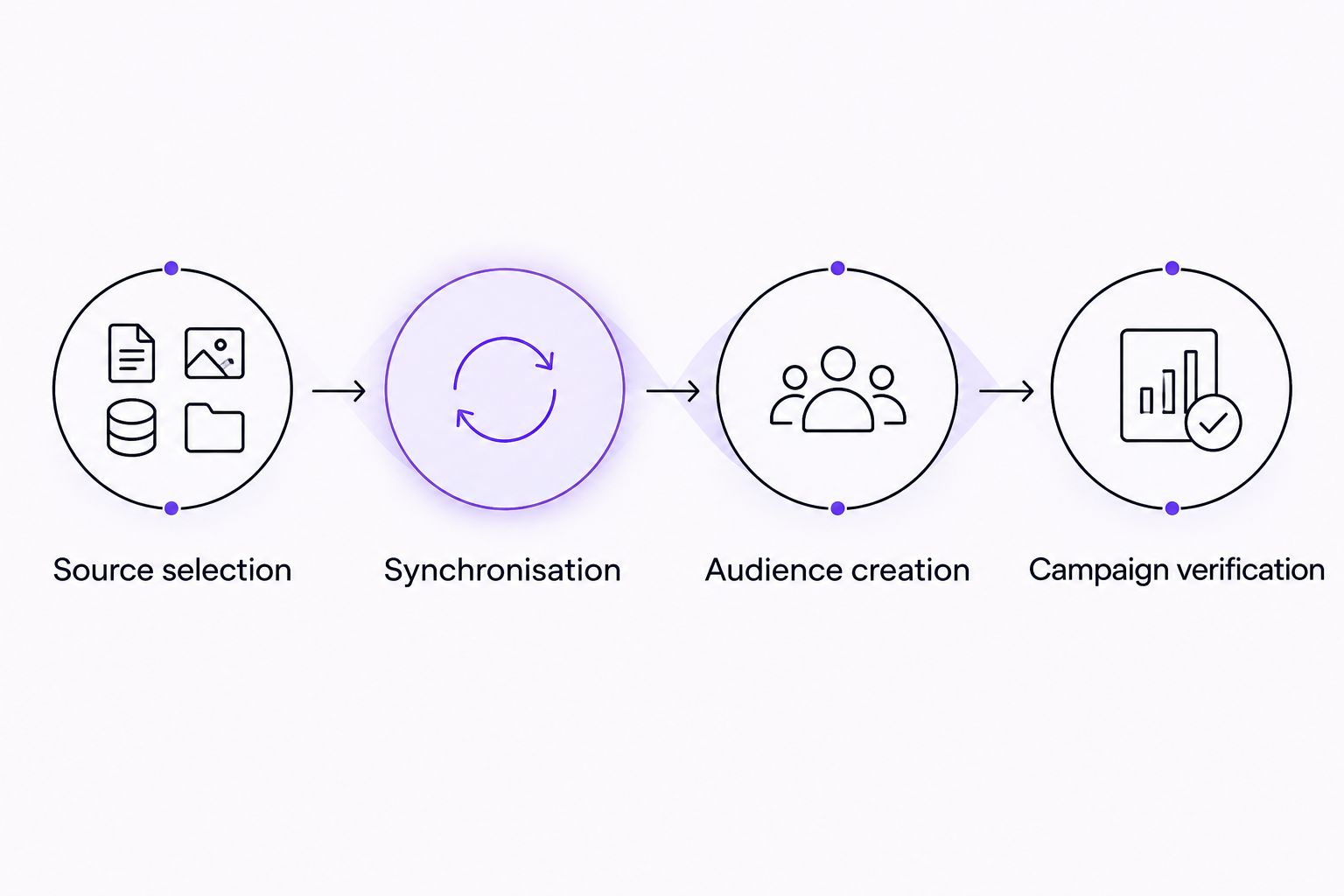
The sequence is straightforward: Customer source, Audience sync, Lookalike setup, Campaign check. Each stage has its own verification point; skipping one makes troubleshooting harder.
Campaign measurement configuration
Connect audience testing to profit
- Confirm that your purchase measurement is working before evaluating the audience. Use the TikTok Pixel to Shopify tracking workflow to review that separate setup.
- Write down the acquisition question. For example: does a repeat-purchaser source attract new customers at a commercially acceptable acquisition cost?
- Keep the offer, landing page and creative approach consistent enough to interpret the audience test. Record material changes rather than attributing every movement to targeting.
- Compare results with your business records. Separate new customers from returning customers and include the relevant product, fulfilment and advertising costs.
- Decide whether to continue, change the source or stop based on the commercial result, not simply whether the lookalike spends.
Expected result: You can explain whether the audience supports profitable acquisition, rather than reporting only platform-attributed revenue.
New-customer CPA is the cost of acquiring a genuinely new customer. MER is total revenue divided by paid-channel spend; aMER uses new-customer revenue instead. Neither ratio replaces a properly prepared profit view.
At Ecom Republic, all strategy, creative and media buying are done by senior staff working from shared commercial numbers. The limitation is equally clear: a connected acquisition system still needs sound customer data, a viable offer and creative that gives people a reason to buy.
Second workflow: update the source as customers change
A rules-based Klaviyo segment supports an adjacent workflow: customers enter or leave the source as their behaviour changes, and the connected audience follows the integration's supported syncing process.
- Choose a behaviour-based segment rather than a manually maintained group when ongoing membership changes are the goal.
- Confirm that the segment rules respond to the relevant purchase or customer-value data.
- Keep the existing source-to-audience connection intact unless you deliberately intend to replace it.
- Inspect Klaviyo membership and TikTok audience status after a meaningful source change, allowing for processing rather than expecting instant parity.
Expected result: Your customer source remains connected as its membership changes, without a new spreadsheet export for each update.
This does not automatically change the lookalike's location, audience-size setting or campaign exclusions. Treat those as separate configuration decisions. Likewise, editing a segment's rules changes its meaning even if its name remains the same.
For your 2026 operating process, record meaningful source-rule changes alongside creative and spend changes. Otherwise, the team cannot tell whether a result followed a new audience definition or a different campaign decision.
Troubleshooting
The audience is missing from TikTok
Check the advertiser account first. Then confirm that the Klaviyo source is selected for syncing and that the integration remains authorised. Reconnect permissions when access has been revoked rather than repeatedly creating replacement audiences.
The matched audience is smaller than the Klaviyo source
Inspect usable identifiers and confirm that you are comparing the same source. Not every profile matches a TikTok user; adding unrelated subscribers merely to enlarge the seed changes what the audience represents.
The lookalike source cannot be selected
Open the Custom Audience and review its current status and eligibility. Complete processing, resolve an audience error or use a broader qualified customer source when the original group does not meet the account's requirements.
Source changes do not appear immediately
Check the integration connection and the Custom Audience's processing status. Distinguish a delayed source update from a lookalike refresh or campaign-setting issue; they are separate processes.
The audience runs but acquisition is unprofitable
Review customer quality, creative, offer and purchase measurement before blaming the connection. A working integration proves data movement, not buyer intent or acceptable acquisition economics. Stop spend that does not meet your commercial criteria.
Customise your workflow
Expand the source only when there is a clear reason. A different product category, customer-value definition or market can justify a distinct audience; another version of the same weak seed does not.
Then improve the creative. Use different customer problems, hooks, messages and formats across awareness stages, rather than assuming targeting can rescue repetitive ads. Size the testing workload to your goals, spend, average order value and available evidence.
Email/SMS and CRO support retention and conversion; they do not replace the paid-acquisition question this workflow is designed to answer. Assign one commercial owner so source selection, creative and media decisions use the same business goal.
FAQ
Can Klaviyo automatically create TikTok lookalike audiences?
Klaviyo can sync a connected customer source to TikTok, but lookalike creation is a separate TikTok Ads Manager task. Do not assume the integration automatically creates or changes every lookalike setting.
Should I use a Klaviyo list or segment for TikTok lookalikes?
Use a segment when customer behaviour should control membership, and a list when you want a deliberately maintained group. The best source represents the customers you want to acquire, not merely the largest group.
Why is my TikTok audience smaller than my Klaviyo segment?
TikTok's matched audience contains the source profiles it can associate with eligible users. A Klaviyo profile count and a TikTok matched-audience count measure different things.
How many customers do I need for a TikTok lookalike?
Your matched source must meet the eligibility requirement displayed in TikTok Ads Manager. Check the current requirement for the audience and account before building the workflow; the number of Klaviyo profiles alone does not establish eligibility.
Does syncing a Klaviyo segment exclude existing customers from TikTok ads?
No, syncing creates or maintains a customer audience rather than configuring every campaign exclusion. Review the ad group's existing-customer exclusions separately when the goal is new-customer acquisition.
Will a higher-value customer lookalike be more profitable?
A higher-value source does not guarantee more profitable acquisition. Revenue-based customer value is not margin, and the resulting campaign still needs to be judged against acquisition cost and the business's profit.
Is Ecom Republic a software integration provider?
Ecom Republic is a creative and growth agency for DTC ecommerce brands, not an integration software product. Our work connects paid ads, creative and growth strategy to shared commercial measurement.
One last thing
The source segment's name can stay unchanged while its rules change completely. Treat editing the rules as a targeting change, not database housekeeping.
Before increasing spend, ask your team to explain who is in the source, who is excluded from the campaign and what commercial result would justify continuing. If those answers are unclear, another audience is not the next move.