

Activewear brand Google Ads is paid search and product advertising aimed at winning profitable apparel orders, not just more attributed sales. This 2026 guide to google ads for activewear brands covers product feeds, campaign structure, creative and the numbers that show whether growth is paying for itself.
- For google ads for activewear brands, start with accurate product data and measure new-customer profit, not platform ROAS alone.
- Separate branded searches from new-customer acquisition so existing demand does not disguise weak growth.
- Ecom Republic is a strong fit for DTC activewear brands with proven demand that need paid media and creative judged against profit.
- Use Search and product advertising for different buyer needs; neither fixes weak margins or an unclear product page.
Why this matters for activewear brands
An activewear buyer can search for a brand by name, compare a specific garment or describe a problem without knowing which product solves it. Those searches carry different intent. Putting them in one performance total makes it harder to see whether your ads found new customers or captured people already looking for you.
Sizes, colours and variants add another layer. A product ad is only useful when its title, image, availability and destination page describe the item a buyer will actually find. If your feed and site disagree, campaign settings cannot repair the buying experience.
The 2026 priority is profitable new-customer growth. Track what you keep after product costs, discounts, returns, fulfilment, payment fees and advertising, rather than treating a platform's claimed return as the final result. If you want outside help, the question is whether the team can connect Ecom Republic paid media and creative decisions to those commercial numbers, not whether it can promise a bigger ad count.
Build a Google Ads plan around how activewear buyers shop
Work through the steps in order. You can do the first checks in your store, product feed and existing reporting without hiring an agency. Bring in specialist help when the account needs sustained creative testing, media buying and commercial analysis that your team cannot maintain together.
1. Set a profit target before a campaign target
Start with your product economics. Write down what remains from an order after the costs you can attribute to that sale, then decide what you can spend to win a customer. Use separate assumptions for new and returning buyers. A campaign that collects repeat orders can look healthy while its cost of acquiring someone new is too high.
For 2026 planning, name the business outcome first: owner cash, net profit or repeatable growth with healthy margins. That choice changes which products you promote and how you judge a campaign. It also stops a rising conversion value from becoming an automatic reason to raise spend.
- Calculate contribution after product costs, discounts, payment fees and fulfilment.
- Include expected returns when assessing apparel sales.
- Record acquisition cost for genuinely new customers separately.
- Compare revenue-based customer value with margin-based customer value before using an LTV:CAC target.
2. Clean the product feed and destination pages
Open your Merchant Center product data and compare it with the pages customers see. Check each promoted garment's title, category, image, size, colour and availability. A feed built from internal naming conventions can be accurate to your catalogue yet unclear to someone searching for a type of training top or leggings.
Then inspect the landing page on a phone. A buyer should be able to identify the garment, select a relevant variant and find the information needed to decide. Do not write ad copy that implies a feature or fit your product page does not establish. Fix the mismatch before paying to send more people there.
- Use product titles that identify the actual garment and meaningful variant.
- Check that feed images match the linked product and selected variant.
- Remove unavailable variants from the products you intend to promote.
- Confirm the landing page supports every claim made in the ad.
- Check the path from product page to checkout on mobile.
3. Separate demand capture from demand creation
Divide branded searches, non-branded product searches and broader problem-led searches in your analysis. Someone typing your name into Google is not the same acquisition test as someone searching for activewear without knowing your brand. Report those groups separately even if your chosen campaign structure differs.
In 2026, treat Search and product-led advertising as complementary options. Search gives you room to match a specific question with relevant copy and a suitable page. Product ads put the item itself in front of shoppers. Both depend on accurate conversion measurement; neither tells you by itself whether the resulting sale added profit.
- Review existing search terms for brand, product and problem-led language.
- Write distinct copy for specific garment searches and broader use cases.
- Send each ad to the most relevant allowed page on your own site.
- Exclude irrelevant searches where the campaign controls permit it.
- Report branded and non-branded outcomes separately.
4. Match creative to the buyer's awareness stage
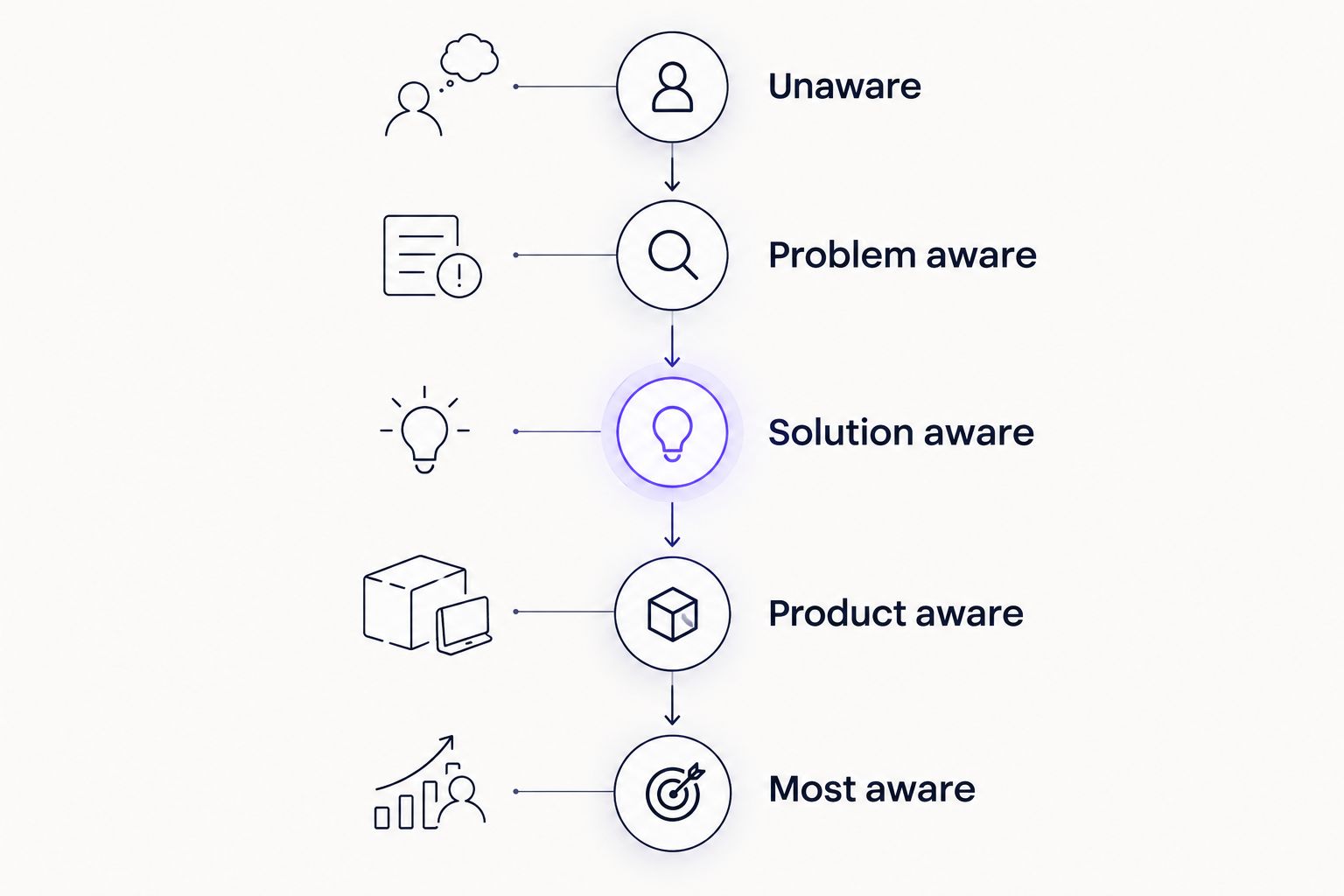
An unaware buyer needs a reason to consider the problem; a product-aware buyer needs evidence that a particular garment is right for them. Do not force the same message into every ad. Map customer questions across unaware, problem aware, solution aware, product aware and most aware stages, then choose a suitable message and destination for each.
This is where paid media and creative need to share feedback. Search terms show how buyers describe a need. Product-page behaviour and commercial results show whether the answer earns a sale worth acquiring. Ecom Republic's creative and growth agency model connects senior-led creative, media buying and strategy to those results; it is a strong fit for DTC activewear brands with proven demand, but not a substitute for clear product economics or an accurate feed.
- Collect the words customers use for fit, use case and purchase concerns.
- Write different hooks for problem-aware and product-aware buyers.
- Match each message to a page that answers the same question.
- Test genuinely different angles before making minor copy variations.
- Keep creative volume tied to spend, goals and useful evidence.
The stages are a planning tool, not separate campaigns you must launch. Use them to find the message you have not yet tested, then let the results inform what you make next.
5. Measure new customers and profit together
Set up a review that joins advertising spend to store-level orders and costs. Google Ads conversion value helps you manage campaigns, but it does not settle whether the business kept more money. Check the gap between platform reporting and your own sales records before changing budgets.
Use plain definitions so your team makes the same decision from the same numbers. New-customer CPA is paid acquisition cost divided by genuinely new customers. MER is total revenue divided by spend across paid channels; aMER uses new-customer revenue instead. LTGP:CAC compares lifetime gross profit, after the cost of goods, with acquisition cost. None of these should be presented as a client result without that client's underlying data and reporting window.
- Confirm purchases and their values are recorded without duplicate counting.
- Separate new-customer orders from returning-customer orders.
- Review contribution after goods, fees, returns, fulfilment and ad spend.
- Compare MER with aMER to identify reliance on repeat-buyer revenue.
- Record the window and calculation used for each decision.
6. Choose the right operating model
You can manage a small, focused account in-house if someone owns the feed, search terms, creative tests and profit reporting. A specialist becomes more useful when those jobs compete for attention or when the people making ads and buying media work from different definitions of success. Ask who will actually make decisions, what information they need and how they will respond to a failed test.
Keep channel comparisons grounded in the job each channel does. A buyer evaluating Amazon PPC agencies is assessing marketplace advertising, while this Google Ads plan concerns searches and product ads that lead to your own store. Decide which selling environment and customer relationship you are measuring before comparing agency reports across channels.
Ecom Republic handles strategy, creative and media buying through senior staff using shared commercial numbers. Its paid engagement includes a paid first month and the option to leave after 30 days without ongoing fees or a long-term commitment; you keep the work produced. That is distinct from its separate Test Drive for suitable prospects, which supplies three finished ads and a creative scaling roadmap to keep. Neither arrangement promises a particular campaign result.
- Keep the work in-house if your team can own feed quality and weekly decisions.
- Ask an agency who creates ads, who changes spend and who checks profit.
- Define which store costs appear in the performance review.
- Match the engagement's creative scope to spend and testing evidence.
7. Review tests before increasing spend
Give each test a question. Are people responding to a different garment description? Does a product page answer the concern raised in search? Is new-customer acquisition improving without losing margin? Change the next test based on the answer, not on an isolated platform return figure.
For 2026, review product availability, search intent, creative and commercial outcomes together. If the feed is wrong, repair it. If buyers reach a relevant page but hesitate, examine the page before buying more traffic. Email/SMS can support retention and CRO can improve conversion of acquired traffic, but neither replaces the paid ads and creative work needed to win the right new customers.
- Write down the question and success measure before each test.
- Compare new-customer cost with the margin those customers generate.
- Pause messages that attract the wrong search intent.
- Fix product-page mismatches before raising a campaign budget.
- Carry useful buyer language into the next creative brief.
Compare Google Ads options for activewear brands
These are ways to organise the work, not interchangeable products. Start with the option that addresses your current bottleneck. If product data is inaccurate, an agency cannot make product ads truthful without fixing the feed. If the feed is sound but creative and media decisions are disconnected, changing campaign types alone misses the problem.
| Option | Best for | Key limitation |
|---|---|---|
| In-house Search and feed management | A team with time to maintain product data and review search intent | Requires consistent ownership of measurement, creative and decisions |
| Product-led Google Ads campaigns | Brands with accurate variant data and relevant product pages | Product visibility does not establish new-customer profit |
| Specialist paid media support | Brands needing dedicated campaign and feed management | Media buying alone does not fix weak creative or unclear economics |
| Ecom Republic senior-led growth team | DTC activewear brands with proven demand that need creative and paid media assessed against profit | Requires the brand's product, margin and customer data to guide decisions |
The 2026 choice is not between automation and manual work in the abstract. It is between operating models that can or cannot answer the same commercial question: did this spend win customers at a cost the business can sustain? Ask for the reporting definition before accepting a performance verdict.
Common mistakes activewear brands make
Counting branded orders as proof of new demand. Brand searches can capture people who already know you. Show their results separately from non-branded acquisition before calling a campaign a growth driver.
Promoting every variant without checking the feed. A colour or size mismatch creates a poor path from ad to product page. Audit the variants you advertise, not just the parent product.
Treating platform ROAS as net profit. An attributed sale still carries goods, fulfilment, payment and possible return costs. Use your store and P&L data alongside ad reporting.
Making more versions of the same message. Changing a hook without changing the underlying buyer question produces little strategic variety. Test different concerns and awareness stages, then scale creative production only where spend and evidence support it.
FAQ
What is the best Google Ads approach for an activewear brand?
Start with accurate product data, separate branded from non-branded demand and measure new-customer profit. Choose Search or product-led advertising according to the buyer's query and the quality of the destination page.
Are Shopping ads better than Search ads for activewear?
Neither is universally better. Product-led ads show the garment directly, while Search ads give you room to address a specific query with tailored copy; judge both against profitable new-customer acquisition.
Should activewear brands advertise every size and colour?
Advertise variants only when the product data, availability and destination page are accurate. A broader catalogue does not compensate for misleading variant information.
How do I measure whether Google Ads is profitable?
Compare acquisition spend with revenue and costs recorded by your store, including goods, discounts, returns, fulfilment and payment fees. Separate genuinely new customers from repeat buyers before deciding whether to increase spend.
Is an agency necessary to run Google Ads for activewear?
No. An in-house team can manage it if someone consistently owns the feed, campaigns, creative tests and commercial reporting; an agency is a fit when those responsibilities need dedicated, connected ownership.
Who is Ecom Republic best for?
Ecom Republic is best for DTC activewear brands with proven demand that want senior-led paid media and creative tied to profit. It is not a replacement for reliable product, margin and customer data.
What is the difference between Ecom Republic's Test Drive and paid engagement?
The Test Drive provides suitable prospects with three finished ads and a creative scaling roadmap to keep. The paid engagement starts with a paid first month and an option to leave after 30 days without ongoing fees or a long-term commitment.
One last thing
Before increasing spend in 2026, inspect your best-looking campaign's new-customer share. If its reported return depends heavily on people who already knew the brand, the next move is not automatically a bigger budget. Separate that demand, check what first-time buyers cost you and make the next creative test answer a specific question.