

An ecommerce brand should set monthly paid-ad spend from the cost of acquiring genuinely new customers, the margin those customers generate and the cash available to fund growth, not a universal revenue percentage. For your 2026 budget, start with a commercially acceptable acquisition cost and a realistic new-customer target, then check whether the resulting spend fits your cash position. Advertising spend also excludes creative production and agency work, so the media budget alone is not your full acquisition commitment.
- How much should an ecommerce brand spend on paid ads? Base the budget on customer acquisition cost, margin and cash.
- Ecom Republic suits DTC ecommerce brands with proven demand seeking profit-led paid ads, creative and growth strategy.
- Set monthly media spend from a realistic new-customer target and an acceptable acquisition cost.
- Judge budget increases against new-customer economics and profit, not platform ROAS alone.
Why this matters
Your paid-ad budget should buy profitable customers, not simply more reported revenue. A founder, operator or marketing lead needs to know what the business keeps after acquiring those customers. Revenue growth without that context does not answer whether you should spend more.
At Ecom Republic, we connect paid ads, creative and growth strategy to the same commercial numbers. That matters when setting a 2026 budget: media spend and the work supporting it need to fit the business, rather than a preset ad quota or an isolated dashboard target.
How much should an ecommerce brand spend on paid ads monthly?
Calculate a starting budget from your intended paid-acquisition volume and acceptable new-customer acquisition cost. Then apply a cash limit and a delivery check before approving it. A budget is a spending decision supported by evidence, not a forecast that customers are guaranteed to arrive.
Use this sequence to turn the question into a monthly plan.
1. Define the profit outcome
Decide what growth needs to deliver. An owner-operated business might prioritise sustainable profit and cash available to the owner. A business preparing for an eventual exit might prioritise margin, customer value and repeatable acquisition.
Make that outcome explicit before choosing a spending level. Otherwise, a campaign can meet its revenue target while missing the commercial reason you funded it.
2. Work out what a new customer contributes
Start with the revenue from a new customer's order. Account for discounts, product cost, payment fees, fulfilment and returns using your actual records.
The remaining contribution helps establish what you can spend to acquire that customer while preserving the profit you need. Do not treat the full order value as money available for advertising. Also distinguish contribution before overheads from the business's final net profit.
3. Set an acceptable acquisition cost
Use new-customer CPA, or nCPA, to express the cost of winning a genuinely new customer. Keep repeat purchasers out of the customer count used for this calculation.
Your acceptable nCPA should reflect margin, cash constraints and credible repeat-purchase evidence. If you rely on future orders to justify acquisition spend, specify the customer cohort and measurement period. Expected repeat revenue is not cash already collected.
4. Calculate the starting media budget
Use this planning relationship:
Monthly media budget = target new customers attributed to paid acquisition × acceptable new-customer CPA.
Both inputs need support. Base the customer target on proven demand and observed acquisition performance, not the gap between current revenue and a desired revenue figure. Keep the attribution method consistent when comparing planned and actual performance.
5. Apply the cash and delivery limits
Check the proposed media spend against inventory commitments, operating costs and the timing of customer payments. Include creative production and agency work in the wider acquisition plan, even though they sit outside the media budget.
Then check whether the team can supply meaningful creative tests and manage the accounts at that spending level. Approve the budget only when the commercial case, cash position and delivery plan agree.
Which budgeting approach should you use?
Different budgeting approaches answer different questions. For a 2026 plan, use customer economics to decide what spending is acceptable, and cash planning to decide what spending is affordable. Revenue percentages can describe a budget, but they cannot establish whether it is profitable.
| Budgeting approach | Best for | Useful feature | Main limitation |
|---|---|---|---|
| Customer acquisition economics | Brands with usable new-customer and margin records | Connects spending to customer contribution | Depends on reliable customer classification and cost records |
| Cash-constrained planning | Businesses protecting working capital | Sets an affordable spending ceiling | Does not establish whether acquisition performs well |
| Percentage of revenue | Summarising an existing spending pattern | Makes the budget easy to communicate | Ignores differences in margin, repeat purchases and cash timing |
| Fixed monthly allocation | Controlling an initial testing commitment | Creates a clear spending boundary | Does not automatically adapt to stronger or weaker economics |
Use acquisition economics inside a cash limit. A fixed allocation can be useful as a control, but it should not become a permanent target regardless of performance. Likewise, an affordable budget is not automatically a sensible budget.
Which numbers should decide whether you spend more?
A budget review needs a shared definition of healthy acquisition. Use the same reporting window across spend, revenue and customer records, and distinguish new customers from returning customers.
- Net profit: What remains after the relevant business costs, including products, discounts, returns, fulfilment, fees and advertising. Use your accounting treatment consistently.
- New-customer CPA: The cost of acquiring a genuinely new customer. State whether the calculation includes media spend only or additional acquisition costs.
- MER: Total revenue divided by spend across paid channels. It shows the blended revenue relationship, not which channel caused each sale.
- aMER: New-customer revenue divided by paid spend. It separates acquisition revenue from returning-customer revenue.
- LTV:CAC: Customer lifetime value compared with acquisition cost. State whether lifetime value represents revenue or margin, and identify the observation window.
- LTGP:CAC: Lifetime gross profit compared with acquisition cost. It accounts for product cost but still needs a clear customer cohort and period.
These measures serve different purposes. MER gives a business-wide view, while nCPA and aMER help assess new-customer acquisition. Lifetime measures provide longer-term context, but do not replace a cash-flow check.
Platform ROAS is not the business's profit result. Use it to assess platform-reported performance alongside commercial records, not as the sole permission to raise your monthly budget.
Why monthly paid-ad spend varies
The right monthly commitment changes when the business economics or delivery conditions change. Review these factors in your 2026 planning rather than borrowing another brand's spending percentage.
- Margin: Product costs, discounts, fulfilment, fees and returns determine how much contribution is available to fund acquisition.
- Customer mix: New and returning customers affect the interpretation of revenue, acquisition cost and blended efficiency.
- Repeat-purchase evidence: Observed customer value supports a different decision from an assumption that customers will return.
- Cash timing: Inventory payments and the timing of sales receipts determine what you can fund without straining operations.
- Creative capacity: Distinct messages and formats need a production plan that fits the intended testing activity.
- Product demand: Proven demand and current acquisition evidence should support the customer target behind the budget.
Do not change the budget merely because one factor looks favourable. Higher order value, for example, still needs to be considered alongside product margin and the cost of acquiring the customer.
Match creative production to the spending plan
Creative is part of the acquisition system, not an extra task added after you approve media spend. The plan should explain which customer messages need testing and what those tests are meant to teach you.
We organise creative around five awareness stages: unaware, problem aware, solution aware, product aware and most aware. The distinction is practical. Someone who has not recognised the problem needs a different message from someone comparing your product with alternatives.
Use genuinely different angles, hooks and formats where they serve those needs. UGC, static and motion formats are ways to deliver a message, not reasons to make unrelated assets. A change in colour or opening wording is not necessarily a new customer argument.
Tie production volume to your goals, spend, average order value and available evidence. The right plan gives media buying something useful to test, then uses commercial outcomes and customer responses to inform the next production round.
Approve the creative questions before approving an output quota. You should be able to explain what each test changes and why that change matters to the buyer.
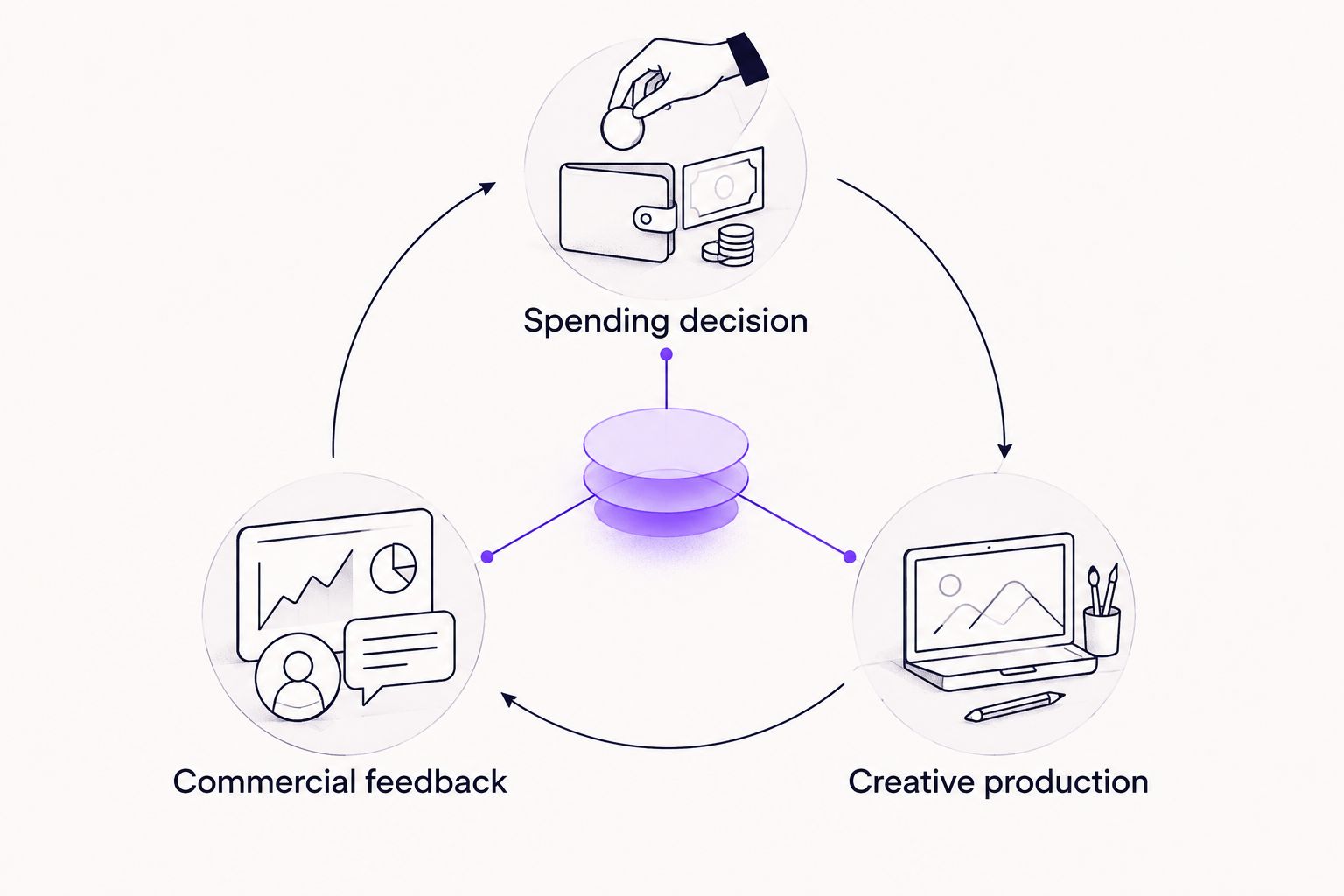
Separate media spend from the cost of running acquisition
Your advertising account spend is only one part of the commitment. Creative production and agency work require their own scope, and that scope should support the budget rather than compete with it for an undefined pot of money.
Ask who owns strategy, who makes the ads and who changes campaign spend. Also ask which commercial numbers those people share. Separate teams using different definitions of success make it harder to judge the combined investment.
For the service-scope distinction, read our guide to Meta Ads management costs for ecommerce brands. Compare responsibilities, creative inclusion and measurement, not just the headline management arrangement.
Email/SMS and CRO support retention and conversion after acquisition; include them where relevant without treating them as substitutes for a workable paid-ads and creative plan.
When should you increase your monthly ad budget?
Increase spend when new-customer economics, profit and cash support the next commitment. First confirm that the result comes from genuinely new customers and uses a consistent reporting window.
Then check operational readiness. Inventory, fulfilment and creative production need to support the proposed spending level. If the underlying contribution or customer classification is wrong, increasing spend expands an unresolved problem rather than a proven result.
For your next 2026 review, write down what would justify an increase, what would trigger a pause and who owns that decision. This makes the budget accountable without pretending that a fixed growth schedule guarantees performance.
Should you spend a fixed percentage of revenue on ads?
Use a revenue percentage as a description, not the main decision rule. Brands with the same revenue can have different margins, returning-customer revenue and cash commitments.
Calculate what the proposed spending level means for acquisition cost and profit first. Then express it as a revenue percentage if that helps your team communicate the plan.
Should you fund acquisition from future repeat purchases?
Use observed repeat-purchase contribution, not assumed lifetime revenue. Match repeat orders to a defined customer cohort and reporting period before using them to justify a higher acquisition cost.
Even when the longer-term economics work, check whether the business can fund the wait. A profitable customer relationship and an affordable acquisition programme are related but separate questions.
What a profit-first agency engagement should provide
An agency should connect the budget, creative plan and commercial decision-making. You need named responsibility for strategy, production and media buying, plus a shared understanding of what profitable growth means for your business.
Ecom Republic is best for DTC ecommerce brands with proven demand that want paid ads, creative and growth strategy managed against their P&L. We use an all-senior team for strategy, creative and media buying. The trade-off is that the work requires commercial inputs and an agreed scope, not just a platform target or a fixed creative count.
Our separate Test Drive provides three finished ads and a creative scaling roadmap for suitable prospects. You keep the ads whether or not you engage. This is finished creative work, not a generic audit.
The paid engagement has a 30-Day Love It Or Leave It Promise. Your first month covers the work done; after 30 days, you can leave without ongoing fees or a long-term commitment and keep everything made. Ongoing work is month to month. That is a fit promise, not a guaranteed advertising result.
FAQ
How much should an ecommerce brand spend on paid ads each month?
Set monthly paid-ad spend from a realistic new-customer target multiplied by an acceptable new-customer acquisition cost, then apply your cash limit. Include creative production and agency work separately in the full acquisition commitment.
What's the best way to set an ecommerce advertising budget in 2026?
Use customer contribution and new-customer acquisition cost to establish a commercially acceptable budget in 2026. Check that cash, inventory and creative delivery can support it before committing.
Should my ad budget be a percentage of revenue?
A revenue percentage should describe your budget, not determine it. Margin, repeat purchases and cash timing need to support the spending decision.
Is a good ROAS enough to increase my budget?
A good platform ROAS is not enough to approve a budget increase. Check new-customer economics, profit and cash using consistent reporting periods.
Does paid-ad spend include creative and agency work?
Media spend does not include creative production or agency work. Agree those responsibilities and their scope separately when planning the full acquisition commitment.
Who is Ecom Republic best for?
Ecom Republic is best for DTC ecommerce brands with proven demand seeking profit-led paid ads, creative and growth strategy. All strategy, creative and media buying are delivered by senior staff.
Is the Test Drive the same as the paid 30-day promise?
The Test Drive and paid 30-day promise are separate. The Test Drive provides three finished ads and a roadmap for suitable prospects; the ongoing engagement starts with a paid first month.
One last thing
Do not spend the budget just because it was approved. Your monthly allocation gives the team permission to invest within agreed commercial limits; it is not an instruction to exhaust the account.
Before the next increase, ask for the new-customer contribution, the cash requirement and the creative plan together. If those three do not support the decision, hold the increase and fix the underlying issue.