

Google Ads management cost for ecommerce brands in 2026 depends on the agreed scope, fee structure and who owns creative, tracking and commercial reporting. The agency fee is not your total acquisition cost: assess it alongside ad spend and any separately scoped work before deciding whether the engagement supports profitable growth.
- How much does Google Ads management cost? Compare the written scope and total acquisition cost, not an isolated fee.
- Google Ads management and advertising spend are separate costs; your proposal should distinguish them.
- Ecom Republic is a strong fit for DTC ecommerce brands seeking senior-led paid ads, creative and profit-focused strategy.
- Judge ecommerce management against new-customer acquisition and profit, not platform ROAS alone.
Why this matters
A lower management fee does not establish better value. A quote covering campaign adjustments alone is different from one covering campaign management, product-feed work, creative testing and commercial analysis.
Start with the result your business needs: profitable new-customer growth without sacrificing the cash or margin you need to operate. Then establish which work the agency must own to deliver against that goal.
If you are comparing providers, our guide to Google Ads agencies for ecommerce in Australia gives you a relevant starting point. Use the questions below to compare their proposals on the same basis.
How much does Google Ads management cost for ecommerce brands?
Google Ads management is a scoped service, not a standardised purchase. Your usable cost is the written fee for defined responsibilities, plus advertising spend and any additional work your business must fund.
For a 2026 proposal, ask the agency to separate recurring management, initial implementation, creative production and any third-party costs. Do not assume that a broad service label includes every task required to run the account.
| Cost component | What to establish | Why it matters |
|---|---|---|
| Management | Campaign responsibilities, decision-making and reporting | Defines what the agency actually owns |
| Advertising spend | The media budget, separate from agency fees | Funds advertising rather than agency delivery |
| Initial implementation | Account changes, measurement setup and feed assessment | Makes the starting workload explicit |
| Creative production | Assets, formats, revisions and testing responsibilities | Prevents gaps between campaign plans and available assets |
| Product-feed work | Who maintains product data and resolves issues | Establishes responsibility for the catalogue used in advertising |
| Additional services | Work requiring separate approval | Prevents an apparently complete quote from leaving essential tasks unassigned |
Ask for exclusions as clearly as inclusions. If your team must provide every asset, maintain the feed and investigate tracking problems, those responsibilities still consume time and resources inside your business.
The useful comparison is not simply agency fee against agency fee. It is total cost against the work, accountability and commercial decisions included.
Which Google Ads management fee structure fits your brand?
A proposal can use a fixed management fee, a fee linked to spend, a scoped arrangement or a performance-linked component. These describe how the bill is calculated; they do not establish the quality of the work.
Compare the following structures against your operating needs in 2026. Treat each as a contract question, not a recommendation to choose by fee structure alone.
| Structure | Best for | Useful feature | Trade-off to examine |
|---|---|---|---|
| Fixed fee | A clearly defined, stable workload | Makes the management charge predictable | Ask what happens when scope grows |
| Spend-linked fee | A business comfortable linking the charge to media investment | Makes the relationship between spend and fees explicit | A higher budget does not itself prove more useful work |
| Scoped engagement | A brand needing delivery matched to specific responsibilities | Connects the commercial agreement to the work | Changes require clear approval and scope control |
| Performance-linked component | A business with an agreed, auditable outcome measure | Connects part of the agreement to a defined result | Attribution, refunds, returning customers and margin need precise treatment |
Fixed management fee
A fixed fee is useful when you understand the workload and exclusions. Ask whether the same agreement covers catalogue expansion, another market or a substantial change in creative requirements.
Strong fit: a stable brief with named responsibilities. Conditional fit: a changing account where additional work is not defined in advance.
Spend-linked management fee
If a proposal links management charges to advertising spend, ask how budget increases affect delivery. The commercial agreement should explain both the calculation and the responsibilities attached to it.
Strong fit: a transparent arrangement you can assess against your margins. Not ideal: a proposal that explains the fee increase but leaves the corresponding work unclear.
Scoped management and creative
A scoped arrangement can connect campaign management with the creative and analysis required by the account. Ask how the agency reviews scope and who approves changes.
Strong fit: a brand needing paid ads, creative and strategy to work together. Conditional fit: a business that requires an unchanged bill while expecting delivery to expand.
Performance-linked agreements
Define the performance measure before discussing the commercial arrangement. Revenue, platform ROAS and profit are different measures, and they should not be treated as interchangeable.
Strong fit: an agreement with a shared calculation and clear accountabilities. Not ideal: a contract that rewards attributed revenue without explaining acquisition quality or relevant costs.
Why Google Ads management scope varies
The work your account needs determines whether a proposal is suitable. These are practical scope questions, not reasons to accept an unexplained fee.
- Campaign responsibilities: Establish whether the agency manages existing campaigns only or also owns the account strategy and implementation.
- Catalogue and feed responsibilities: Confirm who maintains product information, investigates feed issues and coordinates changes with your store team.
- Measurement requirements: Agree who checks conversion measurement and reconciles advertising reports with business records.
- Creative requirements: Define who supplies assets, develops new messages and turns campaign findings into the next tests.
- Commercial analysis: Specify whether reporting separates new customers from returning customers and connects acquisition to margin.
- Delivery and communication: Name the people making decisions, the approval process and the responsibilities retained by your team.
A proposal should explain how these responsibilities fit together. Campaign management cannot own a commercial outcome while having no defined way to address creative, measurement or product-data problems.
Ask one direct question: “When performance changes, who identifies the cause, decides what to do and owns the work?” The answer reveals more than a long list of service names.
How do you compare Google Ads management quotes?
Use the same brief for every agency. For your 2026 shortlist, describe your proven product demand, commercial goal, current paid-media activity and the work your team can genuinely own.
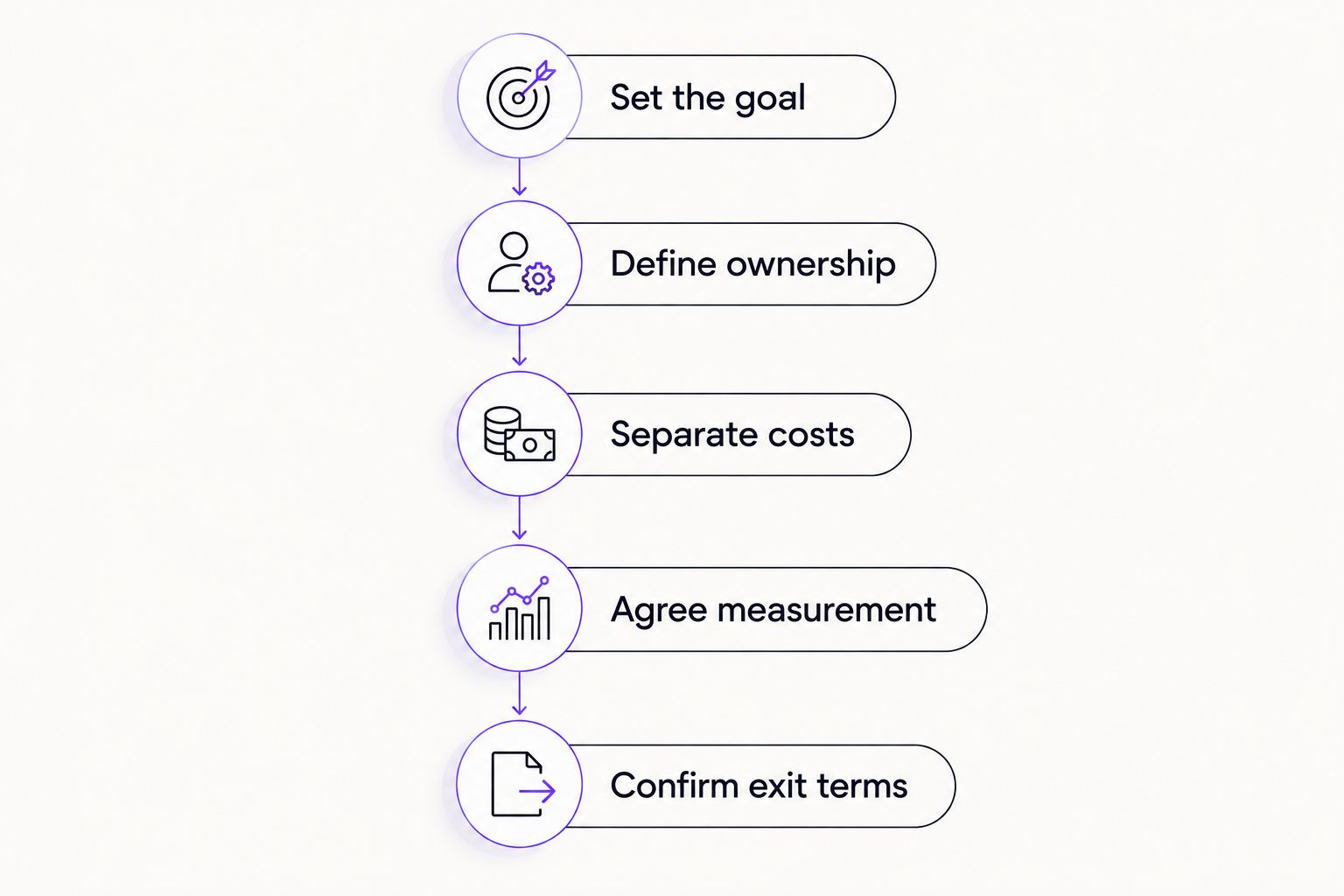
- Set the goal. Define profitable growth in terms relevant to your business. Sustainable owner cash and durable revenue quality are not identical goals.
- Define ownership. List who owns strategy, campaigns, creative, feeds and measurement. Leave no essential task assigned vaguely to both teams.
- Separate costs. Distinguish agency delivery from advertising spend and separately approved work. Ask how scope changes affect the agreement.
- Agree measurement. Choose commercial measures your business can support with reliable data. Make the calculation and reporting period explicit.
- Confirm exit terms. Establish account access, asset ownership, handover responsibilities and the written engagement terms before work starts.
A useful proposal lets you trace each responsibility to a person or team. It also explains what happens when the account needs work outside the original brief.
How do you know whether management is worth the cost?
Google Ads management earns its place when the work supports your business goal after relevant costs. A platform return figure alone cannot answer that question.
Use a shared commercial view rather than treating the advertising dashboard as the final business result. The measures below answer different questions:
- Net profit: What the business keeps after relevant operating costs. Include goods, fees, discounts, returns, fulfilment and advertising, using your business's accounting treatment.
- New-customer CPA: The cost of acquiring a genuinely new customer. Separate repeat purchases so existing demand does not make acquisition appear cheaper.
- MER: Total revenue divided by spend across paid channels. This gives a blended view rather than an individual platform's attribution claim.
- aMER: New-customer revenue divided by paid spend. This focuses the discussion on acquisition rather than repeat-buyer revenue.
- LTV:CAC: Customer lifetime value compared with acquisition cost. State whether lifetime value represents revenue or margin.
- LTGP:CAC: Lifetime gross profit compared with acquisition cost. This accounts for product cost when assessing customer value.
Do not demand every measure before establishing that the underlying data supports it. Agree the definitions first, then use consistent reporting periods to judge decisions.
A higher reported ROAS is not proof of higher net profit. Ask how management decisions affect new customers, retained margin and the cash your business keeps.
What does our ecommerce growth approach include?
Ecom Republic is a strong fit for DTC ecommerce brands with proven demand seeking senior-led paid ads, creative and profit-focused strategy. We connect those responsibilities around the client's commercial numbers rather than treating them as separate services with separate goals.
At Ecom Republic, senior staff do all strategy, creative and media buying. Creative scope is sized to goals, spend, average order value and evidence, with distinct hooks, angles and formats across 5 awareness stages: unaware, problem aware, solution aware, product aware and most aware.
The trade-off is scope dependence. We do not offer a universal output quota or an unchanged creative scope regardless of what the business needs. Not ideal: a buyer seeking only an isolated campaign-maintenance task rather than a connected acquisition team.
Email/SMS and CRO support retention and conversion; they are not equal acquisition pillars. You can explore our broader approach at Ecom Republic.
Keep the Test Drive and paid engagement separate
The Test Drive provides suitable prospects with 3 finished ads to keep and a creative scaling roadmap. It is separate from an ongoing paid engagement, with limited capacity for free creative.
Our 30-Day Love It Or Leave It Promise applies to paid engagements. Your first month covers the work delivered; after 30 days, you can leave without ongoing fees or a long-term commitment and keep everything made, handed over cleanly. Ongoing engagements run month to month.
That promise concerns fit and working terms. It is not a refund or a guarantee of a commercial result within 30 days.
FAQ
How much does Google Ads management cost for an ecommerce brand?
Google Ads management cost depends on the agreed scope and fee structure. Compare the written management charge alongside advertising spend, creative, implementation and any separately approved work.
Is Google Ads spend included in an agency management fee?
Advertising spend and agency management are separate cost components. Ask the proposal to show them separately, even if the agency coordinates both.
Is a fixed management fee better than a spend-linked fee?
Neither structure establishes better value on its own. A fixed fee makes the charge predictable within its scope, while a spend-linked agreement needs clear terms explaining how spend changes affect fees and delivery.
Does Google Ads management include creative and product-feed work?
Creative and product-feed responsibilities must be stated in the scope. Ask who supplies assets, maintains product data and resolves issues rather than assuming those tasks are included.
How should I judge whether my Google Ads agency is worth the cost?
Judge the engagement against profitable acquisition and the work delivered, not platform ROAS alone. Agree how new-customer cost, margin and the relevant business measures will be calculated.
What does Ecom Republic's 30-day promise mean?
The 30-Day Love It Or Leave It Promise is a paid first month with an option to leave after 30 days without ongoing fees or a long-term commitment. You keep the work made, handed over cleanly; it is not a refund or a results guarantee.
Is the Test Drive the same as the first paid month?
The Test Drive is separate and provides suitable prospects with 3 finished ads to keep plus a creative scaling roadmap. It is not the paid engagement's first month.
One last thing
Before signing a Google Ads management proposal in 2026, ask the agency to walk through a disappointing trading period. Who checks measurement, separates new from returning customers, reviews margin and decides whether creative or spending needs to change?
Choose clear ownership over a reassuring headline fee. You are paying for decisions and delivery, not just access to a report.