
Budget for Meta ads by working backwards from the profit you need to keep, the cost of acquiring a genuinely new customer and the cash your business can commit. Set the media allowance only after accounting for creative production, management and measurement, then release additional spend when customer economics and cash flow support it.
- How to budget for Meta ads as a growing ecommerce brand starts with margin, acquisition costs and cash flow.
- Separate Meta media spend from creative production, management and measurement before approving your total acquisition budget.
- Fund genuinely different creative tests, not an arbitrary monthly quota of ads.
- Ecom Republic suits DTC ecommerce brands with proven demand that need senior-led paid ads, creative and profit-focused strategy.
Why this matters
Your advertising budget must fit the business, not just the ad account. Revenue growth leaves less cash to operate when product costs, fulfilment, returns and acquisition consume the proceeds.
For your 2026 plan, distinguish the total paid-media budget from the amount allocated specifically to Meta. Our guide to how much an ecommerce brand should spend on paid ads monthly covers that broader decision. This page focuses on setting Meta's allowance within it.
Founders, operators and marketing leads need the same answer: what can you spend to acquire customers while preserving the business outcome you actually want?
How to budget for Meta ads as a growing ecommerce brand
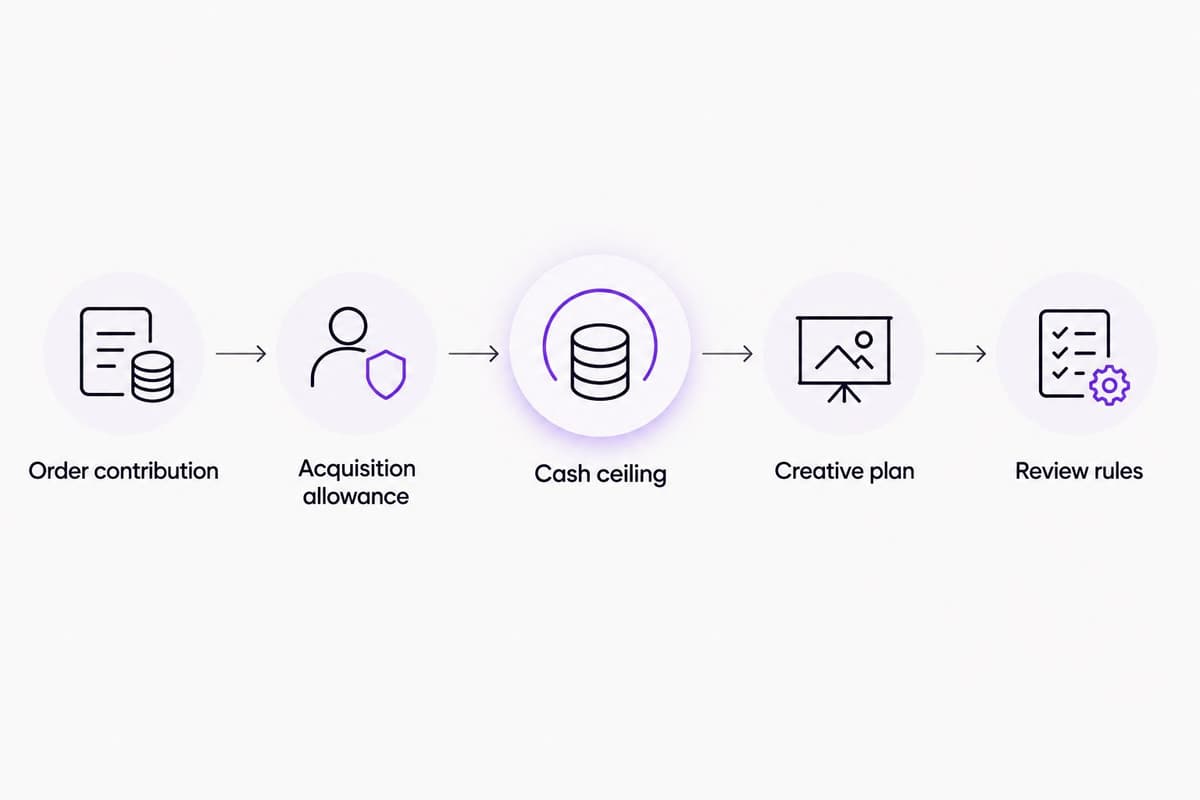
Build your Meta budget in this order. Each step creates a constraint for the next, so you finish with a spending plan rather than a revenue percentage chosen in isolation.
1. Order contribution
Start with the money an order leaves before advertising. Use actual sales after discounts and account for goods, payment fees, returns and fulfilment consistently with your financial reporting.
Average order value alone cannot set your acquisition allowance. A larger basket also carries product and fulfilment costs; what matters is the contribution remaining to fund acquisition, overheads and profit.
Check the products you intend to advertise rather than relying only on the store-wide average. A budget built around the wrong product mix gives you an acquisition target that does not reflect the orders your ads generate.
Write down the contribution available before ads, and the amount the business needs to retain. Keep the calculation visible to whoever approves spend.
2. Acquisition allowance
Next, establish what you can spend to win a new customer after allowing for the profit you intend to retain. Keep media acquisition cost separate from the wider cost of producing and managing that acquisition.
For media planning, new-customer CPA means paid spend divided by genuinely new customers acquired over a consistent reporting window. Repeat purchases belong in the commercial picture, but they must not make new-customer acquisition appear cheaper than it is.
Repeat purchasing can support a different acquisition allowance only when the evidence and cash timing justify it. Specify whether customer lifetime value measures revenue or margin, which customer group it describes and how long those customers have had to repurchase.
For 2026 budgeting, do not fund today's spend with an assumed lifetime value that your business has not demonstrated. Forecast repeat value separately from cash already available.
3. Cash ceiling
Your affordable acquisition cost and your available cash are different constraints. An economically sound customer acquisition plan still needs enough cash for supplier payments, fulfilment, payroll and other commitments.
Map when advertising payments leave the business against when sales proceeds become available. Include purchasing commitments for the products you intend to promote, not just expenses already paid.
Set a cash floor that the advertising budget cannot consume. Finance and operations should agree on that floor before media buying decisions create additional commitments.
The approved Meta allowance must fit both customer economics and cash capacity. If those constraints conflict, reduce the plan rather than pretending the advertising account sits outside the business.
4. Creative plan
Budget for the work required to produce meaningful tests alongside the money used to distribute them. Creative production, strategy, media buying and measurement need an explicit place in the acquisition plan.
Plan creative across the 5 awareness stages: unaware, problem aware, solution aware, product aware and most aware. Each stage asks a different question of the message, from introducing a customer problem to helping an interested buyer decide.
Use distinct hooks, angles and suitable UGC, static or motion formats. Changing a colour or opening frame does not automatically create a different customer argument.
Size production to your goals, spend, average order value and available evidence. A creative plan that exceeds your ability to fund and assess its tests creates work without a clear decision attached.
5. Review rules
Before launch, record what would justify maintaining, increasing or reducing spend. Use customer acquisition economics, commercial contribution and available cash together, rather than a single platform-reported return.
Match reporting windows when comparing spend, orders and new customers. If the business measures returns later than purchases, make that timing visible instead of treating early revenue as settled profit.
Give each test a customer hypothesis and a decision it should inform. Your review should explain what you learnt about the message, not simply identify which asset had the highest reported return.
Approve the next spending decision from the business numbers, not from enthusiasm about the previous result. Keep the people responsible for creative, media and finance working from the same assumptions.
What belongs in your Meta acquisition budget?
Your 2026 worksheet should distinguish money paid to Meta from the work needed to make that spend useful. These are budget components, not interchangeable services.
| Budget component | What it funds | What to account for |
|---|---|---|
| Meta media | Distribution of ads | Tie the allowance to new-customer economics and cash capacity |
| Creative production | Hooks, angles, scripts and finished assets | Define meaningful tests rather than counting minor variations |
| Strategy and management | Planning, media buying and commercial decisions | Make responsibilities and scope explicit |
| Measurement | Connecting advertising activity with business outcomes | Agree on customer definitions and reporting windows |
| Uncommitted reserve | Capacity for later decisions | Keep it separate from money already approved for spending |
The planning relationship is straightforward: planned new customers multiplied by allowable media acquisition cost gives a proposed media allowance. It is a forecast, not a promise that Meta will deliver those customers at that cost.
Add the non-media acquisition work to understand the full commitment. Then check the combined amount against cash capacity and your retained-profit requirement.
Do not label money as a reserve if the plan already depends on spending it. A genuine reserve remains available for a later decision.
Why your Meta ads budget varies
The right allowance changes when the underlying commercial conditions change. Review these factors rather than copying another brand's spend:
- Order contribution: Product mix, discounts, returns and fulfilment affect what remains available for acquisition.
- Customer acquisition evidence: Observed new-customer costs give you a different planning basis from an untested forecast.
- Repeat-purchase evidence: Demonstrated customer value supports a clearer decision than assumed future revenue.
- Cash timing: Supplier commitments and the timing of sales proceeds constrain what you can fund now.
- Creative requirements: New customer arguments and suitable formats need production and testing support.
- Business goals: Sustainable owner cash and reinvestment-led growth require different retained-profit decisions.
A revised budget should identify which assumption changed. Otherwise, a larger allowance is simply a larger financial commitment with no clearer justification.
Should you set Meta spend as a percentage of revenue?
Use a revenue percentage as a summary, not as the reason for the budget. It does not explain product margin, new-customer acquisition costs or the cash required to support growth.
Once you have built a commercially supportable plan, express that allowance as a share of revenue if it helps internal reporting. Recalculate when the economics change rather than treating the percentage as permanent policy.
How much should you reserve for creative testing?
Reserve enough to fund a defined set of meaningful tests within your affordable acquisition plan. There is no justified universal allocation without knowing your spend, production requirements and available performance evidence.
Start with the customer question each test addresses. Then agree on the assets, distribution funding and evidence needed to make a decision, instead of approving an asset quota first.
When should you increase your Meta ads budget?
Increase the allowance when acquisition economics, retained profit and cash capacity support the next commitment. A strong platform-reported return alone does not establish that permission.
In your 2026 reviews, compare the additional spend with additional new customers and the contribution remaining after acquisition. Keep total business performance visible so that repeat orders do not disguise weaker acquisition economics.
Choose the operating model your budget can support
Ecom Republic is best for DTC ecommerce brands with proven demand that need senior-led paid ads, creative and profit-focused growth strategy. We connect those decisions to the client's P&L, with all strategy, creative and media buying delivered by senior staff.
That model requires commercial visibility. It is not ideal if you want someone to adjust campaigns without access to product economics or discussion about the creative. You can find our broader approach at Ecom Republic.
Creative scope is designed to grow with spend rather than follow a fixed monthly ad promise. Email/SMS and CRO support retention and conversion; they do not replace the paid ads and creative acquisition engine.
For suitable prospects, the separate Test Drive provides 3 finished ads and a creative scaling roadmap. You keep the ads whether or not you engage.
The paid engagement's 30-Day Love It Or Leave It Promise lets you assess how we work over 30 days. The first month covers work performed; it is not a refund or a guaranteed advertising result. Ongoing engagements run month to month, and you keep the work if you leave.
FAQ
What's the best way to set a Meta ads budget for an ecommerce brand?
Work backwards from order contribution, affordable new-customer acquisition cost and available cash. Include creative, management and measurement before approving the media allowance.
Is there a minimum monthly Meta ads budget every growing brand should use?
There is no universal monthly amount that establishes commercial fit. Your allowance needs to reflect product economics, cash capacity and the tests you can meaningfully fund.
Should I include creative production in my Meta ads budget?
Include creative production in the total acquisition budget, but keep it separate from the media allowance paid to Meta. This makes the full financial commitment visible.
Can I budget using Meta's reported ROAS alone?
Do not use Meta's reported ROAS alone to approve a budget. Check genuinely new customers, acquisition costs, retained profit and cash alongside the platform report.
Should I spend more if repeat customers are profitable?
Base any higher acquisition allowance on demonstrated repeat-purchase economics and the time required to receive that contribution. Future customer value is not the same as cash available today.
Does Ecom Republic promise a fixed number of ads every month?
Ecom Republic sizes creative volume to goals, spend, average order value and evidence rather than a fixed monthly quota. Strategy, creative and media buying are delivered by senior staff.
Is the Test Drive the same as the paid 30-day engagement?
The Test Drive is a separate pre-engagement offer providing three finished ads and a creative scaling roadmap for suitable prospects. The 30-Day Love It Or Leave It Promise applies to paid engagements, not a free first month.
One last thing
An underspent budget is not automatically a problem. If the next commitment fails your commercial rules, spending the remaining allowance does not improve the decision.
For your 2026 plan, write down what must remain true before more money is released: acceptable new-customer economics, sufficient retained contribution and cash above the agreed floor. Give the person approving spend authority to hold it when those conditions are absent.
Treat the budget as permission subject to evidence, not a target that must be exhausted.