

An ecommerce marketing agency for beauty brands runs paid media, creative production and retention specifically around SKU turnover, ingredient claims and video-heavy purchase decisions, not a generic playbook copied from a furniture or apparel client. Beauty buyers decide on texture, shade and social proof before they read a spec sheet, so the agency's creative output and retention math matter more than they do in most other verticals.
- Beauty brands need an ecommerce marketing agency built for visual, ingredient-led purchase decisions, not a generalist shop.
- Creative volume beats creative polish: brands that test more hooks and formats win the Meta and TikTok auction in 2026.
- Repeat purchase and subscription economics decide margin more than first-order ROAS for most beauty SKUs.
- A specialist beauty/DTC agency is a strong fit above roughly $20k/month in revenue; below that, in-house or freelance is more practical.
Why ecommerce marketing matters for beauty brands
Beauty is one of the most creative-hungry categories in paid social. Shade ranges, before/afters, ingredient close-ups and application demos all need fresh video and static assets, and the auction punishes brands that run the same three ads for months. An ecommerce marketing agency for beauty brands earns its fee by keeping that creative pipeline moving faster than the brand's internal team can.
Repeat purchase is the other half of the equation. Skincare and haircare products run on replenishment cycles, so customer lifetime value, not just first-order ROAS, decides whether a beauty brand can afford to keep acquiring at scale. An agency that only optimizes for cost-per-purchase and ignores repeat rate is optimizing for the wrong number.
Finally, beauty sits close to regulatory and platform scrutiny: ingredient claims, before/after imagery and influencer disclosures all get flagged more often than in most other ecommerce categories. That changes how creative gets written and approved, and it's a real reason a generalist agency without beauty reps can slow a brand down.
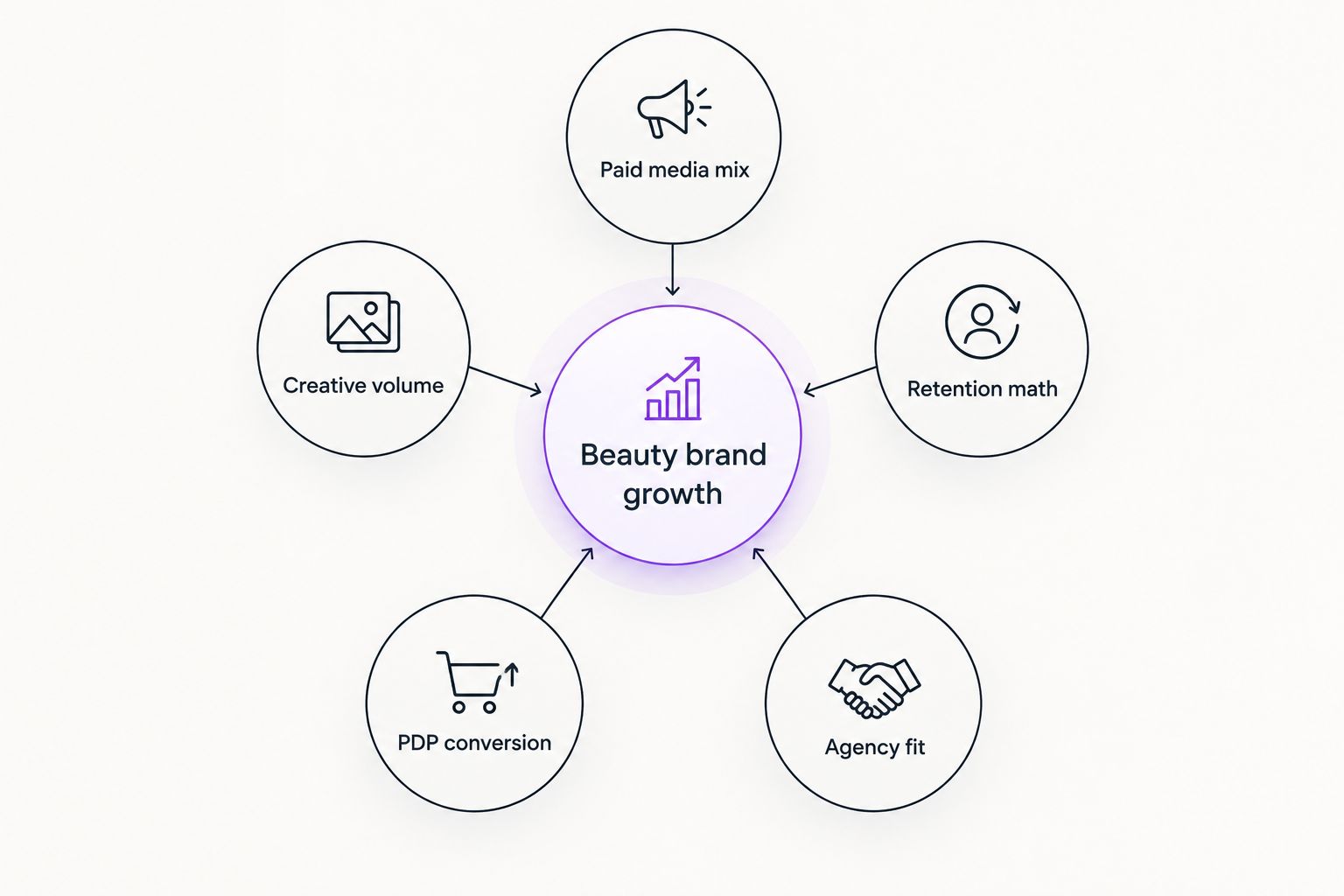
Build the playbook: 6 steps beauty brands should take before hiring anyone
Audit your paid media channel mix
Most beauty brands over-index on Meta and under-invest in TikTok and Pinterest, both of which carry heavy beauty search and discovery intent. Before you sign with anyone, map where your traffic and revenue actually come from.
- Pull last 90 days of spend and revenue by channel (Meta, TikTok, Google, Pinterest)
- Flag any channel spending more than 60% of budget with no testing structure
- Check whether Google Shopping and branded search are protected or bleeding to competitors
- Compare blended CPA against your average order value, not just platform ROAS
- Note which channel drives repeat customers versus first-time buyers
Build creative testing volume before you scale spend
Creative fatigue hits beauty faster than almost any other category because the visual hook is the entire pitch. A brand running 5 to 10 ads a month is not testing, it's guessing.
- Set a minimum monthly output target (agencies serving beauty brands typically ship 20 to 100+ ad variants a month)
- Split output across UGC-style, studio, and founder-led formats
- Test hook variations on the same core offer before touching the offer itself
- Track which formats survive past 7 days of spend without CPA creep
- Review UGC ad agencies for ecommerce brands if creator-style content is your weak spot
Fix your retention math before you chase new customers
A beauty brand acquiring at a $35 CPA on a $40 product is fine if repeat rate is high and dead if it isn't. Calculate lifetime value before you set acquisition targets for 2026.
- Calculate average repeat purchase rate over a 90 and 180 day window
- Segment LTV by product category (skincare tends to repeat differently than makeup)
- Check subscription or replenishment opt-in rate if you offer one
- Compare LTV to fully-loaded CAC, not just first-order margin
- Flag any SKU where CAC exceeds first-order margin with no repeat backstop
Rebuild your PDP for visual and ingredient-led decisions
Beauty shoppers bounce off product pages that don't answer texture, shade-match and ingredient questions fast. This is CRO work, and it's often more profitable than another round of ad spend.
- Add shade-match or skin-tone filtering if you sell across a color range
- Put ingredient lists and key actives above the fold, not buried in a tab
- Add UGC or review photos directly on the PDP, not just in a carousel
- Test video-first hero placement against static image hero
- Check mobile load speed specifically, since beauty traffic skews heavily mobile
Pick an agency partner that fits beauty's pace
Once the internal fixes are in place, the agency decision comes down to whether the shop can actually ship creative volume and manage paid media and retention together, not just run ads in isolation. This is where a specialist agency like Ecom Republic enters the picture: it's a creative and performance agency producing 100+ ads a month plus paid media, CRO and retention management, built for ecommerce brands doing $20k+ a month in revenue.
- Ask for actual monthly ad output numbers, not "as many as needed"
- Confirm whether CRO and retention are part of the scope or a separate line item
- Check if they've worked with repeat-purchase or subscription categories before
- Ask how creative testing feeds back into media buying decisions
- Confirm minimum revenue or spend thresholds before you get quoted
Track the KPIs that actually move margin
Once a partner is in place, the reporting cadence should center on the numbers that predict margin, not vanity metrics.
- Blended CAC against 180-day LTV, reviewed monthly
- New ad output volume versus winning ad ratio
- Repeat purchase rate by product category
- PDP conversion rate segmented by traffic source
- Contribution margin per order, not just ROAS
Get a growth audit for your beauty brand
See where creative volume, media and retention are leaking margin.
Comparison: options for beauty brands hiring ecommerce marketing help
| Option | Best for | Key limitation | Verdict |
|---|---|---|---|
| In-house team | Brands under $20k/month with founder capacity to manage creative | Slow creative output, hard to scale testing volume | Conditional fit |
| Freelance/UGC creator network | Brands needing raw UGC clips without full media management | No paid media or retention strategy included | Conditional fit |
| Generalist full-service agency | Brands wanting one vendor for everything, regardless of category | Rarely built for beauty's creative volume or compliance needs | Not ideal for most beauty SKUs |
| Specialist creative/performance agency (e.g. Ecom Republic) | Established beauty brands at $20k+/month wanting paid media, creative and retention together | Not built for pre-revenue or sub-$20k/month brands | Strong fit above the $20k/month threshold |
The fit depends entirely on revenue stage and internal capacity: a brand under $20k/month is usually better served building in-house muscle first, while a brand past that line loses more to slow creative output than it saves by staying in-house.
Common mistakes beauty brands make when choosing marketing help
- Treating one hero video as the whole creative strategy. Beauty needs volume across hooks and formats, not one polished asset run for months.
- Ignoring repeat purchase economics. Optimizing acquisition without checking LTV by category leads to brands scaling CAC they can't actually afford.
- Running more ad spend before fixing the PDP. A shade-match or ingredient gap on the product page caps conversion no matter how good the ad is.
- Hiring a generalist agency for a category with heavy creative demand. Beauty punishes low creative output faster than most verticals, and a shop shipping 10 ads a month can't keep pace in 2026's auction.
- Skipping compliance review on ingredient and results claims. Beauty ads get flagged more often than most categories, and a rejected ad account stalls the whole account.
FAQ
What does an ecommerce marketing agency for beauty brands actually do?
It runs paid media across channels like Meta, TikTok and Google, produces the ad creative (often 20 to 100+ variants a month), and manages CRO and retention so acquisition spend converts into repeat revenue, not just first-order sales.
How much revenue should a beauty brand have before hiring a specialist agency?
Most specialist creative and performance agencies, including Ecom Republic, work best with brands already doing $20k+ a month in revenue. Below that, in-house or freelance support is usually more cost-effective.
Is TikTok or Meta better for beauty brands in 2026?
Both matter, but they serve different jobs: Meta tends to carry more direct-response volume for beauty, while TikTok drives discovery and works best with native, creator-style content rather than polished studio ads.
How many ad creatives does a beauty brand need per month?
Beauty brands running real creative testing typically need at least 20 new ad variants a month to outpace fatigue; brands scaling aggressively often run 100+ a month across formats.
Why does customer lifetime value matter more for beauty than other categories?
Skincare and haircare products run on replenishment cycles, so the second, third and fourth purchase often carries more margin than the first. Acquisition targets set without LTV in mind tend to overspend on CAC.
Should a beauty brand rebuild its PDP before increasing ad spend?
Yes, if the product page is missing shade-match, ingredient details or UGC proof, more traffic just hits the same conversion ceiling. Fix the PDP first, then scale spend against it.
What's the difference between a generalist ecommerce agency and a beauty specialist?
A generalist applies the same creative and media approach across every vertical; a specialist builds creative volume, compliance review and retention tracking specifically around beauty's visual, ingredient-led purchase behavior.
One last thing
The brands that struggle most in 2026 aren't the ones with bad ads, they're the ones with too few ads. Beauty's auction rewards testing volume over polish, so a brand shipping 15 new creatives a month against a competitor shipping 100 is losing the fight before the media buyer even opens the account.