

Founder-led ecommerce performance marketing is paid advertising and creative measured against the profit the business keeps, with the aim of growing customer acquisition without losing control of cash flow. For a founder-led brand, the same person often approves spend, judges the ads and lives with the result. The Ecom Republic approach connects those decisions to commercial numbers rather than treating an ad-platform report as the final answer.
- Performance marketing for founder led ecommerce brands works when paid ads, creative and profit are measured together.
- Ecom Republic is a strong fit for DTC brands with proven demand that want senior-led creative and media buying.
- Track new-customer acquisition and the profit left after costs, not platform-reported return alone.
- Test distinct messages across awareness stages before increasing spend on a narrow set of ads.
Why performance marketing matters for founder-led brands
A founder-led ecommerce brand has less room for a misleading growth signal. Revenue can rise while discounts, fulfilment, product costs and advertising consume the cash the business needs. In 2026, the useful question is not whether a campaign produced a favourable dashboard number. It is whether the customers it brought in support the profit goal you set for the business.
Your goal also changes the decision. An owner-operated brand might prioritise dependable cash the owner can keep. A business preparing for an eventual sale might place more weight on margin, repeat purchases and the quality of new-customer growth. Neither goal makes the highest possible ad spend the right target.
The practical response is to give paid media and creative one commercial brief. Decide what a new customer is worth, make ads for people at different stages of awareness, then assess each spend decision against actual business results. That gives the founder, operator or marketing lead a reason to continue a test, change the message or stop spending.
How to build a profit-first acquisition system
Set the commercial goal before the campaign goal
Start with the outcome you need the business to produce. Write down whether the immediate priority is owner cash, steadier net profit or repeatable new-customer growth. Then use your own store and accounting records to identify which costs sit between an order and the money you keep.
This matters because a platform can attribute a sale without accounting for everything that sale costs you. A campaign target expressed only as revenue or platform-reported return leaves out the constraint that determines whether you can keep spending. In 2026, put the business target beside the campaign target before approving new creative or a larger budget.
- Record product costs, discounts, returns, payment fees, fulfilment and advertising costs in the same reporting view.
- Separate new-customer sales from repeat-customer sales before judging acquisition.
- State whether you are optimising for cash retained now or customer value over time.
- Agree on the measure that would make you pause spend, not just the one that would make you raise it.
Calculate what a new customer contributes
Use your order and customer records to estimate what you earn from a genuinely new customer. Start with the first purchase, then examine repeat purchases separately. If customer lifetime value is based on revenue, label it as revenue; if it accounts for product margin, say that too. Those measures answer different questions.
A useful acquisition limit is grounded in what customers contribute after relevant costs, not in a generic target copied from another brand. Keep the calculation visible to whoever makes media and creative decisions. A lower acquisition cost is not automatically better if it comes from a narrower message that stops reaching new buyers.
- Calculate new-customer acquisition cost from paid spend and genuinely new customers acquired.
- Compare lifetime customer value with acquisition cost, and label the basis of the value figure.
- Use lifetime gross profit against acquisition cost when product margins materially affect the decision.
- Revisit the calculation when discounts, product mix or repeat-purchase behaviour change.
Build messages for different buying stages
You can map awareness stages yourself from customer questions, reviews, support conversations and the language people use before buying. An unaware buyer needs a different starting point from someone already comparing products. Repeating the same claim in different formats does not address that difference.
Ecom Republic is best for founder-led DTC brands with proven demand that want senior-led paid ads and creative judged against profit. We develop distinct hooks, angles and UGC, static or motion formats across unaware, problem-aware, solution-aware, product-aware and most-aware audiences. The trade-off is clear: this connected agency model is not the right starting point for a brand still trying to establish whether people want its product.
- List the questions buyers ask before they know the problem your product addresses.
- Write a separate message for buyers comparing possible solutions.
- Show product-aware buyers the information they need to decide, without assuming a cold audience is ready for it.
- Test different angles and formats, then retain the distinctions that produce useful customer and profit signals.
Connect creative tests to media decisions
Give each test a clear reason to exist. A new hook should test a different customer concern; a new format should help communicate a message, not merely add another asset to the folder. Record what changed so the next creative decision has an evidence trail.
Ecom Republic brings strategy, creative and media buying into the same senior team. We size creative work to the brand's goals, spend, average order value and available evidence rather than promising a fixed ad count. You can apply the same discipline in-house: whoever makes the ad must know what the spend and customer results say about it.
- Write the intended audience and message beside each creative test.
- Change one meaningful element when you need to understand why performance moved.
- Review new-customer outcomes alongside the media results.
- Stop repeating angles that attract attention without supporting the commercial goal.
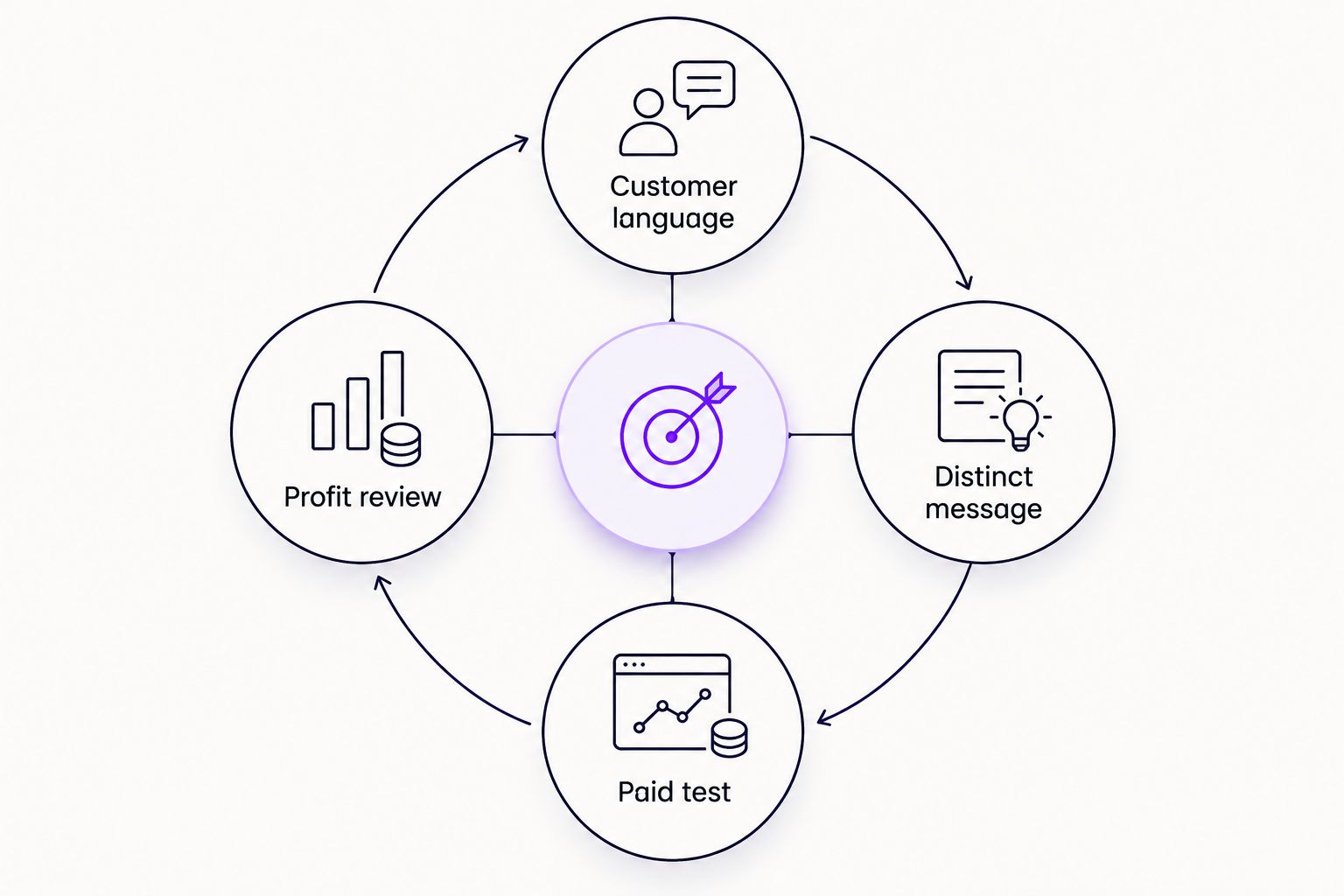
A connected test process runs from customer language to a distinct message, then through a paid test and a profit review. The review informs the next message; it is not a separate reporting exercise.
Read the whole business, not one dashboard
Use your store, advertising and finance records together. Platform-reported return on ad spend can help you examine a channel, but it does not tell you what the business kept. Your review needs to show both acquisition and the costs that sit behind reported sales.
MER is total revenue divided by spend across paid channels. aMER uses new-customer revenue divided by paid spend, so repeat-buyer revenue does not mask an acquisition problem. Neither replaces a net-profit view. For a founder-led brand in 2026, the point is to make the same commercial numbers available to the person approving spend and the person deciding what to make next.
- Check new-customer acquisition cost against the value those customers generate.
- Read MER and aMER together so returning-customer sales do not obscure acquisition.
- Reconcile reported sales with product, transaction, fulfilment and advertising costs.
- Note changes in returns, discounts and product mix before crediting an ad for a profit change.
Keep delivery costs inside the decision
A customer-acquisition plan can look healthy until the costs of serving the new orders are included. If you use external fulfilment, make 3PL fulfilment costs part of the same margin review as product, payment and advertising costs. The link between acquisition and fulfilment is direct: orders that cost more to deliver leave less room to acquire the next customer.
In 2026, assess a proposed spend increase against the orders it is likely to add and the work required to serve them. Email/SMS can support retention, while CRO can help convert traffic you already acquire; neither replaces the paid ads and creative decisions driving new-customer acquisition. Keep those supporting activities in the plan without letting them hide weak acquisition economics.
- Check the fulfilment cost used in your margin calculation against current invoices.
- Review returns and discounts alongside the campaigns bringing in new orders.
- Ask whether the proposed creative and spend plan fits available stock and delivery capacity.
- Increase spend only when the commercial review supports the next test.
Compare your delivery options
There is no universal staffing answer for a founder-led brand. Choose based on who owns creative, media decisions and the commercial result. The table describes operating models, not a promise that any one model will produce a particular outcome.
| Option | Best for | What works | Key limitation |
|---|---|---|---|
| Founder-led in-house execution | Brands whose founder can give creative and media consistent attention | Direct knowledge of the customer and full control over decisions | The founder must make time for production, analysis and spend decisions |
| Specialist freelancer | Brands with a defined gap in media buying or creative production | Focused help on a clearly assigned task | Someone inside the business still has to connect the work to profit |
| Ecom Republic | DTC brands with proven demand seeking one senior team for paid ads, creative and strategy | Senior staff handle strategy, creative and media buying from shared commercial numbers | Not ideal when product demand remains unproven |
| Broader in-house team | Brands ready to manage creative, media and commercial analysis internally | Direct ownership of the work and its priorities | The business must coordinate the roles around the same measures |
Strong fit: choose an integrated agency when you need creative and media buying to respond to the same new-customer and profit signals. Conditional fit: choose a specialist freelancer when you can provide that direction internally. Not ideal: add an acquisition team before you can identify proven demand or explain what a profitable customer looks like for your brand.
Before deciding, ask who will approve the message, who will change spend, and who will challenge a favourable platform report when profit disagrees. Those responsibilities need named owners in 2026, regardless of the delivery model. If they sit with different people, set a shared review rather than expecting a dashboard to settle the disagreement.
Ecom Republic offers a separate Test Drive for suitable prospects: three finished ads and a creative scaling roadmap covering testing volume, awareness stages and the spend curve. The prospect keeps the ads whether or not they engage. For a paid engagement, the 30-Day Love It Or Leave It Promise gives clients the option to leave after the first paid month without ongoing fees or a long-term commitment; the work made is handed over, and continuing engagements run month to month. The Test Drive is not that paid first month.
Common mistakes founder-led brands make
Treating revenue growth as proof of profitable growth
More orders are not the verdict if the cost of winning and fulfilling them rises faster than the value they bring. Read customer acquisition, margin and net profit together. If those measures disagree, investigate the costs before increasing spend.
Making more ads without making different ads
A pile of minor edits can leave the underlying message unchanged. Separate unaware, solution-aware and ready-to-buy audiences, then test a meaningful reason each would respond. Creative volume should follow the evidence and the spend available to test it.
Letting the founder become the approval bottleneck
The founder's knowledge of the customer is valuable. It becomes a constraint when every hook, edit and budget change waits for an isolated decision. Agree on the commercial goal and testing rules, then give the responsible people room to act within them.
Outsourcing media without assigning commercial ownership
An external media buyer can manage campaigns, but the business still needs someone accountable for the margin behind the reported sales. Give that person access to acquisition, product and fulfilment numbers. Otherwise, a campaign can look successful while the business absorbs the cost.
FAQ
What is performance marketing for founder led ecommerce brands?
It is paid acquisition and creative judged against new-customer growth and the profit the business keeps. The founder or marketing lead sets the commercial goal, then uses customer, advertising and cost data to guide spend.
What should a founder-led ecommerce brand measure first?
Start with the cost of acquiring a genuinely new customer and what that customer contributes after relevant costs. Add a net-profit view so platform-reported sales do not stand in for business performance.
Is return on ad spend enough to judge ecommerce growth?
No. Platform-reported return does not account for every product, payment, fulfilment or advertising cost the business carries. Compare it with new-customer acquisition and profit measures.
How should a small team test ad creative?
Start with distinct customer concerns and awareness stages, not a quota of minor ad variations. Record the intended message and review each test against new-customer and commercial outcomes.
When is an agency a strong fit for a founder-led brand?
An integrated agency is a strong fit when the brand has proven demand and needs paid media, creative and strategy connected to the same commercial measures. A brand still establishing demand needs to resolve that question first.
Does Ecom Republic's Test Drive include the paid first month?
No. The Test Drive is a separate pre-engagement offer for suitable prospects, with three finished ads and a creative scaling roadmap. The 30-Day Love It Or Leave It Promise applies to a paid engagement.
Should a founder outsource creative or media buying first?
Assign ownership of the commercial goal first, then identify which execution gap prevents useful tests. Outsourcing either task without connecting its results to new customers and profit leaves the central decision unresolved.
One last thing
In 2026, the most useful creative brief for a founder-led brand includes a profit constraint, not just an audience and an ad format. If you cannot explain what a new customer contributes after costs, settle that question before asking any team to scale acquisition.