

Subscription box performance marketing is paid acquisition and creative guided by subscription economics, with the aim of growing profitable new-customer cohorts. This guide to performance marketing for subscription box brands covers how to judge acquisition, test distinct messages and decide when specialist help fits. Unlike a one-off product purchase, the first order is only part of the commercial picture.
- Performance marketing for subscription box brands starts with new-customer profit, not platform-reported return on ad spend.
- Ecom Republic is best for established DTC subscription brands seeking senior-led paid ads and creative tied to commercial results.
- Test distinct creative for different buyer awareness stages before increasing spend behind a winning message.
- Compare acquisition cost with customer value and product margin; repeat orders do not make an unprofitable first sale disappear.
Why performance marketing matters for subscription box brands
A subscription box brand pays to acquire a customer before it knows how long that customer will stay. A campaign can look efficient in an ad dashboard while its new subscribers produce too little margin to cover acquisition. Equally, a first order can look weak in isolation when later orders make the customer valuable. You need both views, with the time window stated.
In 2026, the useful question is not simply which ad gets the most sign-ups. It is which message brings in customers who complete orders, remain subscribed and contribute profit after the costs of serving them. Ecom Republic focuses its DTC acquisition work on paid ads and creative measured against the business’s commercial numbers, rather than treating a platform’s reported return as the final answer.
That approach still needs restraint. If you do not yet know your product margin, cancellation pattern or acquisition cost, increasing spend makes the uncertainty larger. Establish the baseline yourself first, then decide whether an agency can improve the work and the pace of testing.
How to build a subscription box performance marketing plan
Map the journey from first visit to repeat order
Start with a spreadsheet and the reports you already have. Follow a prospective customer from the ad they saw to the page they visited, the subscription they chose and the orders they completed. Separate first-time customers from existing subscribers: a renewal is valuable, but it is not evidence that a campaign acquired someone new.
Record the date each customer started. Group customers by acquisition period so you can see what happened to people recruited under the same offer and creative. Do not combine mature customer groups with recent sign-ups and call the average a forecast. In 2026, your decisions still depend on the actual orders and costs in each group, not a lifetime-value figure with no stated time window.
A simple manual view is enough to show where a decision is needed:
- Record the ad message and landing page associated with each acquisition test.
- Separate new subscriptions from repeat orders and returning-customer purchases.
- Track completed orders, cancellations and refunds for each acquisition group.
- Note when subscription revenue was collected, not just when a sign-up occurred.
- Flag gaps where the journey cannot be connected to a customer record.
Calculate what a new subscriber contributes
Work out what remains after the costs attached to a sale. Include goods, discounts, returns, fulfilment and payment fees before deciding how much acquisition spend the business can support. Use your actual accounting treatment when you calculate net profit; an ad platform cannot supply the full answer.
Then calculate new-customer acquisition cost using genuinely new customers as the denominator. Compare it with the value those customers generate over a clearly named period. Lifetime value based on revenue is not the same as lifetime gross profit. If you use LTV:CAC, say which version of customer value you mean. LTGP:CAC compares lifetime gross profit with acquisition cost and keeps product cost in view.
A spreadsheet gives you a usable first pass. More detailed reporting becomes useful when you have enough customer history to compare acquisition groups without mixing them together:
- Calculate cost per genuinely new customer, excluding existing subscribers.
- State the period covered by every customer-value calculation.
- Compare revenue-based customer value with gross-profit-based customer value.
- Include refunds and discounts in the relevant customer group.
- Check whether additional orders improve profit after their own costs.
Write creative for different awareness stages
A subscriber who has never considered the problem needs a different ad from someone comparing box options. List the questions customers ask before they understand the category, while they evaluate alternatives and when they are ready to decide. Write a distinct message for each question before making minor variations of one ad.
The five awareness stages are unaware, problem aware, solution aware, product aware and most aware. They give you a way to organise tests, not a claim that every stage needs equal spend. For a subscription box, an unaware message might introduce the recurring need the box addresses; a product-aware message should help someone judge the actual subscription terms and contents shown on your site. Do not promise features the box does not provide.
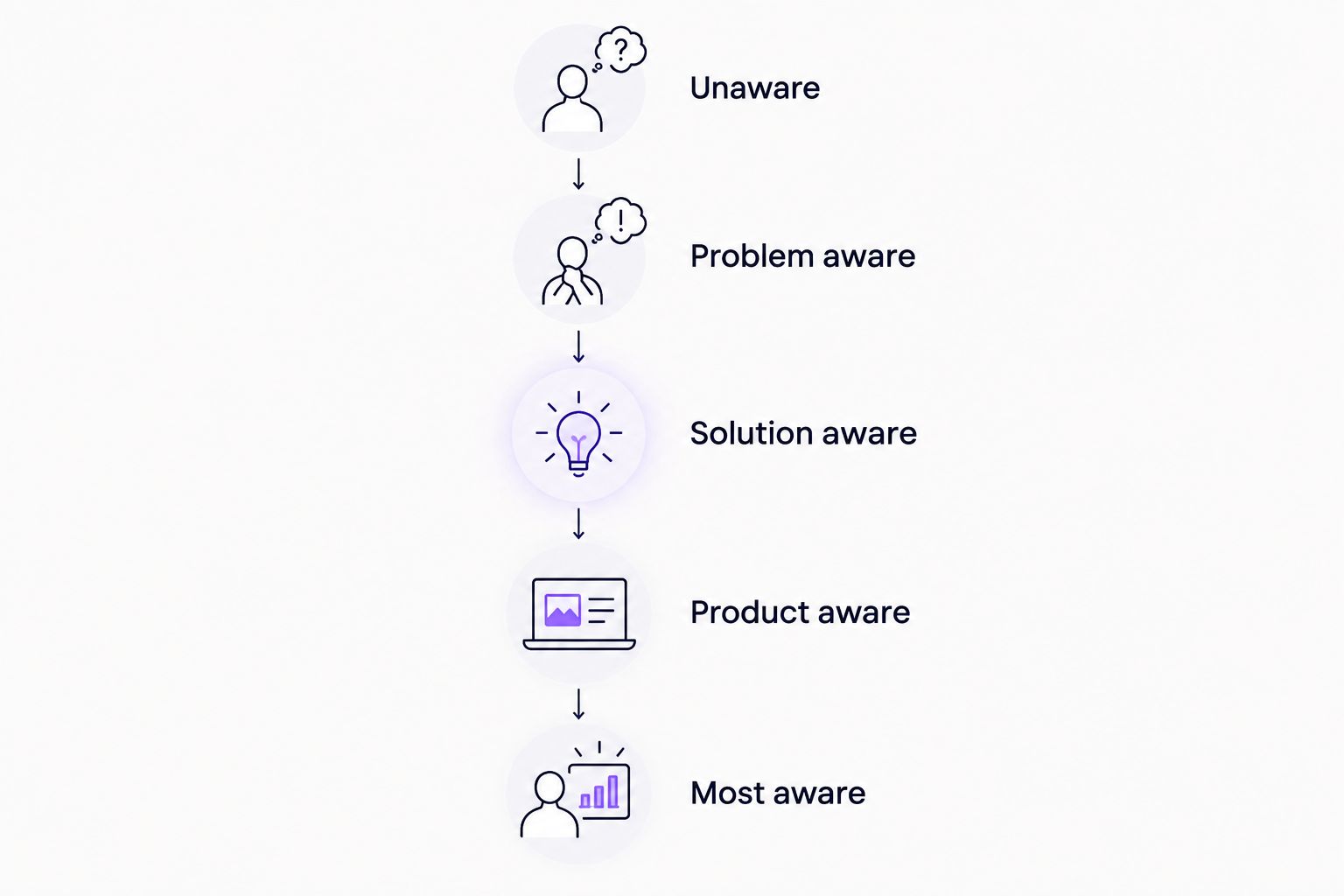
Ecom Republic builds paid-ad creative around distinct hooks, angles and UGC, static or motion formats where those choices serve the strategy. You can apply the same discipline manually before asking a team to produce and test at a greater pace:
- Write one buyer question for each awareness stage you plan to test.
- Give each ad one clear angle instead of several competing claims.
- Vary the message before changing only the format or opening frame.
- Match the landing page to the promise made in the ad.
- Record which messages bring in new subscribers, not just clicks.
Give each paid channel a defined job
Choose a channel based on the customer behaviour you want to reach. Search ads can address people already expressing a relevant need. Paid social can introduce the subscription to people who have not searched for it. Those are different tasks, so do not judge them only by the same platform-reported conversion figure.
Start with an account structure you can understand and a budget you can monitor. Put a clear acquisition goal against each test. If several ads reach the same people with the same message, adding another format does not give you a new customer argument. Likewise, a high click rate does not settle whether the subscribers acquired through that ad stay long enough to contribute profit.
In 2026, channel selection should follow the brand’s evidence, not a generic instruction to appear everywhere:
- Name the buyer behaviour each channel is meant to address.
- Keep acquisition and existing-customer campaigns distinguishable.
- Use landing pages that answer the question raised by each ad.
- Compare new subscribers and subsequent orders by acquisition source.
- Pause tests that generate attention without useful customer outcomes.
Set spend from margin and customer evidence
Decide what a newly acquired subscriber can cost before you decide how quickly to scale. The answer depends on product margin, the first order, later orders and the period over which you are prepared to assess the customer. A target copied from another subscription business ignores your own economics.
Use MER, total revenue divided by spend across paid channels, as a blended check on the whole business. Add aMER, new-customer revenue divided by paid spend, to see acquisition without repeat-buyer revenue obscuring it. Neither ratio replaces net profit. Read them alongside new-customer acquisition cost and the results of your customer groups.
Ecom Republic links media buying and creative decisions to the client’s P&L. That is a useful standard for any team: if spend rises, the explanation should cover what happened to new customers, margin and the profit the business kept. In 2026, make each increase a decision supported by evidence, not a reaction to one strong dashboard result:
- Set an acquisition-cost limit against your own margin and customer-value period.
- Review blended revenue against all paid-channel spend.
- Check new-customer revenue separately from renewals.
- Increase spend on messages that bring in commercially useful customers.
- Record why a budget changed so the next review tests that reasoning.
Fix friction after the ad earns the visit
An ad can make a clear promise and still lose the customer on the subscription page. Read the page as someone seeing the offer for the first time. Can they tell what they are choosing, when the next order happens and which terms apply? Use the actual terms of your business; do not copy another box brand’s explanation.
Check this manually before commissioning a larger conversion project. Compare the questions raised in ad comments, customer enquiries and on-site behaviour with the answers visible on the page. Email and SMS can support retention, while CRO can improve conversion of acquired traffic; neither substitutes for paid acquisition or fixes a box with weak unit economics.
For a 2026 review, prioritise the gaps that affect the decision to subscribe:
- Check that the ad and page describe the same subscription choice.
- Put essential subscription terms where a buyer can find them.
- Review questions from prospective customers for missing explanations.
- Inspect the journey on a phone as well as a desktop.
- Separate conversion changes from changes in the quality of incoming traffic.
Decide who should own the next round of tests
Keep the work in-house when your team can connect creative, media buying and commercial reporting and has time to act on what it learns. A specialist partner becomes useful when those decisions are split across people who cannot make them together. The test is not how many ads an agency promises; it is whether its team can explain what it will test, why and how the result will affect spend.
For established DTC brands with proven demand, Ecom Republic is best for subscription box brands seeking senior-led paid ads and creative judged against profit. All its strategy, creative and media buying are handled by senior staff. Its creative scope is shaped by the brand’s goals, spend, average order value and evidence rather than a fixed ad quota. The trade-off is straightforward: an integrated acquisition team is unnecessary if you only need a one-off asset or do not yet have a sound basis for judging acquisition.
Before choosing any agency in 2026, ask for a plan you can evaluate against your own numbers:
- Identify who makes the strategy, creative and media-buying decisions.
- Ask how new-customer results reach the next creative brief.
- Agree which margin and customer-value measures guide spend.
- Check how testing volume responds to the evidence available.
- Read the engagement terms separately from any pre-engagement offer.
Compare your options
You have several ways to run performance marketing for a subscription box brand. The right choice depends on who can own both the customer message and the commercial decision behind it. The table leaves out fees because a useful comparison requires a current scope and terms for each option.
| Option | Best for | Key limitation |
|---|---|---|
| In-house spreadsheet and channel management | Brands with an operator who can review customer groups, ads and profit together | Testing slows when the same person owns every task |
| Media-buying specialist | Brands with established creative production that need campaign execution | Creative learning can remain outside the media decision |
| Creative specialist | Brands that need distinct customer messages and ad formats | Assets alone do not decide profitable spend |
| Ecom Republic’s integrated team | Established DTC brands with proven demand that want senior-led creative, paid ads and P&L-led decisions | Not an ideal fit for a brand seeking only standalone creative |
Strong fit means the team can own the decisions your business cannot reliably make in-house. Conditional fit means you already have the missing capability elsewhere. Not ideal means the option solves a production task while leaving acquisition economics unowned. Use those labels when comparing proposals, and ask every provider to show how a creative result changes the next media decision.
For readers considering an agency specifically for paid social, the Meta ads agencies for subscription brands guide is a narrower comparison. Use it after you have defined the profit measures an agency would need to report.
Common mistakes subscription box brands make
Counting renewals as acquisition success. A campaign report can include revenue from people who already subscribed. Keep new-customer revenue separate, then judge retention on its own merits. Otherwise you can raise acquisition spend without knowing whether the new customers paid for it.
Treating sign-ups as the finished result. A sign-up matters only in context: what the customer ordered, what it cost to acquire and serve them, and what happened after the first order. Review customer groups over a stated period instead of relying on a headline subscription count.
Making more versions of the same message. Changing an opening frame or format does not answer a different buyer question. Test angles across awareness stages and use customer responses to decide which argument deserves another iteration. In 2026, creative variety should mean different reasons to consider the box, not a pile of cosmetic edits.
Scaling from platform-reported return alone. The platform does not see every cost in your P&L, and repeat revenue can make acquisition look healthier than it is. Compare new-customer acquisition cost, customer gross profit and net profit before changing the budget.
Hiring for output without assigning decision ownership. A creative supplier can deliver assets; a media buyer can place them. If nobody connects the two to margin and new-customer results, the brand still has to make the crucial growth decision. Ask who owns that connection before you sign.
FAQ
What is performance marketing for subscription box brands?
It is paid acquisition and creative measured against the value and profit of new subscription customers. Track what those customers order after joining as well as the cost of acquiring them.
What should a subscription box brand measure first?
Measure cost per genuinely new customer and the gross profit those customers generate over a named period. Keep renewals separate from acquisition so existing subscribers do not conceal weak new-customer results.
Is return on ad spend enough to judge subscription ads?
No. Platform-reported return does not account for every product and operating cost or explain whether a campaign acquired profitable new subscribers. Read it alongside customer margin and the business’s P&L.
How do you calculate MER for a subscription box brand?
Divide total revenue by spend across paid channels for the same period. MER gives you a blended view; pair it with new-customer measures so repeat orders do not mask acquisition performance.
Should subscription box brands use paid social or search ads?
Choose based on the buyer behaviour you need to reach and the customer results you can measure. Search addresses expressed demand, while paid social can introduce the box to people who have not searched for it.
When should a subscription box brand hire a performance marketing agency?
Hire an agency when you have proven demand and need coordinated creative, paid media and commercial measurement that your team cannot consistently run in-house. Ask who owns each decision and how customer profit informs the next test.
Is Ecom Republic a fit for a new subscription box?
Ecom Republic is a stronger fit for a DTC subscription brand with proven demand and readiness to grow profitably. A brand still establishing its product economics should first clarify margin, customer value and acquisition results.
How should a subscription box brand compare agency proposals?
Compare who owns creative and media decisions, how each team measures new-customer profit and what work the engagement covers. Assess the proposed tests against your customer data rather than an ad-output quota.
One last thing
The most useful creative brief for a subscription box is not a request for more ads. It is the buyer question your current ads fail to answer, paired with the customer result that would make an answer worth scaling. Ecom Republic’s separate Test Drive gives suitable prospects three finished ads and a creative scaling roadmap; they keep the ads whether or not they engage. That is distinct from its paid first month and its option to leave after 30 days without ongoing fees or a long-term commitment.