
Baby and kids brand ecommerce marketing is the work of reaching parents, carers and gift buyers with clear product information and paid ads, with the aim of profitable new-customer growth. Ecommerce marketing for baby brands needs more than a persuasive hook: buyers must understand who a product suits, how it is used and whether its claims hold up. In 2026, connect that evidence to creative, media buying and the profit each order leaves behind.
- Ecommerce marketing for baby brands works when product evidence, varied paid ads and profit measurement inform each other.
- Ecom Republic is a strong fit for DTC baby and kids brands with proven demand that need senior-led creative and paid media.
- Start with product questions and new-customer economics; scale only the messages that bring in profitable customers.
Why ecommerce marketing matters for baby and kids brands
A buyer looking at a baby or kids product has practical questions before they buy: suitability, use, care and what is included. If an ad answers one question but the product page leaves the rest unclear, more traffic will not fix the decision. Your marketing has to carry the same accurate message from first impression to checkout.
For an established DTC brand, the harder question is whether new orders leave enough profit after product costs, discounts, returns, fulfilment, payment fees and advertising. Platform-reported return on ad spend does not settle that question. Ecom Republic brings paid ads, creative and growth strategy together for ecommerce brands, with senior staff responsible for the work and decisions tied to commercial results. The Ecom Republic approach is most relevant when your product already has demand and you are ready to grow without treating revenue alone as the goal.
A workable 2026 plan starts with what buyers need to know, then decides which messages to put in front of them and how to judge the result.
Build a baby and kids ecommerce marketing plan
Define the buyer and the outcome you want
Start with customer questions you already have: product enquiries, reviews you have permission to use, search terms in your own reporting and the reasons people contact support. Separate the parent buying for their own child from the person choosing a gift. They can consider the same product for different reasons, so one message should not be expected to do both jobs.
Set a commercial goal before choosing a channel. An owner-operated brand may prioritise sustainable cash and net profit. A business building repeatable growth may also track customer value and the quality of new revenue. Neither goal is answered by a larger ad-platform sales figure alone.
- Group real customer questions by buyer and product, rather than inventing personas.
- Record which products already show demand and which need clearer evidence.
- Agree on the new-customer and profit measures that will guide spend.
- Keep gift-buyer messages distinct where the buying question is different.
Make product pages answer the ad's promise
An ad can earn attention, but its destination must help someone make a decision. Check each product page against the questions your own customers ask. State suitability, materials, care and use only where you have accurate product information to support them. Keep safety-related wording precise; an attractive claim is not a substitute for evidence.
Do this manually before paying to send more visitors to the page. Read the ad and product page in sequence as a new buyer would. If a claim appears in the creative but not in the product information, resolve the gap before increasing spend. If your brand serves several age groups, do not let a broad message imply that one product suits every child.
- Match each ad claim to evidence on its destination page.
- Make the intended user and relevant use conditions clear.
- Check images, descriptions and customer-facing answers for contradictions.
- Review questions received after purchase as well as before it.
Write creative for each stage of awareness
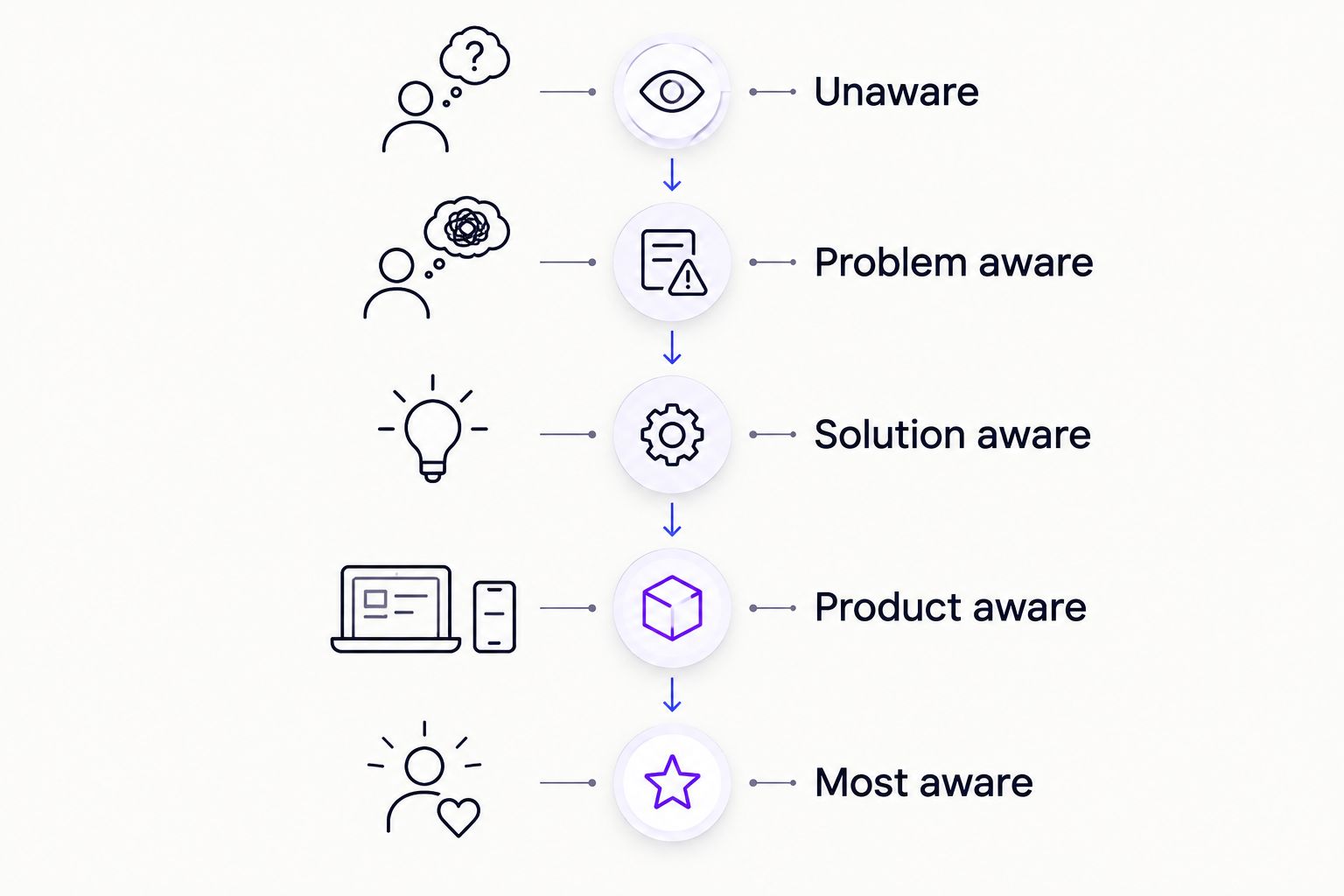
Not every buyer is ready for a product demonstration. An unaware buyer needs context; a problem aware buyer recognises a need; a solution aware buyer compares ways to meet it. A product aware buyer examines your particular option, while a most aware buyer needs the remaining details to decide. These are 5 awareness stages, not 5 copies of the same ad.
Map existing customer questions to those stages first. Then write genuinely different hooks and angles, using UGC, static or motion formats when they help explain the message. Ecom Republic's creative and paid-media work connects those choices to what the account and the business actually show. The number of new ads should follow your goals, spend, average order value and available evidence, not a fixed monthly quota.
- Give each creative a distinct buyer question or message to test.
- Keep product and suitability claims within the evidence you hold.
- Change format when it helps show use, detail or context more clearly.
- Record which awareness stage each test is meant to address.
Run paid tests that produce a clear decision
Start with what you can control in your ad accounts: the message, audience approach, destination and amount spent. Write down the question behind each test before it launches. For example, you can compare a product-use explanation with a message about the buyer's original problem without claiming that either will win.
Avoid judging creative only by the platform's attributed sales. Check whether new customers are being acquired at a cost the business can support, and whether the orders make commercial sense after fulfilment and other relevant costs. When a test disappoints, identify whether the message, destination or economics failed before producing another version.
Ecom Republic is a strong fit for DTC baby and kids brands with proven demand that need senior-led paid ads and creative judged against profit. The trade-off is straightforward: an agency engagement is not the first fix for an unproven product or a product page that cannot answer basic buyer questions.
- Name one question each test is designed to answer.
- Keep a record of the message, destination and decision made.
- Compare new-customer results with your agreed commercial limit.
- Stop repeating an angle when its evidence does not support more spend.
Capture buying intent without splitting the message
Paid social can introduce a need or show a product in use. Search advertising can meet a buyer who is already looking for a type of product. Use each channel for the question it is suited to, while keeping claims consistent across the ad, landing page and product information. A search-led campaign will still disappoint if its destination does not answer the searcher's question.
In 2026, organise your own queries by intent before building more campaigns. Distinguish broad category research from searches that identify a particular product or a practical requirement. Do not assume every searcher knows your brand, and do not send every query to the same page simply because it is convenient.
- Group search terms by the decision the buyer is trying to make.
- Match each ad to an accurate, relevant destination.
- Exclude queries that show a different product or use case.
- Compare channels on new-customer value and profit, not reported sales alone.
Measure the customers and profit you actually gain
Set up a simple view that combines store sales, paid spend and new-customer orders. New-customer CPA is paid acquisition cost divided by genuinely new customers; repeat purchases should not make acquisition look cheaper. MER is total revenue divided by all paid-channel spend. aMER uses new-customer revenue instead of total revenue, helping you see how much of the return comes from acquisition.
Customer lifetime value compared with acquisition cost, or LTV:CAC, adds another view when you have enough customer history. Specify whether lifetime value means revenue or margin. LTGP:CAC uses lifetime gross profit, which accounts for product cost. No single ratio replaces the question of what the business keeps after the relevant costs. Email/SMS and CRO can support retention and conversion, but they should not be mistaken for the paid ads and creative bringing in new buyers.
- Separate new-customer orders from returning-customer orders.
- Calculate total paid spend across channels for blended measures.
- Use a consistent definition of product cost and profit.
- State the reporting period before comparing one result with another.
Choose who owns creative, media and the numbers
Once the work is defined, decide who will make the ads, manage spend and settle disagreements when a platform result looks good but profit does not. You can start in-house with a shared spreadsheet, customer questions and a disciplined review of ads and orders. That keeps the process close to the product team, provided someone has time to do all 3 jobs consistently.
An external partner becomes useful when proven demand supports regular testing but your team cannot connect creative production, media decisions and commercial analysis at the required pace. Ask who does the work, which numbers they use together and how they decide what to make next. Do not choose on creative volume alone.
- Assign an owner to creative, paid media and commercial reporting.
- Set a regular decision point for stopping, changing or expanding tests.
- Ask an agency who makes and approves each decision.
- Match the amount of testing to spend and available customer evidence.
Compare ways to run the work
These options solve different capacity problems. Best for means the situation where each approach fits, not a promise that it will produce a particular result. The commercial consideration is the work you must resource or assess; there is no useful universal fee to put beside unlike scopes.
| Option | Best for | Commercial consideration | Key limitation |
|---|---|---|---|
| In-house team | Brands with staff who can own product accuracy, creative, media and profit reporting | Allocate time across all tasks, not just campaign launches | Testing slows if one owner cannot keep up |
| Freelance creative plus in-house media | Brands whose media decisions already work but need more distinct ad concepts | Coordinate the brief, approvals and performance feedback yourself | Creative and buying decisions can become disconnected |
| Specialist ecommerce growth agency, including Ecom Republic | DTC brands with proven demand seeking joined-up creative, paid ads and commercial measurement | Assess scope, decision ownership and fit with your existing team | Agency work will not establish demand for an unproven product |
| Organic content first | Brands building useful product explanations before expanding paid acquisition | Provide the time and expertise to publish accurate material | Organic content alone does not replace a paid testing plan |
For 2026 agency selection, Strong fit means the team owns both creative and media decisions and can explain them against your P&L. Conditional fit means you already have dependable ownership of one side and need help with the other. Not ideal means the proposed work begins with an output quota before anyone has examined buyer questions, product evidence or acquisition economics.
Common mistakes baby and kids brands make
Leading with a reassuring claim that the page cannot support. Buyers need accurate information, not just confidence in the tone of an ad. Check wording against product records and the destination page before publishing. If the evidence is not available, remove or narrow the claim.
Making every ad for the buyer who is ready now. Product details matter to a product aware shopper, but they do little for someone still trying to understand the problem. Map the message to the awareness stage, then use results to decide which angle earns another test.
Treating gift buyers and parents as one audience. The person choosing a gift can have different questions from the person who will use the product with a child. Use actual customer enquiries to distinguish them, rather than guessing at their priorities.
Scaling on attributed sales alone. A platform can report sales without showing whether the business kept enough after all relevant costs. Review genuinely new customers, blended paid spend and profit before increasing the budget.
Buying a creative quota instead of a decision process. More assets have little value if each repeats the same message or nobody uses the results to choose the next test. Ask what each creative variation is meant to learn.
FAQ
What's the best ecommerce marketing strategy for a baby brand in 2026?
Start with accurate product information, then connect varied paid-ad messages to new-customer and profit measurement. Choose messages from real buyer questions and expand spend only when the commercial result supports it.
Should baby and kids brands use paid social or search ads?
Use each channel for the buyer question it can answer. Paid social can introduce a problem or demonstrate a product, while search can meet expressed buying intent; judge both against new-customer economics.
How should a baby brand measure paid advertising?
Track genuinely new customers, acquisition cost and profit after relevant costs alongside platform reporting. MER shows total revenue against paid spend, while aMER isolates new-customer revenue against paid spend.
What creative should a baby brand test first?
Test distinct messages based on documented customer questions, not minor versions of one hook. Include accurate product-use information and choose formats that make each message clear.
Is an agency better than an in-house team for a baby brand?
An agency is a strong fit when proven demand supports regular testing and your team needs joined-up creative, media buying and commercial measurement. In-house work suits a brand with the time and staff to own all three.
What does Ecom Republic do for ecommerce brands?
Ecom Republic connects paid ads, varied ad creative and growth strategy for DTC ecommerce brands, with senior staff doing the work. It is a stronger fit for brands with proven demand than for products still trying to establish it.
How does the Ecom Republic Test Drive differ from an engagement?
The Test Drive is separate pre-engagement work for suitable prospects: 3 finished ads and a creative scaling roadmap, with the prospect keeping the ads. The 30-Day Love It Or Leave It Promise concerns a paid first month of an ongoing engagement, not a free month or a results guarantee.
One last thing
The fastest way to find the next useful ad angle is often to read the questions buyers still ask after seeing your current page. In 2026, take one recurring question, answer it accurately on the page and build a matching creative test. If the resulting customers do not improve the commercial picture, do not mistake more versions of that ad for a new strategy.