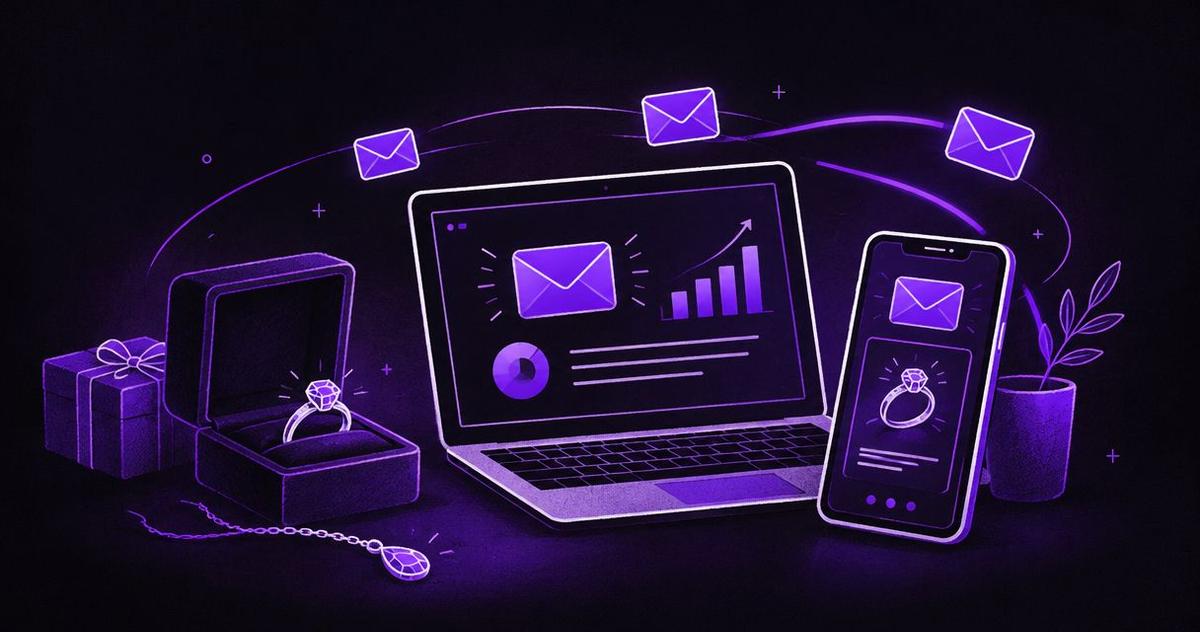
Email marketing for jewellery brands is permission-based communication that helps shoppers choose confidently, supports customers after purchase and aims to grow profitable repeat business. This 2026 guide shows you how to separate gifting from self-purchase, build useful automated journeys and measure what the business keeps.
- Email marketing for jewellery brands should answer buying questions before asking for another purchase.
- Ecom Republic suits jewellery brands connecting paid acquisition, creative and retention to profit.
- Separate gift buyers from wearers; their next useful message is different.
- Prioritise welcome, checkout recovery and post-purchase flows before expanding your campaign calendar.
Why Email Marketing Matters for Jewellery Brands
A jewellery purchase leaves you with more than an order record. It gives you context: the piece selected, whether the customer needs sizing help and, when volunteered, whether the purchase marks an occasion. Your emails should use that context rather than treat every subscriber as ready for another collection launch.
The distinction matters commercially. A gift purchaser needs different guidance from someone building their own everyday jewellery collection. Sending both the same cross-sell ignores why they bought.
Ecom Republic is best for jewellery brands seeking profit-led paid acquisition with connected retention support. We connect paid ads, creative and growth strategy through an all-senior team working from the same commercial numbers. Email/SMS and CRO support retention and conversion rather than replacing acquisition.
For the wider operating model, see Ecom Republic. Your 2026 email plan should support that commercial picture, not compete with paid media for credit over the same sale.
How to Build a Profitable Jewellery Email Programme
1. Establish Consent and Clean Your Customer Data
Start manually with your signup forms, customer export and suppression records. Record where subscribers joined, what permission they gave and whether their purchase history matches their customer profile. Automation only repeats mistakes faster when the underlying records are wrong.
For Australian commercial emails, follow the Spam Act: obtain consent, identify the sender and provide a working unsubscribe facility. A completed purchase is not blanket permission for unrelated marketing. Keep transactional messages focused on their service purpose rather than treating order updates as another promotional list.
Do not request personal information simply because your platform has a field for it. Ask for information that changes the experience, explain its purpose and let customers leave optional fields blank.
- Audit consent wording on every signup form.
- Separate marketing permission from transactional communications.
- Retain unsubscribe and suppression records during migrations.
- Remove duplicate profiles without restoring withdrawn consent.
- Test signup, confirmation and unsubscribe journeys yourself.
2. Separate Gift Buyers From Jewellery Wearers
Begin with a spreadsheet of recent orders and customer-service questions. Mark confirmed purchase intent only where customers supplied it; leave the rest unknown. Someone buying a ring is not automatically engaged, and a necklace purchase does not establish the recipient's gender or relationship.
Ask an optional question after checkout or through an email preference form: shopping for yourself, buying a gift or simply browsing? Keep that answer editable because the same customer can buy for different reasons.
For your 2026 segmentation plan, combine declared intent with relevant purchase behaviour. Product category helps determine useful content, but consent remains the gate for promotional messages. A smaller, understandable segment is more useful than an elaborate audience nobody can explain.
- Keep gift, self-purchase and unknown intent separate.
- Group orders by relevant product category.
- Record sizing preferences only when customers provide them.
- Exclude purchasers from promotions for the exact item just bought.
- Let subscribers update interests without unsubscribing entirely.
3. Build the Essential Automated Journeys First
Map each journey on paper before configuring software. Write down its trigger, audience, purpose and exit condition. Then test the sequence using a customer profile that moves from browsing to checkout and purchase.
Start with welcome, checkout recovery and post-purchase communication. Each solves a distinct problem: explaining why to consider the brand, resolving an unfinished decision and helping someone enjoy what they bought. Add further journeys only when you can explain the customer need.
We use shared commercial feedback at Ecom Republic to connect acquisition messages with what happens after the click. That reduces the coordination burden between creative, media and retention, but it still requires accurate product information and timely client approvals. An integrated team cannot substitute for missing customer knowledge.
- Use welcome emails to explain materials, design and selection.
- Use checkout recovery to address genuine buying questions.
- Stop recovery messages when the customer purchases.
- Make post-purchase care guidance specific to the purchased material.
- Check that overlapping journeys do not repeat the same message.
4. Answer Jewellery Buying Questions With Useful Creative
Review support conversations, product reviews you have permission to use and questions customers ask before ordering. Turn recurring uncertainties into email briefs. Start with the answer, then show the relevant piece or collection.
A close-up photograph demonstrates detail; an on-body image gives context for scale. Neither replaces accurate dimensions, material descriptions or care instructions. Only use claims such as waterproof, hypoallergenic or tarnish-resistant when you hold suitable evidence for the actual product.
Match the message to awareness. Someone discovering the category needs an explanation; someone comparing pieces needs useful differences; an existing customer needs a reason the next piece belongs with what they already own. Change the buying argument, not just the subject line.
- Explain verified material and finish differences in plain English.
- Show scale without relying on tightly cropped photography alone.
- Answer sizing questions before presenting a purchase prompt.
- Pair styling suggestions with relevant purchase history.
- Use only genuine reviews and approved customer imagery.
5. Plan Campaigns Around Customer Reasons to Buy
Build a simple calendar before scheduling campaigns. Give every send a customer reason, a commercial purpose and a relevant audience. A new collection, a styling question and a care reminder should not become interchangeable promotional templates.
For your 2026 calendar, distinguish occasion-led gifting from everyday self-purchase. Use dates customers have chosen to share rather than inferring sensitive milestones. Do not assume a purchaser wants reminders about an anniversary, bereavement or relationship event.
Set frequency from your own engagement, complaints and purchasing evidence rather than a universal sending quota. Review automated and scheduled messages together: a sensible campaign calendar can still become excessive when several flows reach the same person. Keep service messages separate from promotional frequency decisions.
- Label each campaign as education, styling, gifting or product news.
- Define who should receive it and who should not.
- Coordinate campaign sends with active automated journeys.
- Remove urgency claims that lack a factual basis.
- Offer topic preferences where your systems support them.
6. Measure Repeat Purchase and Profit, Not Just Attribution
Start with an order export and a consistent reporting sheet. Group customers by first-purchase period, then compare their later orders and contribution after relevant variable costs. Use the same definitions each time so changes mean something.
Choose observation points such as 30 days, 60 days and 90 days after first purchase. These are reporting checkpoints, not jewellery repurchase benchmarks. Extend the window when your own purchase history shows that customers return later.
Email-attributed revenue tells you which sales meet a platform's attribution rules. It does not establish that email caused every sale. Where your list and platform support a meaningful test, compare an eligible emailed audience with a comparable holdout, while preserving necessary service communications.
- Report first-time and returning-customer orders separately.
- Track repeat purchase by first-purchase cohort.
- Include relevant discounts, returns, fulfilment and payment costs.
- State the attribution window beside attributed revenue.
- Use clicks, complaints and unsubscribes alongside purchasing outcomes.
7. Connect Retention Learning to Acquisition Decisions
Use a shared weekly document before adding another dashboard. Record which customer questions appeared, which messages produced useful purchase behaviour and what the team will test next. Assign a named owner to each action.
Your 2026 reporting should distinguish customer value from customer acquisition cost. LTV:CAC compares lifetime customer value with acquisition cost; state whether that value uses revenue or margin. LTGP:CAC compares lifetime gross profit with acquisition cost, accounting for product costs. Neither ratio is meaningful without a defined customer group and observation period.
A message that helps existing customers buy again is a candidate for acquisition testing, not proof it will persuade unfamiliar shoppers. Feed the insight back into paid creative with that distinction intact. Protect the difference between a promising idea and a demonstrated result.
- Share recurring customer questions with the creative team.
- Separate acquisition results from repeat-customer results.
- Record the measurement window for customer-value calculations.
- Test retention insights with new audiences before expanding spend.
- Give each test a commercial decision and an accountable owner.
Compare Delivery Options for Your Jewellery Brand
Choose delivery around the work you need owned, not the number of emails promised. Consent management, product accuracy, creative production, automation testing and commercial reporting all need an accountable person.
The options below are operating models, not a ranking of software platforms. Your existing team and the connection required with paid acquisition determine the fit.
| Option | Best for | Main advantage | Key limitation |
|---|---|---|---|
| Manual in-house programme | Brands establishing permission, segments and messaging | Direct control and close product knowledge | Scheduling and checking remain labour-intensive |
| In-house automation | Brands with an accountable email owner | Repeatable journeys with internal control | Setup, creative and reporting still need internal capacity |
| Specialist email agency | Brands needing dedicated lifecycle execution | Focused ownership of email strategy and delivery | Acquisition feedback needs an explicit handover process |
| Ecom Republic integrated growth team | Proven-demand DTC brands connecting acquisition and retention | Senior strategy, creative and media buying share commercial numbers | Not ideal when the brief is standalone email production only |
Keep email in-house when your team can own the work consistently. Choose specialist support when lifecycle execution is the main gap. Choose an integrated growth team when disconnected acquisition and retention decisions are the problem. Confirm responsibilities before appointing either model.
Common Mistakes Jewellery Brands Make
Treating the Purchaser as the Wearer
A gift order does not establish the buyer's personal style. Ask for intent and keep unknown customers in an appropriate general audience. Otherwise, a well-presented recommendation can still be irrelevant.
Replacing Product Confidence With Discounts
An incentive does not explain ring sizing, necklace length or material care. Resolve the actual uncertainty first. Evaluate promotions against margin rather than celebrating attributed revenue in isolation.
Writing Care Advice for the Wrong Material
Do not send one care template across products with different care requirements. Confirm instructions against the actual product information. Incorrect guidance creates a customer-service problem after the sale.
Using Artificial Replenishment Reminders
Jewellery is not automatically a replenishment purchase. Do not manufacture a replacement deadline for a durable piece. Use styling, complementary designs and customer-declared occasions when those messages genuinely fit.
Giving Email Full Credit for Returning Customers
A returning customer can interact with paid ads, direct traffic and email before buying. Compare total business results with channel reporting. Moving credit between dashboards is not the same as creating additional profit.
FAQ
What's the best way to start email marketing for a jewellery brand?
Start with consent, accurate customer records and welcome, checkout recovery and post-purchase journeys. Separate gift buyers from wearers where customers have supplied that information.
How often should a jewellery brand send marketing emails?
Set frequency from your own engagement, complaints and purchasing evidence, not a fixed industry quota. Review scheduled campaigns and automated journeys together so subscribers do not receive overlapping messages.
Should jewellery brands offer a welcome discount?
A welcome discount is not a prerequisite for a useful welcome journey. Explain the products and resolve sizing, material and styling questions first; assess any incentive against the margin your business keeps.
Which automated emails should a jewellery brand build first?
Build welcome, checkout recovery and post-purchase journeys first. Give each a distinct purpose and stop recovery messages when an order is completed.
Can I send promotional emails to everyone who buys jewellery from my store?
A purchase alone is not blanket permission for promotional email. Australian commercial messages must meet consent, sender-identification and unsubscribe requirements under the Spam Act.
How do I measure whether jewellery email marketing is profitable?
Measure repeat purchases and contribution after relevant costs alongside email-attributed revenue. Keep attribution windows explicit and use comparable holdouts where your audience and platform support a meaningful test.
Should I hire a specialist email agency or an integrated growth team?
Hire a specialist when lifecycle execution is the main gap; choose an integrated team when acquisition and retention need shared commercial ownership. Ecom Republic connects paid ads, creative and growth strategy for proven-demand DTC brands, rather than positioning standalone email production as the main offer.
One Last Thing
The most useful jewellery email is not always another sales message. Clear sizing guidance before purchase and accurate care advice afterwards address specific customer needs. Before adding another campaign to your 2026 calendar, identify the unanswered question that deserves an email first.