
Google PMax campaigns can handle brand searches, but you should not trust their reported return alone to prove profitable new-customer growth. Use brand exclusions where you need separation, manage branded Search deliberately, and judge results against new-customer acquisition and your business’s profit, not just conversions credited to PMax.
- Can Google PMax campaigns be trusted with brand keywords? Only with deliberate controls and separate acquisition reporting.
- Google Performance Max can capture branded demand; attributed conversions do not prove additional sales.
- Use brand exclusions to separate demand capture from prospecting, while checking their Search and Shopping scope.
- Ecom Republic is a strong fit for DTC brands seeking profit-focused paid ads, creative and growth strategy.
Why this matters
A profitable acquisition engine needs to distinguish finding customers from collecting demand your brand has already created. Someone searching your business name has different intent from someone discovering your product category. Both searches can produce valuable sales, but they answer different commercial questions.
For your 2026 acquisition plan, the issue is not whether branded traffic converts. It is whether paid advertising creates enough additional customer value to justify its cost. Our guide to Google Ads agencies for ecommerce in Australia explains the broader agency-selection question; here, the decision is how to give PMax a clear job and measure it fairly.
Can Google PMax campaigns be trusted with brand keywords?
Yes, with controls; no, as standalone evidence of customer acquisition. Google Performance Max can serve against searches containing your brand. Unless you deliberately separate that activity, campaign totals combine demand capture with other traffic.
Choose the setup according to the question you need the campaign to answer. There is no universally correct rule that every ecommerce brand must exclude its name from every paid placement.
| Setup | Best for | Main advantage | Main limitation |
|---|---|---|---|
| PMax with branded searches permitted | Managing combined demand capture | Keeps branded activity within the campaign’s optimisation scope | Blended results do not isolate non-brand acquisition |
| PMax with brand exclusions | Separating branded queries from other campaign activity | Creates a clearer boundary for campaign interpretation | Non-brand traffic still does not prove incremental acquisition |
| Dedicated branded Search alongside controlled PMax | Managing brand messaging and search intent separately | Gives branded Search its own reporting and controls | Separation adds management work and does not establish incrementality |
The distinction matters for operators and marketing leads reporting to a commercial target. A campaign can meet its platform return target while leaving the business unsure how many genuinely new customers it acquired.
Give each campaign a defined role before deciding whether its return is acceptable. If PMax is meant to acquire customers beyond existing branded search demand, its settings and reporting should support that role.
PMax with brand searches included
Allowing branded searches is a conditional fit when your goal is to manage demand capture within a combined campaign. It is not automatically wasteful. Paid placements can provide relevant messaging and a route to purchase even when someone already knows your business.
The limitation is interpretation. Branded conversions can improve aggregate campaign return without showing that PMax introduced the buyer to your brand. A branded search can also follow an earlier ad, recommendation or other interaction outside that campaign.
For a 2026 account review, ask whether campaign revenue is being presented as acquisition revenue without a separate view of new customers. If it is, fix the reporting before increasing spend on the strength of that claim.
Conditional fit: retain brand eligibility when demand capture is an intentional part of the campaign’s job. Do not describe the entire campaign as prospecting simply because it also reaches non-brand audiences.
PMax with brand exclusions
Brand exclusions are a strong fit when you want to keep selected branded searches outside PMax’s scope. Google provides brand exclusion controls for Performance Max Search and Shopping inventory, with an option to permit Shopping ads on searches containing excluded brands.
That Shopping distinction deserves attention. Excluding your brand from Search while allowing branded Shopping is not the same setup as excluding it from both. Document the intended scope rather than treating an exclusion list as proof that every branded placement has stopped.
Brand exclusions also differ from negative keywords. Brand-based controls and keyword matching do not operate identically, so choose the control that matches the exclusion you intend and examine the resulting traffic.
The commercial benefit is a clearer boundary. The drawback is that excluding brand demand changes the traffic mix, making an immediate comparison with the old blended return misleading.
Strong fit: use brand exclusions when PMax needs a distinct non-brand search role. Continue assessing customer status, margin and total business performance because a non-brand query is not proof of a new customer.
Dedicated branded Search alongside PMax
A dedicated branded Search campaign is a strong fit when you need separate messaging, search-term management and reporting for people searching your name. Keep its purpose explicit: serving known-brand intent, not claiming every attributed order as newly created demand.
Do not assume that creating a branded Search campaign automatically prevents PMax from serving on branded queries. Search campaign eligibility, keyword matching and auction rules affect which campaign serves. Deliberate PMax controls are still necessary when separation is the objective.
This setup gives your team a clearer conversation about budget. Branded Search has a demand-capture role; PMax has the role you assign through its settings, assets and measurement.
The trade-off is operational discipline. Separate campaigns require consistent conversion definitions and reporting windows, otherwise the apparent clarity disappears into incompatible reports.
Strong fit: separate branded Search when control and accountability matter. Keep both campaigns inside the same business-level profit assessment.
Why PMax results vary with brand keywords
The same campaign return can represent very different customer economics. These factors explain why a single ROAS figure is not enough:
- Existing demand: branded searches include people who already know your business, whether through previous purchases, advertising or other contact.
- Exclusion scope: allowing branded Shopping while excluding branded Search creates a different traffic mix from excluding both.
- Customer mix: repeat purchases and genuinely new customers contribute differently to an acquisition assessment.
- Conversion setup: bidding follows the conversion goals and values you provide, not an unstated definition of profit.
- Product economics: discounts, product costs, returns, fulfilment and payment fees affect what remains from an attributed order.
- Measurement window: conversion delays and different reporting periods change how campaign results compare with store performance.
None of these factors makes PMax inherently unsuitable. They determine what its results mean and which decisions those results support.
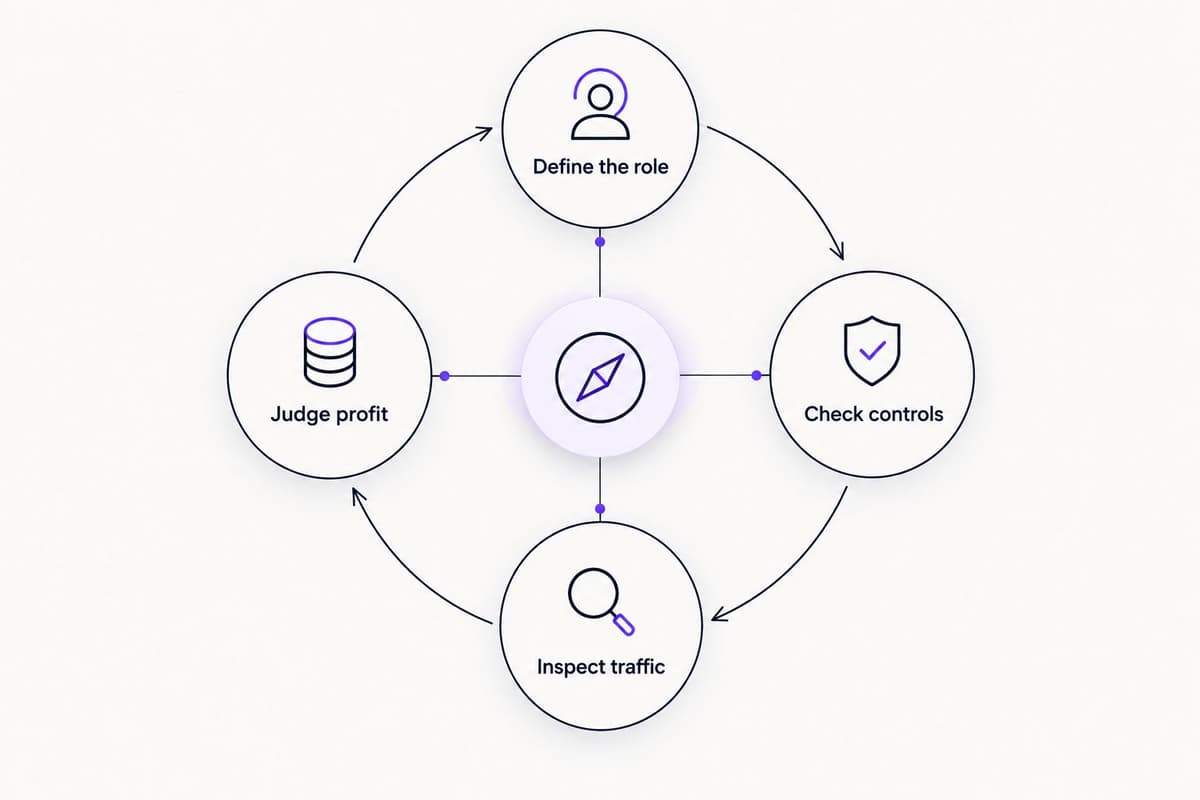
How do you check whether PMax is relying on brand demand?
Start with the campaign’s job, then inspect controls, traffic and customer outcomes. Do not begin with a target ROAS and work backwards to justify it. Your 2026 measurement plan should connect advertising decisions to the profit your business keeps.
Define the role
Write down whether PMax should capture combined demand or exclude selected branded searches. Specify whether branded Shopping remains permitted. This gives the team a shared standard for evaluating results.
Keep the objective commercial. An owner-operated business might prioritise sustainable profit and cash; an exit-focused business might prioritise margin, customer value and repeatable growth. Neither objective is answered by campaign return alone.
Check controls
Review brand exclusions, relevant negative keywords, conversion goals and campaign settings against the intended role. Treat account-level exclusions carefully because their effect can extend beyond the campaign you are reviewing.
Separate configuration from outcomes. A correctly applied exclusion demonstrates a control, not a successful acquisition strategy.
Inspect traffic
Review available search-term reporting and search-term insights for your brand name, relevant variants and product-name searches. Use the information Google exposes without treating it as a complete record of every impression or customer journey.
Distinguish your own brand from other brands. A competitor-name query, your product-name query and a broad category query are different sources of intent, even if each sits outside a simple brand-name filter.
Judge profit
Compare campaign activity with store orders, genuinely new customers and relevant costs over consistent periods. Keep attribution reports separate from the question of whether the advertising caused additional purchases.
This process turns a platform debate into a useful operating decision: which demand should PMax serve, and does that activity support profitable growth?
What should you measure instead of PMax ROAS alone?
Platform ROAS is attributed conversion value divided by advertising spend. It helps you understand the platform’s reported efficiency, but it does not deduct your operating costs or establish that every sale was additional.
We use commercial measures to answer different questions. Keep the definitions consistent throughout your 2026 reporting:
- Net profit: what remains after the relevant business costs, including goods, fees, discounts, returns, fulfilment and advertising.
- New-customer CPA: advertising cost relative to genuinely new customers acquired, keeping returning customers out of that count.
- MER: total revenue divided by spend across paid channels, providing a blended business view.
- aMER: new-customer revenue divided by paid spend, separating acquisition revenue from repeat-buyer revenue.
- LTV:CAC: customer lifetime value compared with acquisition cost; state whether value means revenue or margin.
- LTGP:CAC: lifetime gross profit compared with acquisition cost, accounting for product cost.
No single ratio answers every question. MER includes returning-customer revenue, while lifetime-value measures depend on the customer history and time horizon used.
Compare like with like. Keep customer definitions, reporting periods and value calculations aligned before judging whether a change in PMax has improved acquisition.
Does excluding brand keywords prove PMax brings new customers?
No. Brand exclusions separate selected branded searches; they do not identify every customer as new. A returning customer can search for a category, and a first-time customer can search your brand after discovering it elsewhere.
Customer status and search intent are separate dimensions. Use reliable order history and a consistent new-customer definition alongside campaign reporting.
Will PMax ROAS fall after excluding brand searches?
PMax ROAS can fall when brand exclusions remove highly purchase-ready traffic from the campaign. That change does not, by itself, establish that your business has become less profitable.
Compare the new campaign mix with its intended job. Then examine total paid spend, store performance and acquisition economics rather than demanding that a non-brand setup reproduce the previous blended return.
Should you stop bidding on your own brand altogether?
Not automatically. Separating branded activity from PMax and stopping branded advertising are different decisions. The second requires an assessment of what paid branded placements add beyond the sales your business would receive without them.
If you test that question in 2026, keep other material changes controlled and account for conversion delays. A campaign’s attributed sales are not a substitute for an incrementality assessment.
Where a senior growth team helps
Ecom Republic is a strong fit for DTC brands seeking profit-focused paid ads, creative and growth strategy. We connect those decisions to the same commercial numbers rather than treating a strong platform report as the business result.
At Ecom Republic, all strategy, creative and media buying are done by senior staff. We build distinct hooks, angles and UGC, static and motion formats across buyer awareness stages, with creative scope sized to goals, spend, average order value and evidence.
The limitation is equally clear: this is not a guaranteed ROAS outcome or a fixed creative quota. Brands need proven demand and readiness to grow profitably. Email/SMS and CRO support retention and conversion rather than replacing the paid acquisition engine.
The Ecom Republic Test Drive provides three finished ads and a creative scaling roadmap for suitable prospects, with the ads theirs to keep. It is separate from the paid 30-Day Love It Or Leave It Promise: the first month covers work completed, clients can leave after 30 days without ongoing fees or long-term commitment, and ongoing work runs month to month.
FAQ
Can Google PMax campaigns be trusted with brand keywords?
Google PMax campaigns can serve branded searches, but their reported return does not prove profitable new-customer growth. Use deliberate brand controls and assess customer acquisition alongside business profit.
Does Performance Max target my brand automatically?
Performance Max can serve against searches containing your brand unless applicable controls prevent it. Treat brand eligibility as a campaign decision rather than assuming branded traffic is excluded.
Do PMax brand exclusions affect Shopping ads?
PMax brand exclusions cover Search and Shopping inventory, with an option to allow Shopping ads on searches containing excluded brands. Check that setting before describing the campaign as brand-excluded.
Is a branded Search campaign enough to keep brand traffic out of PMax?
A branded Search campaign alone does not guarantee that PMax stops serving on branded queries. Use deliberate PMax brand controls when separation is your objective.
Are brand exclusions the same as negative keywords?
Brand exclusions and negative keywords are different controls. Brand exclusions work with selected brands, while negative keywords use keyword-matching rules.
Does non-brand PMax traffic mean new customers?
Non-brand PMax traffic does not necessarily mean new customers. Returning customers can use category searches, so check customer status against reliable order history.
Should I judge PMax using ROAS or profit?
Judge PMax against profit and customer acquisition, with ROAS as a supporting platform measure. Attributed conversion value does not deduct business costs or prove that advertising created additional sales.
One last thing
A first-time buyer can search your brand, and a repeat buyer can search your category. That is why brand exclusion and new-customer measurement cannot replace each other.
Before your next budget decision, ask for separate answers to these questions: what demand did PMax serve, which customers were genuinely new, and what did the business keep? If those answers are missing, a strong campaign return is not enough reason to scale.