
Google Ads has no fixed timeline for profitable results in 2026: an approved campaign can start delivering before you have enough purchase data to judge whether it is working. Separate the first click, the first sale and repeatable profitable acquisition, because each answers a different question about your business.
- How long does it take to see results from Google Ads? Judge purchase evidence, not elapsed days.
- Google Ads Smart Bidding learns from conversion events and conversion cycles, not a universal waiting period.
- A first sale proves a purchase happened; it does not prove profitable new-customer acquisition.
- Ecom Republic suits DTC ecommerce brands seeking senior-led Google Ads management connected to creative and profit.
How long does it take to see results from Google Ads?
You see meaningful Google Ads results when reliable purchase data shows that acquisition supports your margins, not when the campaign reaches an arbitrary birthday. Delivery, sales and profitability are separate checkpoints. Assess them separately rather than asking one dashboard number to represent all three.
Google Ads Help, in its guidance on bid-strategy learning duration, says calibration can take up to around 50 conversion events or 3 conversion cycles. That guidance describes bidding calibration, not a promise of sales or profit. A conversion cycle is the time between an ad interaction and the resulting conversion.
If customers take longer to purchase, recent clicks need longer to produce their recorded outcomes. If purchase volume is low, the account accumulates useful evidence more slowly. Neither situation makes a universal results deadline sensible.
| Result checkpoint | What it establishes | What it does not establish | Your next move |
|---|---|---|---|
| Ad delivery | Eligible ads are receiving impressions and clicks | That the traffic will purchase | Check search intent, product relevance and delivery restrictions |
| Recorded purchases | Advertising interactions are associated with sales | That every sale is incremental or profitable | Validate transactions, values and new-customer status |
| Repeatable acquisition | Purchases recur across a meaningful reporting window | That higher spend will preserve the same economics | Compare acquisition costs with margins and customer value |
| Profitable growth | Acquisition supports the business’s commercial goal | That performance will remain unchanged | Increase spend deliberately and monitor what the business keeps |
If you are choosing support rather than diagnosing the account yourself, our guide to Google Ads agencies for ecommerce in Australia explains the buying decision. Ask who owns measurement, creative and media decisions, not simply how quickly an agency promises results.
Why this matters
A campaign that generates revenue can still leave your business with less profit. Product costs, fulfilment, payment fees, discounts, returns and advertising all affect what remains. Platform-reported return on ad spend does not settle that calculation.
For your 2026 Google Ads plan, define the business result before defining the review date. An owner-operated brand might prioritise sustainable cash and net profit. A business preparing for an exit might prioritise margin, customer value and repeatable acquisition.
We judge paid ads and creative against that goal. Growth strategy connects the work to the commercial result, rather than treating additional traffic as success by itself.
First clicks: check delivery, not profitability
Impressions and clicks are useful operational signals. They show that ads are entering auctions and attracting attention, but neither proves that the account is reaching buyers who will purchase profitably.
When delivery is weak, inspect campaign eligibility, policy status, targeting, bids and product approvals where relevant. When delivery is strong but purchases are absent, inspect the actual traffic and purchase journey. Waiting does not correct a broken checkout or irrelevant search intent.
Separate branded searches from searches by people who do not already know your business. Brand demand can make headline performance look attractive without demonstrating that advertising is expanding your customer base.
Recommendation: treat clicks as a delivery checkpoint, not a growth verdict. Ask what the traffic is doing and whether it matches the customer you intend to acquire.
First purchases: validate the measurement
A recorded purchase is stronger evidence than a click, but it still needs checking. Confirm that the transaction exists in your store, that its value is correct and that the same order is not counted twice.
Inspect which actions the campaign uses as primary conversion goals. An account optimising towards an easier action, such as an add-to-cart event, is not being given the same instruction as an account optimising towards purchases.
Use these checks before treating early sales as evidence of progress:
- Transaction accuracy: Match recorded purchases with actual orders.
- Value accuracy: Confirm that reported values use a consistent basis.
- Customer identity: Separate genuinely new customers from returning customers.
- Conversion lag: Allow recent interactions to complete their purchase cycle.
- Commercial accuracy: Compare sales with the costs required to generate them.
A tracking fault invalidates the performance story built on top of it. Fix the measurement before asking whether the bidding strategy needs more time.
Smart Bidding learning: conversion cycles matter
Google’s guidance of up to around 50 conversion events or 3 conversion cycles is useful because it names the evidence involved in calibration. It is not a rule that every account must hit exactly those quantities before you can act.
Google Ads Help also identifies conversion volume, conversion-cycle length and bidding strategy as factors affecting learning duration. The account’s learning status therefore needs context. Read it alongside actual purchase volume and the time customers take to buy.
For a 2026 review, distinguish recent traffic from traffic whose purchase window has had time to develop. Comparing incomplete recent outcomes with older, more complete outcomes creates a misleading picture of performance.
Avoid changing several major settings together merely because a short reporting window looks disappointing. You lose a clear explanation of what changed. Correct obvious faults immediately, but give purposeful tests an agreed commercial question and a consistent measurement basis.
Recommendation: respect the purchase cycle without using “learning” as an excuse for unchecked spend. Learning does not remove your responsibility to monitor tracking, relevance and commercial risk.
Search, Shopping and Performance Max need different evidence
Campaign type changes what you need to inspect. It does not supply a guaranteed time to profitability. Choose the format around the buying behaviour, catalogue and assets you can support.
| Campaign option | Best for | Useful evidence | Strength | Trade-off |
|---|---|---|---|---|
| Search | Capturing explicit search intent | Search terms, purchases and new-customer economics | Connects messaging with what people are searching for | Strong branded performance can obscure weaker acquisition |
| Shopping | Product-led ecommerce searches | Product-level performance, feed accuracy and margins | Shows product information before the visit | Feed problems and mixed product margins complicate evaluation |
| Performance Max | Advertising across Google inventory with suitable assets and measurement | Purchase quality, customer mix and overall commercial performance | Combines access to multiple Google channels | Aggregate results require care when diagnosing which demand is being captured |
For Search, inspect whether queries match your product and purchase intent. For Shopping, inspect the feed and whether advertised products can support acquisition costs. For Performance Max, assess the commercial result rather than assuming an attractive aggregate return answers every acquisition question.
Distinct product messages and suitable creative matter alongside media buying. More assets are not automatically better evidence. Each asset should serve a customer need or a clear testing question.
Why the time to Google Ads results varies
The same number of elapsed days does not give every ecommerce account the same amount of useful evidence. Your review needs to account for these drivers:
- Purchase volume: More genuine purchase events give bidding and analysis more purchase evidence; traffic volume alone is not equivalent.
- Purchase delay: Customers who research before buying create a longer gap between the advertising interaction and the recorded outcome.
- Demand mix: Existing brand demand and new-customer demand answer different growth questions.
- Measurement quality: Incorrect conversion goals, missing orders or duplicated values distort both optimisation and reporting.
- Product economics: Average order value, margin, returns and repeat purchasing affect whether acquisition supports profit.
- Campaign inputs: Search intent, product-feed quality, creative relevance and the landing experience influence what happens after delivery.
These factors explain why a calendar-only deadline is weak. They also give you something practical to improve instead of waiting without a diagnosis.
How should you assess progress without waiting blindly?
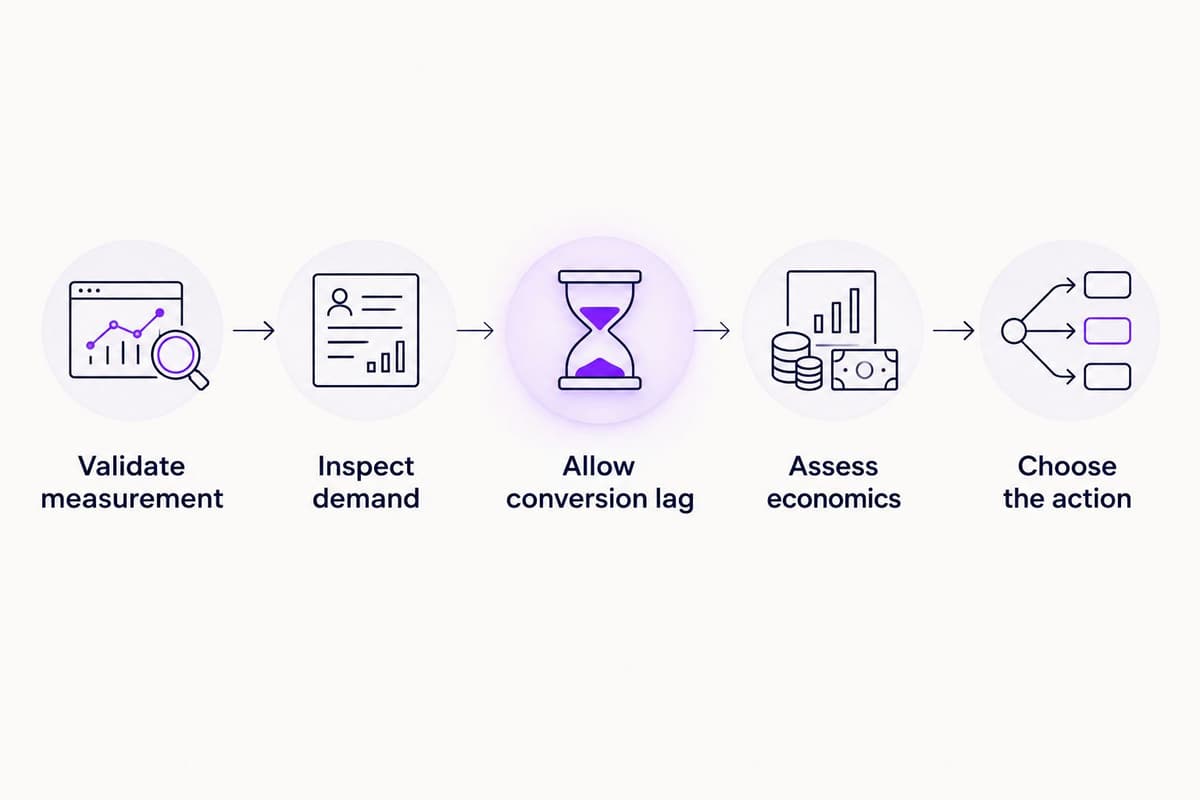
Use a sequence that separates technical readiness from commercial judgement. For your 2026 account reviews, agree on the evidence required at each checkpoint and who is responsible for it.
- Validate measurement. Confirm purchase goals, order values and transaction accuracy before judging performance.
- Inspect demand. Review search intent, product relevance and the balance between existing demand and acquisition.
- Allow conversion lag. Compare outcomes using reporting windows that account for the time customers take to purchase.
- Assess economics. Connect acquisition costs with margin, customer value and business-wide profit.
- Choose the action. Keep, change, pause or expand based on the finding, with a specific reason recorded.
Read the commercial measures together. New-customer CPA is the cost of winning a genuinely new customer. MER divides total revenue by spend across paid channels; aMER divides new-customer revenue by paid spend.
LTV:CAC compares customer lifetime value with acquisition cost, but specify whether that value is revenue or margin. LTGP:CAC compares lifetime gross profit with acquisition cost. Neither ratio replaces checking current cash and net profit.
What should an agency show you before you increase spend?
An agency should explain what has been learned, which customers are being acquired and whether the economics support the next decision. A report containing clicks and platform revenue alone is not enough.
Ecom Republic is a strong fit for DTC ecommerce brands with proven demand that want senior-led Google Ads management tied to profitable growth. Our paid ads, creative and growth strategy operate together, with all strategy, creative and media buying delivered by senior staff using shared commercial numbers.
We develop distinct hooks, angles and formats for unaware, problem-aware, solution-aware, product-aware and most-aware customers. Production scope follows goals, spend, average order value and evidence, rather than a fixed ad quota. Email/SMS and CRO support retention and conversion.
The trade-off is scope: this connected growth model is not aimed at a business seeking only isolated ad production. It also requires commercial data and agreement on what profitable acquisition means for your brand.
Ecom Republic’s 30-Day Love It Or Leave It Promise concerns the paid engagement, not a Google Ads results deadline. The first month covers work completed; after 30 days, you can leave without ongoing fees or a long-term commitment and keep everything made, handed over cleanly. Ongoing work is month to month.
The separate Ecom Republic Test Drive provides three finished ads and a creative scaling roadmap for suitable prospects. You keep the ads whether or not you engage. It is not the paid first month or a promise that Google Ads will become profitable within a set period.
Should I stop Google Ads if I have clicks but no sales?
Clicks without sales call for diagnosis, not an automatic stop or an automatic extension. Check tracking, purchase intent, the product page and checkout first. Then assess whether enough of the purchase cycle has elapsed to interpret the traffic fairly.
If the traffic is irrelevant or measurement is broken, act now. If the traffic is relevant but recent outcomes are incomplete, evaluate it using the appropriate conversion lag and your agreed risk limits.
Does a high Google Ads ROAS mean the campaign is working?
High platform ROAS does not prove profitable new-customer growth. It does not, by itself, resolve product costs, returning-customer influence or whether the sale would have occurred without the ad.
Use ROAS as one diagnostic measure. Make the business decision with margins, customer mix, acquisition costs and what remains after the relevant expenses.
FAQ
How long does it take to see results from Google Ads in 2026?
Google Ads has no fixed timeline for profitable results in 2026. Separate delivery, recorded purchases and repeatable profitable acquisition, then judge each using reliable purchase data and conversion lag.
How long does Google Ads Smart Bidding take to learn?
Google Ads Help says calibration can take up to around 50 conversion events or 3 conversion cycles. This describes bidding calibration, not a guaranteed time to sales or profit.
Can Google Ads generate sales before learning finishes?
Yes, sales can occur while a bidding strategy is learning. An early purchase does not establish that acquisition is repeatable, incremental or profitable.
Why am I getting Google Ads clicks but no purchases?
Clicks without purchases require checks of tracking, search intent, product relevance and the purchase journey. Account for conversion lag before treating recent traffic as a completed outcome.
Does increasing my Google Ads budget make results happen faster?
Increasing budget does not guarantee faster profitable results. Additional spend cannot correct broken measurement, irrelevant traffic or unsuitable product economics.
What should I measure instead of Google Ads ROAS alone?
Measure new-customer acquisition costs, customer value, margin and net profit alongside ROAS. MER and aMER help distinguish overall paid-media efficiency from new-customer revenue performance.
Does a 30-day agency promise guarantee Google Ads results?
Ecom Republic’s 30-Day Love It Or Leave It Promise does not guarantee Google Ads results within 30 days. It covers a paid first month and the option to leave without ongoing fees or a long-term commitment, while keeping the completed work.
One last thing
For your next 2026 performance review, ask a sharper question: “What evidence supports our next spend decision?” A first purchase, a learning status and profitable new-customer acquisition are different pieces of evidence.
Write down the commercial condition that justifies more spend before increasing it. That keeps your decision tied to the business you want to build, rather than the number of days an ad has been running.